

Spain vs Argentina Possible Lineups: Team News, Injuries and Starting XI Prediction

Spain and Argentina are expected to retain most of the players who started their World Cup semifinals, but several important selection decisions remain before the final.
Spain must monitor Lamine Yamal and Pedro Porro after both players trained separately during the first New Jersey session. The Spanish federation described the work as precautionary and expects both to be available.
Argentina have not reported a new major injury concern, but Lionel Scaloni must decide whether to retain Giuliano Simeone, restore Rodrigo De Paul or give semifinal match-winner Lautaro Martínez a starting role.
For the full match prediction, tactical analysis and score forecast, read the main Hub: Spain vs Argentina Prediction: 2026 World Cup Final Preview, Lineups and Score Forecast.
Fans can also review the Spain vs Argentina prediction market on MEXC.
Summary
Spain are likely to use a 4-3-3 or fluid 4-2-3-1 led by Rodri, Dani Olmo, Lamine Yamal and Mikel Oyarzabal.
Argentina are expected to use a 4-3-3 that becomes a 4-4-2 or 4-3-1-2 without the ball, with Lionel Messi given freedom behind Julián Álvarez.
| Team-news question | Current assessment |
|---|---|
| Will Lamine Yamal play? | Expected to be available |
| Will Pedro Porro play? | Expected to be available |
| Is Porro fully fit? | Managing a minor hamstring strain |
| Is Messi expected to start? | Yes |
| Could Lautaro Martínez start? | Possible |
| Could Rodrigo De Paul return? | Possible |
| Confirmed lineups available? | Not yet |
| Expected publication time | About one hour before kickoff |
Predicted Spain Starting XI
Formation: 4-3-3 / 4-2-3-1
Unai Simón; Pedro Porro, Pau Cubarsí, Aymeric Laporte, Marc Cucurella; Rodri, Fabián Ruiz, Dani Olmo; Lamine Yamal, Mikel Oyarzabal, Álex Baena.
| Position | Predicted Spain starter |
| Goalkeeper | Unai Simón |
| Right-back | Pedro Porro |
| Centre-back | Pau Cubarsí |
| Centre-back | Aymeric Laporte |
| Left-back | Marc Cucurella |
| Defensive midfield | Rodri |
| Central midfield | Fabián Ruiz |
| Attacking midfield | Dani Olmo |
| Right wing | Lamine Yamal |
| Left attack | Álex Baena |
| Centre-forward | Mikel Oyarzabal |
Why Spain May Keep the Same Core
Luis de la Fuente used a stable starting group during the quarterfinal and semifinal.
Spain’s structure against France functioned effectively. Rodri controlled the centre, Porro balanced Yamal on the right, and Oyarzabal provided intelligent movement through the middle.
Changing several positions before the final could disrupt the passing relationships and pressing triggers that helped Spain defeat France 2-0.
The greatest question is not whether Spain want continuity, but whether Yamal and Porro are fit enough to perform their normal roles.
Spain Goalkeeper and Defense
Unai Simón
Unai Simón is expected to remain Spain’s starting goalkeeper.
His distribution is important when Argentina press with Álvarez and another forward. Simón may need to choose between short passes into Rodri and longer balls toward Oyarzabal or the wings.
Pedro Porro
Pedro Porro has established himself as Spain’s first-choice right-back during the tournament.
He scored against France and provided defensive balance beside Yamal.
Porro trained separately in New Jersey because of a minor hamstring strain. The problem is not considered serious, and Spain expect him to be available.
If he cannot start, Marcos Llorente is a possible alternative.
Pau Cubarsí and Aymeric Laporte
Pau Cubarsí and Aymeric Laporte are expected to continue as the centre-back partnership.
Cubarsí provides speed and passing, while Laporte offers experience and left-footed distribution.
Their main tactical problem will be Messi. Neither centre-back should follow him too far into midfield, because that could create space for Álvarez.
Marc Cucurella
Marc Cucurella is likely to start at left-back.
He may face Giuliano Simeone or another hard-working right-sided player. Cucurella must also choose when to advance, because Argentina can attack the space behind him through Messi’s passes.
Spain Midfield
Rodri
Rodri is the most important player in Spain’s structure.
He protects the centre-backs, controls possession and attempts to block passes into Messi.
Argentina may use Enzo Fernández and Mac Allister to pull Rodri away from his central position.
Fabián Ruiz
Fabián Ruiz is expected to continue as the progressive central midfielder.
He can receive under pressure, carry the ball and support Spain’s left side.
His movement is also important when Argentina concentrate on stopping Yamal.
Dani Olmo
Dani Olmo can operate as a central midfielder, number ten or additional forward.
He may move behind Paredes and Enzo, trying to receive between Argentina’s midfield and defense.
Olmo’s ability to exchange positions with Oyarzabal could make it difficult for Romero and Lisandro Martínez to select their marking assignments.
Spain Attack
Lamine Yamal
Lamine Yamal is expected to start despite training separately.
Spain described his individual session as precautionary. He has been managing aches and bruises after a physical semifinal against France.
Yamal’s role is essential because he can isolate Nicolás Tagliafico, cut inside onto his left foot and create opportunities for Oyarzabal and Olmo.
If Yamal is unexpectedly unavailable, Spain could use another winger or move Baena to the right, but that would significantly change the attacking structure.
Mikel Oyarzabal
Mikel Oyarzabal is the predicted centre-forward.
He does not remain permanently between the centre-backs. His movement creates space for Olmo, Yamal and Baena.
Oyarzabal also took responsibility for Spain’s semifinal penalty.
Álex Baena
Álex Baena is expected to operate from the left or inside-left channel.
He can combine with Cucurella and move centrally when Yamal holds the width on the opposite side.
Spain could select a more direct winger, but Baena’s tactical discipline may be valuable in a final.
Predicted Argentina Starting XI
Formation: 4-3-3 / 4-3-1-2
Emiliano Martínez; Nahuel Molina, Cristian Romero, Lisandro Martínez, Nicolás Tagliafico; Leandro Paredes, Enzo Fernández, Alexis Mac Allister; Giuliano Simeone, Lionel Messi, Julián Álvarez.
| Position | Predicted Argentina starter |
| Goalkeeper | Emiliano Martínez |
| Right-back | Nahuel Molina |
| Centre-back | Cristian Romero |
| Centre-back | Lisandro Martínez |
| Left-back | Nicolás Tagliafico |
| Defensive midfield | Leandro Paredes |
| Central midfield | Enzo Fernández |
| Central midfield | Alexis Mac Allister |
| Right attack | Giuliano Simeone |
| Free forward | Lionel Messi |
| Striker | Julián Álvarez |
Why Argentina May Keep the Semifinal Lineup
Scaloni made only one change before the semifinal, replacing Rodrigo De Paul with Giuliano Simeone.
The structure helped Argentina remain competitive against England and eventually increase their attacking pressure.
Keeping the same lineup would provide continuity, but the final matchup creates different tactical demands.
Spain will control possession more consistently than England. Argentina may therefore prefer De Paul’s midfield work, or use Lautaro to increase penalty-area presence.
Argentina Goalkeeper and Defense
Emiliano Martínez
Emiliano Martínez will start in goal.
His saves, long distribution and penalty-shootout record make him one of Argentina’s most important players.
Against Spain’s pressing, Martínez may choose to play directly rather than forcing short passes into crowded areas.
Nahuel Molina
Nahuel Molina is expected to start at right-back.
He may face Baena and Cucurella. Molina must defend the wide channel while remaining available to support Messi and the right-sided attack.
Cristian Romero and Lisandro Martínez
Cristian Romero and Lisandro Martínez should continue in central defense.
Romero is aggressive when stepping toward attackers, while Lisandro provides left-footed passing and anticipation.
They must communicate carefully when Oyarzabal drops away from the defensive line. Following him too far could create space for Olmo or Yamal.
Nicolás Tagliafico
Tagliafico faces one of the final’s most difficult tasks: defending Yamal.
He may need help from Mac Allister, Simeone or another midfielder. However, additional support can leave Porro free to overlap.
Argentina Midfield
Leandro Paredes
Paredes provides passing from the deepest midfield position.
He may be targeted by Spain’s pressing, particularly if Olmo and Oyarzabal block his central options.
Scaloni could instead use a more mobile midfield arrangement if he believes Paredes will be exposed.
Enzo Fernández
Enzo Fernández scored Argentina’s equaliser against England.
He will be responsible for progressing possession, supporting the press and arriving around the box.
His direct duel with Rodri could determine which team controls central areas.
Alexis Mac Allister
Mac Allister offers tactical intelligence and movement between midfield roles.
He may be asked to support Tagliafico against Yamal while also helping Argentina play through Spain’s pressure.
That double responsibility could limit his forward runs.
Argentina Attack
Lionel Messi
Lionel Messi is expected to start and captain Argentina.
There is no current indication that he will miss the final.
Messi may conserve energy without the ball before moving between Rodri and Spain’s centre-backs. His two semifinal assists demonstrated that he can determine a match without scoring.
Julián Álvarez
Julián Álvarez is the predicted central striker.
His movement and pressing can force Spain’s defenders into quicker decisions.
When Messi drops into midfield, Álvarez will attempt to run behind Cubarsí and Laporte.
Giuliano Simeone
Simeone started against England and contributed defensive work from the right.
His pressing and tracking may be useful against Cucurella.
However, Scaloni could replace him with Rodrigo De Paul to strengthen midfield or Lautaro Martínez to increase the scoring threat.
Could Lautaro Martínez Start?
Yes.
Lautaro scored the semifinal winner after entering as a substitute. His movement inside the penalty area and finishing give Argentina a different option from Álvarez.
Possible solutions include:
- Lautaro replacing Álvarez;
- Lautaro starting with Álvarez;
- Lautaro remaining the main second-half substitute;
- Messi playing behind two strikers.
Starting both Lautaro and Álvarez would increase Argentina’s goal threat but could reduce midfield control.
Could Rodrigo De Paul Return?
De Paul may return if Scaloni wants more intensity and midfield coverage.
He could replace Giuliano Simeone, allowing Argentina to use a narrower midfield.
De Paul’s experience with Messi and his defensive running may be particularly valuable against Spain’s possession.
The disadvantage is that Argentina would have less natural width on the right.
Latest Spain Injury News
Yamal and Porro trained separately during Spain’s first session in New Jersey.
The Spanish Football Federation described the work as precautionary and connected to workload management.
Porro has a minor hamstring strain, while Yamal has aches and bruises from the France semifinal. Both are expected to be available.
The remaining Spain players trained normally.
Latest Argentina Team News
Messi is expected to start after playing throughout the knockout stage.
Argentina have not announced a new major absence following the England semifinal.
The principal uncertainty concerns selection rather than injury:
- Simeone or De Paul;
- Álvarez or Lautaro;
- three midfielders or a more aggressive two-striker structure.
Final decisions may depend on how Scaloni wants to defend against Rodri and Yamal.
When Will the Confirmed Lineups Be Released?
Official lineups are normally published approximately one hour before kickoff.
Check:
- FIFA Match Centre
- Spanish Football Federation
- Argentine Football Association
- verified national-team social channels
Until those announcements, all starting elevens should be described as predicted or possible.
How Lineup Changes Could Affect the Prediction
Spain’s position becomes weaker if Yamal or Rodri cannot start.
Argentina’s attacking threat increases if Lautaro plays, but their ability to control the midfield may decrease.
The most important lineup questions are:
- Whether Porro can perform at full intensity.
- Whether Yamal starts without physical restrictions.
- Whether De Paul returns.
- Whether Lautaro starts or remains a substitute.
- Whether Argentina use one or two central strikers.
How to Participate on MEXC
- Open the Spain vs Argentina prediction market.
- Review the available outcomes.
- Check the market closing time.
- Wait for confirmed lineups when possible.
- Read the settlement rules.
- Confirm whether extra time and penalties are included.
- Select the result matching your analysis.
- Review the order before confirming.
Recommended Reading
- Complete Spain vs Argentina final prediction
- Spain vs Argentina market on MEXC
- FIFA Match Centre and official lineups
- Latest Yamal and Porro fitness update
- Argentina’s semifinal starting lineup
Frequently Asked Questions
What Is Spain’s Predicted Lineup?
Unai Simón; Porro, Cubarsí, Laporte, Cucurella; Rodri, Fabián Ruiz, Olmo; Yamal, Oyarzabal and Baena.
What Is Argentina’s Predicted Lineup?
Emiliano Martínez; Molina, Romero, Lisandro Martínez, Tagliafico; Paredes, Enzo, Mac Allister; Simeone, Messi and Álvarez.
Will Lamine Yamal Play?
Spain expect him to be available despite precautionary individual training.
Will Pedro Porro Play?
He is expected to be available, although he has been managing a minor hamstring strain.
Will Messi Start?
Yes. Messi is expected to captain Argentina.
Could Lautaro Martínez Start?
Yes, particularly after scoring the semifinal winner, but Álvarez remains the predicted starter.
When Will the Official Lineups Be Confirmed?
Approximately one hour before kickoff.
Where Can I Read the Complete Match Prediction?
Read Spain vs Argentina Prediction: 2026 World Cup Final Preview, Lineups and Score Forecast.
Where Can I Participate?
Use the Spain vs Argentina prediction market on MEXC.
Risk Notice
Predicted lineups, formations and player availability may change before kickoff.
This article is for informational and entertainment purposes only.
Description:Crypto Pulse is powered by AI and public sources to bring you the hottest token trends instantly. For expert insights and in-depth analysis, visit MEXC Learn.
The articles shared on this page are sourced from public platforms and are provided for reference only. They do not represent the position or views of MEXC. All rights belong to James Mitchell. If you believe any content infringes upon the rights of a third party, please contact service@support.mexc.com for prompt removal. MEXC does not guarantee the accuracy, completeness, or timeliness of any content and is not responsible for any actions taken based on the information provided. The content does not constitute financial, legal, or other professional advice, nor should it be interpreted as a recommendation or endorsement by MEXC. For expert insights and in-depth analysis, visit MEXC Learn.
Latest Updates on Cash Cat
View More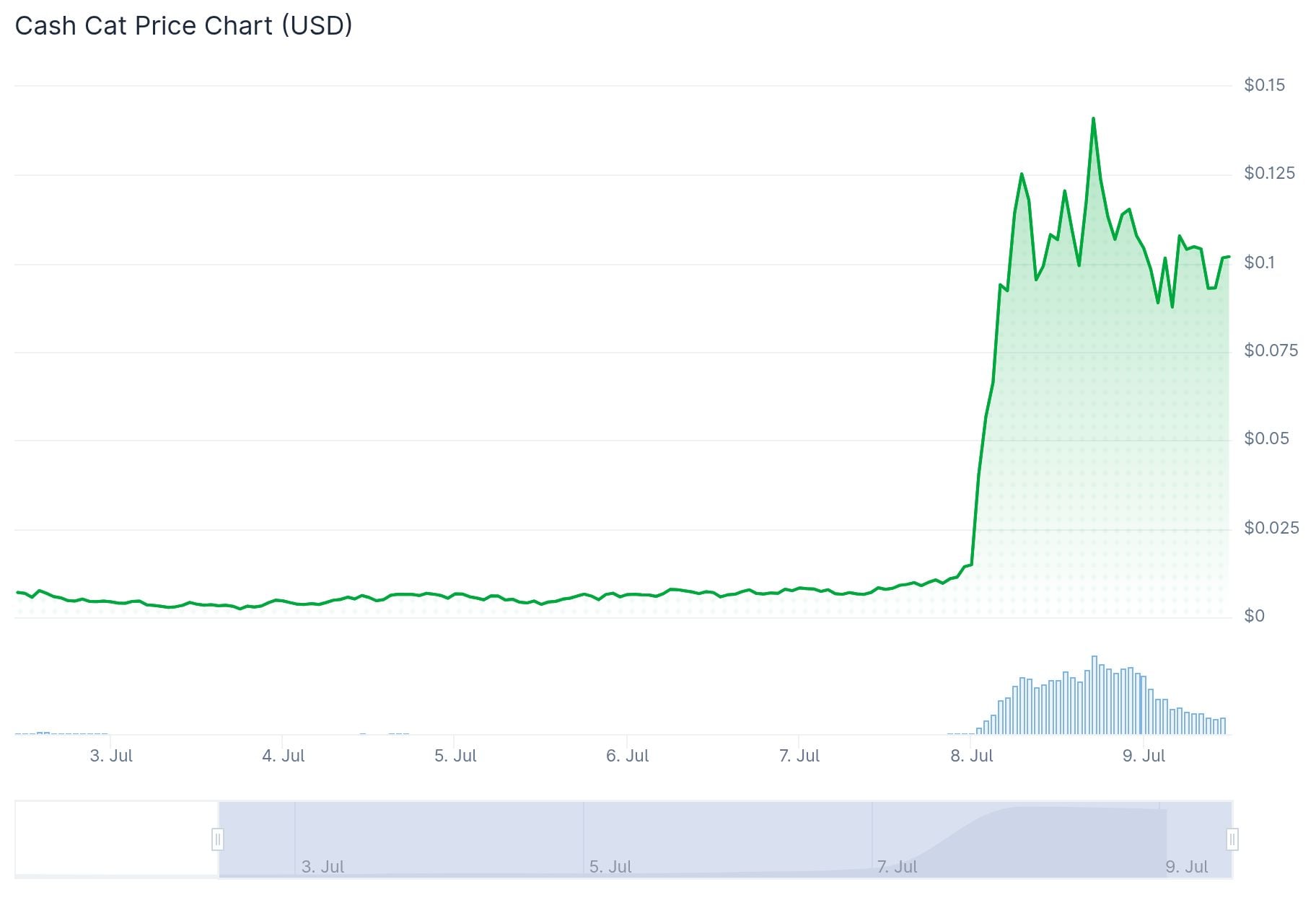
Cash Cat (CASHCAT) Price: Why the Robinhood Chain Meme Coin Jumped Over 1,400% in 24 Hours
Cash Cat (CASHCAT) Explodes Over 1,400% as Robinhood Chain Meme Token Goes Viral

$560 Million Record: CashCat Coin Takes Over Robinhood; Hyperliquid Joins XRP in Bitwise 10 Crypto Index; 105,742,020% in Bitcoin: Satoshi-Era Whale Awakens - Morning Crypto Report
HOT
Currently trending cryptocurrencies that are gaining significant market attention
Crypto Prices
The cryptocurrencies with the highest trading volume
Newly Added
Recently listed cryptocurrencies that are available for trading