Solana has returned to a price zone that once triggered one of the strongest rallies in crypto history, and that development is starting to draw fresh attentionSolana has returned to a price zone that once triggered one of the strongest rallies in crypto history, and that development is starting to draw fresh attention

Solana Returns to Zone That Triggered 20X Rally; How High Can SOL Price Go This Time?

2026/05/06 19:45
5 min read
For feedback or concerns regarding this content, please contact us at crypto.news@mexc.com

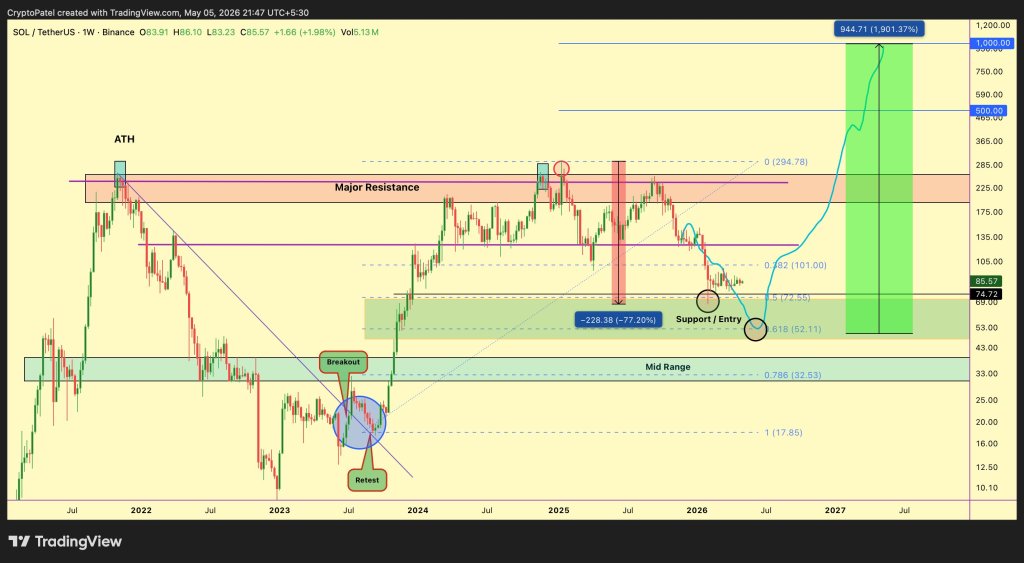
Solana has returned to a price zone that once triggered one of the strongest rallies in crypto history, and that development is starting to draw fresh attention toward the SOL price structure again. A long term chart shared by Crypto Patel now shows SOL revisiting the same support region that preceded its massive run from below $20 to almost $300 during the previous cycle.

That earlier rally pushed Solana up more than 2,200%. Current market conditions, however, look very different from what investors saw in 2021 and early 2024. The crypto market has expanded aggressively since then, and capital now spreads across thousands of competing assets instead of concentrating heavily around a few major altcoins.

Crypto Patel pointed out that Solana has moved back into the same buy zone that produced its previous explosive rally. His chart maps out a long term structure where the SOL price repeatedly reacts around key support and resistance levels inside a rising channel.
@CryptoPatel / X

The chart shows Solana reaching its first major all time high during November 2021 before the market entered a brutal correction phase. SOL later dropped toward the lower boundary of the pattern during 2022 and early 2023. That collapse eventually formed the base that launched the next recovery cycle.

A breakout from that zone helped Solana rally toward nearly $295 during the following bullish phase. Crypto Patel now believes SOL has returned close to another major support region after a deep correction from its latest highs.

The chart also projects a possible path toward much higher prices over the next alt season. One projection even stretches toward the $1,000 region. That target would represent another massive expansion from current levels near $85.

Long Term Solana Pattern Still Supports Another SOL Price Recovery

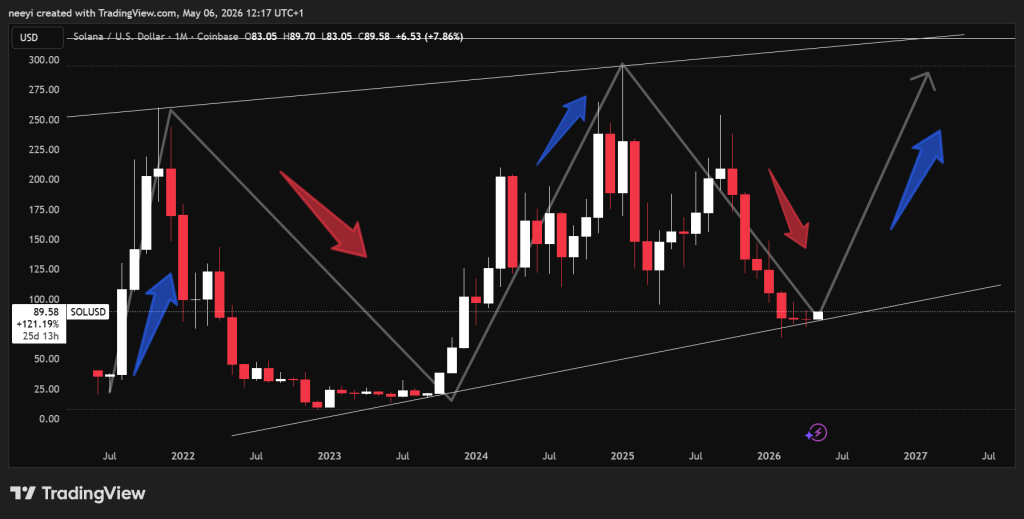
A closer look at the long term Solana structure reveals a fairly predictable cycle. SOL has repeatedly bounced between the lower support area and upper resistance region of its ascending channel.

That pattern matters because both previous all time highs formed after Solana rebounded strongly from the base of the structure. Historical behavior often gives analysts clues about where future resistance may appear again.

Recent SOL price action appears to follow that same framework. Solana corrected sharply from its previous peak and returned near the lower part of the long term channel. Technical analysts usually pay close attention to those zones because they often determine whether a trend survives or breaks completely.

Another factor deserves attention here. Previous rallies happened during periods when capital flowed heavily into fewer altcoins. Market concentration looked much stronger during earlier cycles compared to today’s environment.

Why a $1,000 Solana Price May Be Difficult During the Next Alt Season

Crypto Patel’s chart leaves open the possibility of SOL eventually touching $1,000, though current market conditions make that scenario difficult during the next alt season.

The long term ascending channel actually points toward a more realistic target near the $300 to $320 region. That area closely matches the upper resistance boundary where Solana previously struggled during earlier cycles.
SOL Price Chart / TradingView.com

A move toward $320 would still represent a major achievement from current levels around $85. Solana would need to reclaim strong market dominance and attract sustained institutional and retail demand for that scenario to develop.

The jump toward $1,000 creates a very different discussion. Solana would likely need another explosive 10x style expansion from current prices. Current crypto market structure may not support that type of concentration anymore.

Thousands of projects now compete for liquidity across AI tokens, meme coins, gaming assets, Layer 2 ecosystems, Real World Asset projects, and decentralized infrastructure platforms. Capital rotates much faster across sectors than it did during previous bull runs.

Read Also: Toncoin (TON) Price Up Over 60%: Why the Rally May Not Be Over Yet

Solana continues to benefit from strong adoption across decentralized finance, meme coin activity, stablecoin transfers, and consumer crypto applications. Continuous ecosystem growth could eventually support prices above $500 over a longer timeframe.

The next alt season, however, may produce more moderate gains across large cap assets like SOL. Historical patterns still support another strong recovery for Solana, though expectations of a rapid move toward $1,000 may require far more market concentration than current conditions appear ready to provide.

FAQs

What Will SOL Be Worth in 5 Years?

Experts predict Solana (SOL) could range from a conservative $150 to an optimistic $2,160 by 2031. Current estimates suggest an average value around $1,050, driven by ecosystem adoption. [

1, 2, 3]
Will Solana Defeat Ethereum?

“Defeat” is unlikely as they serve different niches. Solana leads in retail speed and volume, while Ethereum remains the institutional gold standard for security and high-value assets. [1, 2, 3, 4, 5]

Subscribe to our YouTube channel for daily crypto updates, market insights, and expert analysis.

The post Solana Returns to Zone That Triggered 20X Rally; How High Can SOL Price Go This Time? appeared first on CaptainAltcoin.


Market Opportunity
Solana Logo
Solana Price(SOL)
$88.52
$88.52$88.52
+3.54%
USD
Solana (SOL) Live Price Chart
Disclaimer: The articles reposted on this site are sourced from public platforms and are provided for informational purposes only. They do not necessarily reflect the views of MEXC. All rights remain with the original authors. If you believe any content infringes on third-party rights, please contact crypto.news@mexc.com for removal. MEXC makes no guarantees regarding the accuracy, completeness, or timeliness of the content and is not responsible for any actions taken based on the information provided. The content does not constitute financial, legal, or other professional advice, nor should it be considered a recommendation or endorsement by MEXC.
Tags:

You May Also Like

Mutuum Finance (MUTM) Update: V1 Protocol Goes Live, Key Mechanisms Explained

Mutuum Finance (MUTM) Update: V1 Protocol Goes Live, Key Mechanisms Explained

The start of April 2026 marks a significant turning point for the decentralized world. While many older networks are struggling with slow growth and high fees,
Share
Techbullion2026/04/02 19:46
Unlocking Massive Value: Curve Finance Revenue Sharing Proposal for CRV Holders

Unlocking Massive Value: Curve Finance Revenue Sharing Proposal for CRV Holders

BitcoinWorld Unlocking Massive Value: Curve Finance Revenue Sharing Proposal for CRV Holders The dynamic world of decentralized finance (DeFi) is constantly evolving, bringing forth new opportunities and innovations. A significant development is currently unfolding at Curve Finance, a leading decentralized exchange (DEX). Its founder, Michael Egorov, has put forth an exciting proposal designed to offer a more direct path for token holders to earn revenue. This initiative, centered around a new Curve Finance revenue sharing model, aims to bolster the value for those actively participating in the protocol’s governance. What is the “Yield Basis” Proposal and How Does it Work? At the core of this forward-thinking initiative is a new protocol dubbed Yield Basis. Michael Egorov introduced this concept on the CurveDAO governance forum, outlining a mechanism to distribute sustainable profits directly to CRV holders. Specifically, it targets those who stake their CRV tokens to gain veCRV, which are essential for governance participation within the Curve ecosystem. Let’s break down the initial steps of this innovative proposal: crvUSD Issuance: Before the Yield Basis protocol goes live, $60 million in crvUSD will be issued. Strategic Fund Allocation: The funds generated from the sale of these crvUSD tokens will be strategically deployed into three distinct Bitcoin-based liquidity pools: WBTC, cbBTC, and tBTC. Pool Capping: To ensure balanced risk and diversified exposure, each of these pools will be capped at $10 million. This carefully designed structure aims to establish a robust and consistent income stream, forming the bedrock of a sustainable Curve Finance revenue sharing mechanism. Why is This Curve Finance Revenue Sharing Significant for CRV Holders? This proposal marks a pivotal moment for CRV holders, particularly those dedicated to the long-term health and governance of Curve Finance. Historically, generating revenue for token holders in the DeFi space can often be complex. The Yield Basis proposal simplifies this by offering a more direct and transparent pathway to earnings. By staking CRV for veCRV, holders are not merely engaging in governance; they are now directly positioned to benefit from the protocol’s overall success. The significance of this development is multifaceted: Direct Profit Distribution: veCRV holders are set to receive a substantial share of the profits generated by the Yield Basis protocol. Incentivized Governance: This direct financial incentive encourages more users to stake their CRV, which in turn strengthens the protocol’s decentralized governance structure. Enhanced Value Proposition: The promise of sustainable revenue sharing could significantly boost the inherent value of holding and staking CRV tokens. Ultimately, this move underscores Curve Finance’s dedication to rewarding its committed community and ensuring the long-term vitality of its ecosystem through effective Curve Finance revenue sharing. Understanding the Mechanics: Profit Distribution and Ecosystem Support The distribution model for Yield Basis has been thoughtfully crafted to strike a balance between rewarding veCRV holders and supporting the wider Curve ecosystem. Under the terms of the proposal, a substantial portion of the value generated by Yield Basis will flow back to those who contribute to the protocol’s governance. Returns for veCRV Holders: A significant share, specifically between 35% and 65% of the value generated by Yield Basis, will be distributed to veCRV holders. This flexible range allows for dynamic adjustments based on market conditions and the protocol’s performance. Ecosystem Reserve: Crucially, 25% of the Yield Basis tokens will be reserved exclusively for the Curve ecosystem. This allocation can be utilized for various strategic purposes, such as funding ongoing development, issuing grants, or further incentivizing liquidity providers. This ensures the continuous growth and innovation of the platform. The proposal is currently undergoing a democratic vote on the CurveDAO governance forum, giving the community a direct voice in shaping the future of Curve Finance revenue sharing. The voting period is scheduled to conclude on September 24th. What’s Next for Curve Finance and CRV Holders? The proposed Yield Basis protocol represents a pioneering approach to sustainable revenue generation and community incentivization within the DeFi landscape. If approved by the community, this Curve Finance revenue sharing model has the potential to establish a new benchmark for how decentralized exchanges reward their most dedicated participants. It aims to foster a more robust and engaged community by directly linking governance participation with tangible financial benefits. This strategic move by Michael Egorov and the Curve Finance team highlights a strong commitment to innovation and strengthening the decentralized nature of the protocol. For CRV holders, a thorough understanding of this proposal is crucial for making informed decisions regarding their staking strategies and overall engagement with one of DeFi’s foundational platforms. FAQs about Curve Finance Revenue Sharing Q1: What is the main goal of the Yield Basis proposal? A1: The primary goal is to establish a more direct and sustainable way for CRV token holders who stake their tokens (receiving veCRV) to earn revenue from the Curve Finance protocol. Q2: How will funds be generated for the Yield Basis protocol? A2: Initially, $60 million in crvUSD will be issued and sold. The funds from this sale will then be allocated to three Bitcoin-based pools (WBTC, cbBTC, and tBTC), with each pool capped at $10 million, to generate profits. Q3: Who benefits from the Yield Basis revenue sharing? A3: The proposal states that between 35% and 65% of the value generated by Yield Basis will be returned to veCRV holders, who are CRV stakers participating in governance. Q4: What is the purpose of the 25% reserve for the Curve ecosystem? A4: This 25% reserve of Yield Basis tokens is intended to support the broader Curve ecosystem, potentially funding development, grants, or other initiatives that contribute to the platform’s growth and sustainability. Q5: When is the vote on the Yield Basis proposal? A5: A vote on the proposal is currently underway on the CurveDAO governance forum and is scheduled to run until September 24th. If you found this article insightful and valuable, please consider sharing it with your friends, colleagues, and followers on social media! Your support helps us continue to deliver important DeFi insights and analysis to a wider audience. To learn more about the latest DeFi market trends, explore our article on key developments shaping decentralized finance institutional adoption. This post Unlocking Massive Value: Curve Finance Revenue Sharing Proposal for CRV Holders first appeared on BitcoinWorld.


Share
Coinstats2025/09/18 00:35
Oscar Health (OSCR) Stock Soars 11% on Record-Breaking Quarterly Earnings

Oscar Health (OSCR) Stock Soars 11% on Record-Breaking Quarterly Earnings

Oscar Health (OSCR) stock rallied 11% after delivering record $679M profit, $2.07 EPS (vs $1.06 estimate), and 57% membership growth year-over-year. The post Oscar
Share
Blockonomi2026/05/06 19:52

Starter Gold Rush: Win $2,500!

Starter Gold Rush: Win $2,500!Starter Gold Rush: Win $2,500!

Start your first trade & capture every Alpha move