

Walmart (WMT) Stock; Stays Resilient Amid Market Rout as Amazon Competition Intensifies
TLDRs;
- Walmart outperforms broader market selloff as investors rotate into defensive retail and consumer staple exposure.
- Strong e-commerce growth and AI-driven logistics strengthen Walmart’s long-term positioning despite macroeconomic uncertainty.
- Rising fuel costs and weak consumer spending trends raise concerns about discretionary demand resilience.
- Intensifying competition with Amazon and valuation pressure challenge Walmart’s premium earnings multiple outlook.
Walmart Inc. (NYSE: WMT) managed to hold its ground last week even as broader financial markets experienced a sharp pullback. While the S&P 500 and Nasdaq posted significant losses driven by renewed macroeconomic uncertainty and shifting Federal Reserve expectations, Walmart emerged as a relative safe haven for investors seeking stability in consumer staples.
The stock ended the week higher, extending a modest weekly gain and reinforcing its defensive reputation. The resilience highlights a recurring market pattern where large retailers with steady demand profiles attract capital during risk-off sentiment, particularly when technology stocks face heavy selling pressure.
Consumer demand holds steady
Despite broader concerns about economic slowdown risks, Walmart continues to benefit from consistent demand for essential goods. The company reported solid growth in both physical and digital channels in its latest quarterly performance update, with e-commerce sales expanding at a strong double-digit rate.
Walmart Inc., WMT
Comparable store sales also rose on a steady trajectory, signaling that shoppers are still prioritizing value-driven retail even as inflationary pressures and fuel costs weigh on household budgets. Analysts note that Walmart’s scale and pricing power continue to give it an advantage in retaining cost-conscious consumers.
However, signs of consumer stress are emerging in discretionary categories. Internal metrics suggest that shoppers are reducing basket sizes in certain segments, particularly as gasoline prices affect monthly household spending patterns.
AI and logistics expansion accelerates
A key driver behind Walmart’s evolving investment case is its aggressive push into automation and artificial intelligence. The company has significantly expanded the use of AI-powered systems across its supply chain and fulfillment network, with nearly half of its U.S. e-commerce operations now supported by automated processes.
This shift is aimed at improving delivery speed, reducing costs, and increasing efficiency across its massive logistics footprint. Walmart is also leveraging physical stores as distribution hubs, blending traditional retail infrastructure with modern digital fulfillment strategies.
Management has emphasized “responsible AI deployment,” signaling that automation is intended to enhance productivity rather than replace human oversight entirely. Still, investor debate continues around how rapidly AI-driven efficiencies will translate into higher margins.
Amazon rivalry intensifies competitive pressure
Competition with Amazon remains one of the most important strategic battlegrounds for Walmart. The retail giant has expanded its express delivery offerings and introduced new partnerships to strengthen last-mile logistics capabilities, directly targeting Amazon’s dominance in fast delivery and convenience.
At the same time, Amazon’s seasonal sales strategy and growing focus on grocery delivery continue to pressure Walmart’s digital ambitions. Both companies are investing heavily in logistics infrastructure, pricing strategies, and AI systems to capture more consumer spending in an increasingly fragmented retail environment.
Walmart has responded with expanded delivery services and partnerships aimed at increasing product variety and fulfillment speed, reinforcing its position as a hybrid retailer operating across both physical and digital ecosystems.
Macroeconomic risks and valuation concerns
While Walmart’s operational performance remains solid, external risks continue to shape investor sentiment. Rising fuel prices, inflation pressures, and uncertain Federal Reserve policy all present headwinds for consumer spending.
Analysts also point to valuation concerns, with Walmart trading at a premium multiple compared to historical averages. This leaves less room for error if earnings growth slows or margins come under pressure from higher costs or competitive pricing battles.
The post Walmart (WMT) Stock; Stays Resilient Amid Market Rout as Amazon Competition Intensifies appeared first on CoinCentral.


You May Also Like
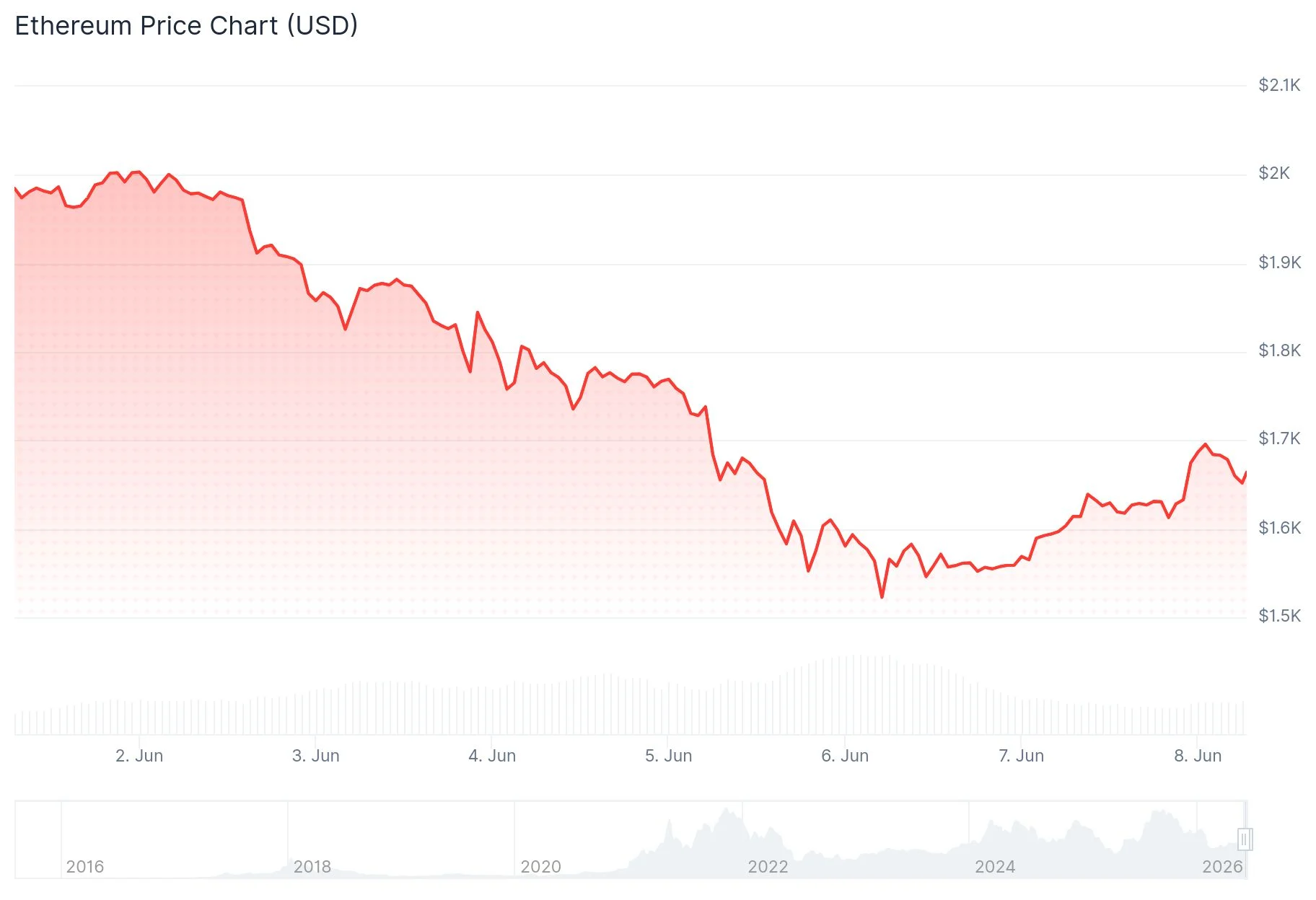
Ethereum (ETH) Crashes to $1,500 — Can Bulls Defend or Is $1,000 Coming?

Arthur Hayes says ‘I Didn’t Buy’ amid $2M HYPE transfer

Safe Havens Are Failing — Why Gold, Silver, and Crypto Are All Falling Together



