Bitget to Exit Japan: Services for Japanese Residents End December 31, 2026

Bitget announced on August 3, 2026, that it will discontinue services for users residing in Japan. The exchange is asking affected users to close all open positions and withdraw all assets from their accounts by December 31, 2026.
Any positions that remain open after 11:00 a.m. Japan Standard Time on December 31 will be forcibly closed, so users should take action before the deadline.
- Bitget announced its exit from the Japanese market on August 3, 2026
- Accounts will be switched to close-only mode on November 1, 2026
- Remaining open positions will be forcibly closed on December 31, 2026
- Bitget is asking users to close positions and withdraw assets by December 31
- The timing of Bitget’s exit comes amid warnings from Japan’s Financial Services Agency and the passage of stricter legislation
What Bitget Announced About Ending Services for Users in Japan
Bitget, operated by Seychelles-based Bitget Limited, announced on August 3, 2026, that it will discontinue services for users residing in Japan and gradually impose restrictions on affected accounts.
The company said the decision was part of its “ongoing efforts to comply with Japanese regulations.” As of the announcement date, Bitget also stopped accepting new registrations from users residing in Japan.
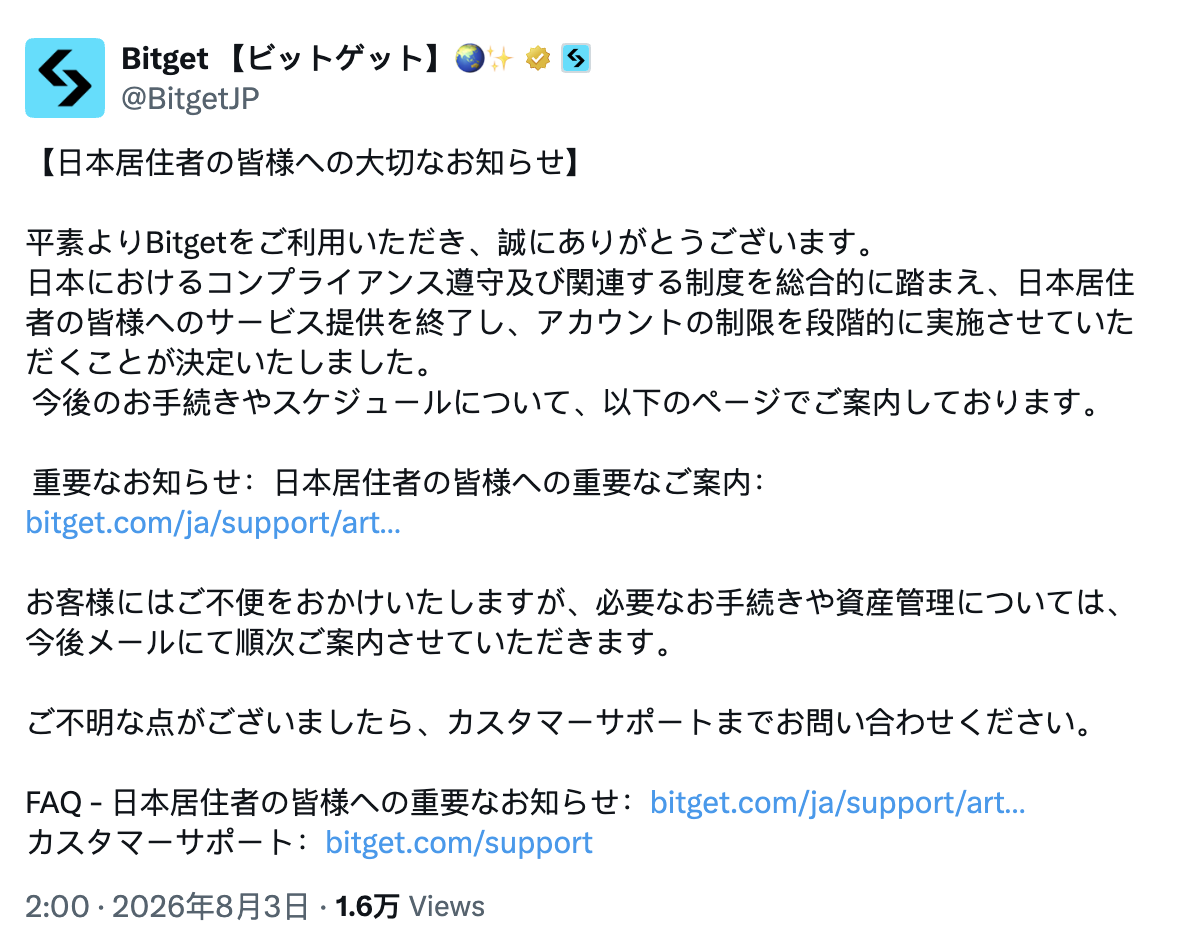
https://x.com/BitgetJP/status/2084096916661682680
At 11:00 a.m. JST on November 1, 2026, accounts identified as belonging to residents of Japan will be switched to close-only mode.
Under close-only mode, users will no longer be able to access features that allow them to open new trades or begin using investment products. Restricted services will include spot trading, futures trading, P2P trading, Convert, Earn, card services, copy trading, and trading bots.
Deposits will remain available with certain restrictions, while cryptocurrency withdrawals will continue to be supported. Users will be able to transfer their assets to self-custody wallets or other exchanges.
After 11:00 a.m. JST on December 31, 2026, any open positions remaining across all products will be forcibly closed. Bitget is asking users to close all outstanding positions and withdraw the assets held in their accounts before this deadline.
Users who do not reside in Japan but have been incorrectly classified as Japanese residents may retain access by completing Level 2 identity verification, including proof of address, before 11:00 a.m. JST on November 1, 2026.
Users who currently reside in Japan will not be eligible to continue using the platform even if they complete Level 2 verification. Accounts that do not complete the required verification by the deadline will automatically be classified as belonging to residents of Japan.
Bitget said further details will be sent gradually to users through their registered email addresses.
Timeline of FSA Warnings and the Promulgation of Stricter Legislation
Bitget has previously faced multiple actions from Japan’s Financial Services Agency.
The exchange received warnings in March 2023 and November 2024. In February 2025, the Bitget app was removed after the FSA asked Apple and Google to remove apps operated by unregistered overseas cryptocurrency exchanges. In June 2025, Bitget was also added to the agency’s list of unregistered service providers.
On the regulatory front, legislation transferring the oversight of cryptocurrency trading from the Payment Services Act to the Financial Instruments and Exchange Act was passed on July 15, 2026, and promulgated on July 23.
The revised framework introduces tougher penalties for operating without registration, including an increase in the maximum custodial sentence from three years to ten years.
Bitget’s announcement came 11 days after the amended legislation was promulgated. Although Bitget did not explicitly identify the legal revision as the direct reason for its decision, the timing suggests that the increasingly strict regulatory environment may have been a contributing factor.
Bitget is not the first overseas cryptocurrency exchange to withdraw from the Japanese market. Bybit has already begun implementing similar measures in phases.
Read more about Bybit’s withdrawal from the Japanese market here.
What Users Need to Do Before the Deadlines
Users with Bitget accounts classified as belonging to residents of Japan should confirm their residency status by 11:00 a.m. JST on November 1, 2026.
Those who do not live in Japan but have been incorrectly identified as Japanese residents may correct their classification by completing Level 2 identity verification before the deadline. This option is not available to users who currently reside in Japan.
Most importantly, affected users should close all open positions and withdraw all assets from their Bitget accounts by 11:00 a.m. JST on December 31, 2026.
Any positions that remain open after the deadline will be forcibly closed across all products.
Users who complete all position closures and asset withdrawals before the deadline will not be affected by the forced closure process. Those who wish to continue holding their cryptocurrency do not necessarily need to sell it; they can instead transfer it to a self-custody wallet or another exchange.
You May Also Like

Tesla Jumps Before Q2 Deliveries: Why the Real Test Is Not Just the Number, but the Quality of the Beat

SEC Innovation Exemption: How Tokenized Stocks Can Trade Onchain