

Must Read
IN PROTEST. Supporters of the Liberty and Refoundation party protest in front of the presidential palace in support of Honduran President Xiomara Castro in whatIN PROTEST. Supporters of the Liberty and Refoundation party protest in front of the presidential palace in support of Honduran President Xiomara Castro in what
[OPINION] Honduras’ election turmoil offers a warning — and a mirror — for the Philippines
For Filipinos watching the slow erosion of trust in elections, institutions, and regional stability, the turmoil unfolding in Honduras should feel familiar. More than a week after voters went to the polls, the country still has no declared president. Repeated failures in the election results transmission system froze the count, revived memories of past disputed elections, and triggered accusations of manipulation that have deepened public distrust in state institutions.
At first glance, Honduras may seem far removed from Philippine political realities. Yet the forces shaping its current crisis mirror those confronting Manila today: fragile electoral systems, external geopolitical pressure, and the growing costs of reliance on China. Beneath the procedural chaos, Honduras is reassessing its alignment with Beijing after discovering that promised economic gains failed to materialize, while political leverage and external scrutiny intensified instead.
This dilemma is not unique to Latin America. It echoes the Philippines’ own experience in the West Philippine Sea, where China’s economic engagement has coexisted with coercive behavior, and where Manila continues to balance development needs against sovereignty, democratic credibility, and alliance commitments.
Honduras’ debate is therefore not a distant case study, but a warning, and a mirror, for the Philippines.
The scale of Honduras’ crisis becomes clearer when placed in context. In 2017, severe irregularities in the vote count led the Organization of American States to question the legitimacy of the election and recommend that the process be repeated after the National Party candidate Juan Orlando Hernández was declared the winner. The current stalemate has revived those memories, once again fueling accusations of manipulation in favor of National Party candidate Nasry Asfura and deepening public distrust in state institutions.
The election has also drawn unusual international attention. The United States has closely monitored the process as part of its broader effort to curb Chinese influence in the region, an interest underscored when US President Donald Trump publicly signaled support for the National Party candidate days before the vote.
Honduras recognized the People’s Republic of China in 2023 with expectations of major investment and expanded market access. Those gains never arrived. High-profile projects stalled, trade agreements failed to materialize, and agricultural producers who hoped for relief saw no measurable improvement. Even the shrimp sector, a pillar of Honduras’ export economy, found that China’s market did not deliver the opportunities advertised at the time of diplomatic recognition. The frustration ran so deep that both major opposition parties announced during the campaign that they would restore formal ties with Taiwan if elected.
China’s unfulfilled pledges
The pattern is unmistakable: investment pledges that remain unfulfilled, paired with rising political and economic pressure. Diplomatic outreach brought fanfare, but not the tangible benefits needed to justify alignment.
A Honduran reversal toward Taiwan would mark the first time in nearly two decades that a country formally reconsiders its switch to Beijing.
For the Philippines, the strategic message is clear. China’s influence is not guaranteed, and its model carries reputational and political costs that are becoming harder for smaller states to absorb. In both regions, Beijing’s ability to sustain partnerships depends not on rhetoric but on real economic outcomes, and on whether coercive tactics undermine the goodwill it seeks to build.
Honduras’ experience also highlights the vulnerability that follows recognition of Beijing.
When countries attempt to step away, China often responds with economic pressure. Japan faced seafood import bans. Lithuania saw its exports delayed at Chinese ports. Australia endured tariffs on wine, barley, and coal after political disagreements. The Philippines, meanwhile, has experienced harassment of its vessels, dangerous maneuvers in disputed areas of the South China Sea, and threats linked to its defense cooperation with the United States. These tactics vary in form but share a common objective: raising the cost of independent decision-making.
With its small, agriculture-dependent economy, Honduras is highly exposed to such pressure. The Philippines, despite being far larger faces a parallel dilemma: strategic dependence on China in some sectors and strategic vulnerability to China in others. Manila’s experience in the West Philippine Sea is, in many ways, the maritime counterpart to the political and economic leverage Beijing attempted to cultivate in Honduras.
Countries can rethink alignments
Honduras’ political debate matters for the Philippines because it demonstrates that countries can rethink their alignments when promised benefits fail to materialize, and that public opinion can shift decisively when Beijing’s behavior clashes with its development narrative. It also underscores that democratic partners, whether Taiwan, Japan, or the United States, gain credibility when they deliver tangible support rather than grand announcements.
If Honduras restores ties with Taiwan, the decision will resonate across both the Atlantic and the Pacific. It will show that even states that formally recognized Beijing can walk away when the costs outweigh the gains. It will also test how China responds when a smaller nation asserts autonomy.
For Filipinos observing China’s increasingly aggressive posture in the West Philippine Sea, the lesson is unmistakable: influence rooted in coercion eventually erodes itself. Honduras may be the first country in years to challenge that model, but it will not be the last. – Rappler.com
Juan Fernando Herrera Ramos is a Honduran journalist based in Taipei. He covers Taiwan–Latin America relations, China’s regional diplomacy, and international affairs. His reporting and analysis have appeared in Nikkei Asia, The Diplomat, The Strategist (ASPI), Taipei Times, Ketagalan Media, and other outlets.
Market Opportunity
Black Mirror Price(MIRROR)
$0.001639
$0.001639$0.001639
USD
Black Mirror (MIRROR) Live Price Chart
Disclaimer: The articles reposted on this site are sourced from public platforms and are provided for informational purposes only. They do not necessarily reflect the views of MEXC. All rights remain with the original authors. If you believe any content infringes on third-party rights, please contact service@support.mexc.com for removal. MEXC makes no guarantees regarding the accuracy, completeness, or timeliness of the content and is not responsible for any actions taken based on the information provided. The content does not constitute financial, legal, or other professional advice, nor should it be considered a recommendation or endorsement by MEXC.
You May Also Like
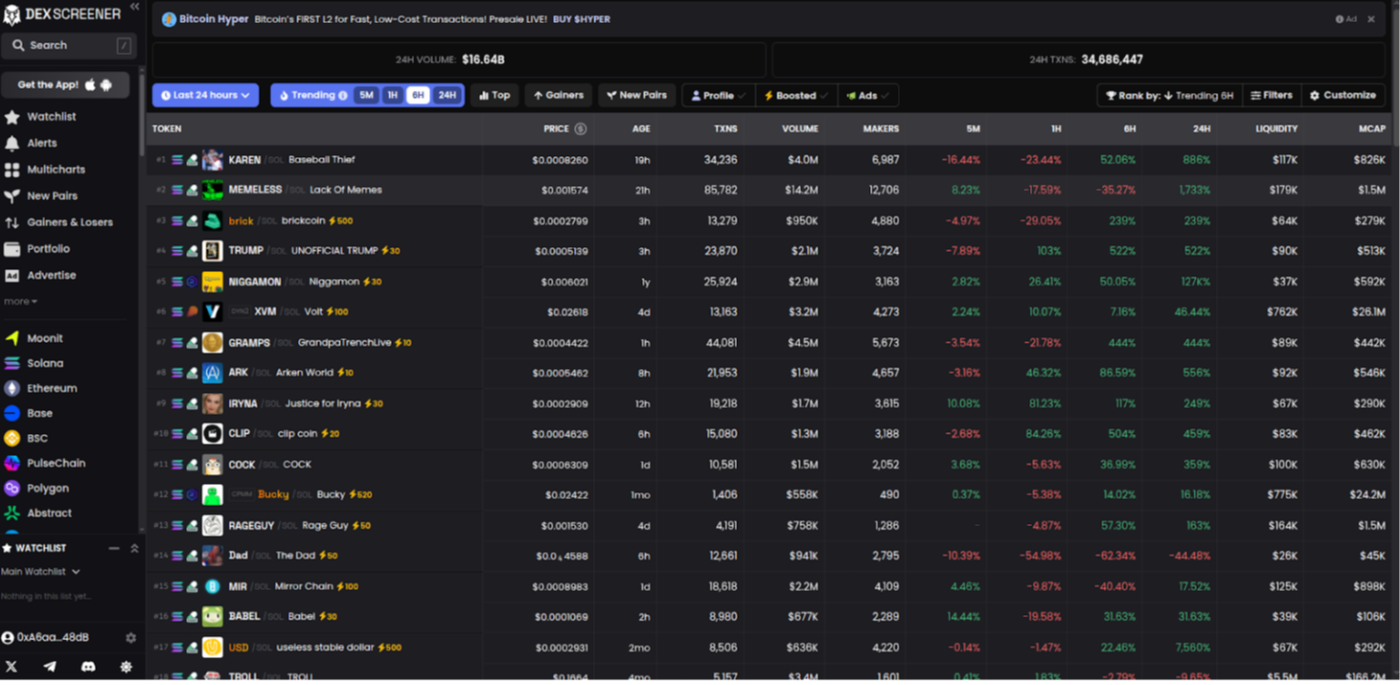
Building a DEXScreener Clone: A Step-by-Step Guide
DEX Screener is used by crypto traders who need access to on-chain data like trading volumes, liquidity, and token prices. This information allows them to analyze trends, monitor new listings, and make informed investment decisions. In this tutorial, I will build a DEXScreener clone from scratch, covering everything from the initial design to a functional app. We will use Streamlit, a Python framework for building full-stack apps.
Share
Hackernoon2025/09/18 15:05
Which DOGE? Musk's Cryptic Post Explodes Confusion
A viral chart documenting a sharp decline in U.S. federal employment during President Trump's second term has sparked unexpected confusion in cryptocurrency markets
Share
Coinstats2025/12/20 01:13

Google's AP2 protocol has been released. Does encrypted AI still have a chance?
Following the MCP and A2A protocols, the AI Agent market has seen another blockbuster arrival: the Agent Payments Protocol (AP2), developed by Google. This will clearly further enhance AI Agents' autonomous multi-tasking capabilities, but the unfortunate reality is that it has little to do with web3AI. Let's take a closer look: What problem does AP2 solve? Simply put, the MCP protocol is like a universal hook, enabling AI agents to connect to various external tools and data sources; A2A is a team collaboration communication protocol that allows multiple AI agents to cooperate with each other to complete complex tasks; AP2 completes the last piece of the puzzle - payment capability. In other words, MCP opens up connectivity, A2A promotes collaboration efficiency, and AP2 achieves value exchange. The arrival of AP2 truly injects "soul" into the autonomous collaboration and task execution of Multi-Agents. Imagine AI Agents connecting Qunar, Meituan, and Didi to complete the booking of flights, hotels, and car rentals, but then getting stuck at the point of "self-payment." What's the point of all that multitasking? So, remember this: AP2 is an extension of MCP+A2A, solving the last mile problem of AI Agent automated execution. What are the technical highlights of AP2? The core innovation of AP2 is the Mandates mechanism, which is divided into real-time authorization mode and delegated authorization mode. Real-time authorization is easy to understand. The AI Agent finds the product and shows it to you. The operation can only be performed after the user signs. Delegated authorization requires the user to set rules in advance, such as only buying the iPhone 17 when the price drops to 5,000. The AI Agent monitors the trigger conditions and executes automatically. The implementation logic is cryptographically signed using Verifiable Credentials (VCs). Users can set complex commission conditions, including price ranges, time limits, and payment method priorities, forming a tamper-proof digital contract. Once signed, the AI Agent executes according to the conditions, with VCs ensuring auditability and security at every step. Of particular note is the "A2A x402" extension, a technical component developed by Google specifically for crypto payments, developed in collaboration with Coinbase and the Ethereum Foundation. This extension enables AI Agents to seamlessly process stablecoins, ETH, and other blockchain assets, supporting native payment scenarios within the Web3 ecosystem. What kind of imagination space can AP2 bring? After analyzing the technical principles, do you think that's it? Yes, in fact, the AP2 is boring when it is disassembled alone. Its real charm lies in connecting and opening up the "MCP+A2A+AP2" technology stack, completely opening up the complete link of AI Agent's autonomous analysis+execution+payment. From now on, AI Agents can open up many application scenarios. For example, AI Agents for stock investment and financial management can help us monitor the market 24/7 and conduct independent transactions. Enterprise procurement AI Agents can automatically replenish and renew without human intervention. AP2's complementary payment capabilities will further expand the penetration of the Agent-to-Agent economy into more scenarios. Google obviously understands that after the technical framework is established, the ecological implementation must be relied upon, so it has brought in more than 60 partners to develop it, almost covering the entire payment and business ecosystem. Interestingly, it also involves major Crypto players such as Ethereum, Coinbase, MetaMask, and Sui. Combined with the current trend of currency and stock integration, the imagination space has been doubled. Is web3 AI really dead? Not entirely. Google's AP2 looks complete, but it only achieves technical compatibility with Crypto payments. It can only be regarded as an extension of the traditional authorization framework and belongs to the category of automated execution. There is a "paradigm" difference between it and the autonomous asset management pursued by pure Crypto native solutions. The Crypto-native solutions under exploration are taking the "decentralized custody + on-chain verification" route, including AI Agent autonomous asset management, AI Agent autonomous transactions (DeFAI), AI Agent digital identity and on-chain reputation system (ERC-8004...), AI Agent on-chain governance DAO framework, AI Agent NPC and digital avatars, and many other interesting and fun directions. Ultimately, once users get used to AI Agent payments in traditional fields, their acceptance of AI Agents autonomously owning digital assets will also increase. And for those scenarios that AP2 cannot reach, such as anonymous transactions, censorship-resistant payments, and decentralized asset management, there will always be a time for crypto-native solutions to show their strength? The two are more likely to be complementary rather than competitive, but to be honest, the key technological advancements behind AI Agents currently all come from web2AI, and web3AI still needs to keep up the good work!
Share
PANews2025/09/18 07:00