The Uniswap protocol fee switch is expected to go live later this week after a governance proposal crossed the required voting threshold. The decision representsThe Uniswap protocol fee switch is expected to go live later this week after a governance proposal crossed the required voting threshold. The decision represents

Uniswap Protocol v2 and v3 Set for Fee Activation After UNIfication Passes

The Uniswap protocol fee switch is expected to go live later this week after a governance proposal crossed the required voting threshold. The decision represents one of the most meaningful upgrades in Uniswap’s history. 

Voting momentum built quickly after the proposal opened on Dec. 20. More than 62 million votes were cast in favor as of early Monday. That total exceeds the 40 million votes needed to approve the Uniswap protocol fee switch. Voting is scheduled to end on Christmas Day.

UNIfication Proposal Advances Toward Activation

The proposal, known as UNIfication, introduces protocol-level fees for Uniswap v2 and v3. The changes will activate on the Unichain mainnet. 

Uniswap Labs CEO Hayden Adams said approval would trigger a two-day timelock. Once that period ends, the Uniswap protocol fee switch will activate automatically.
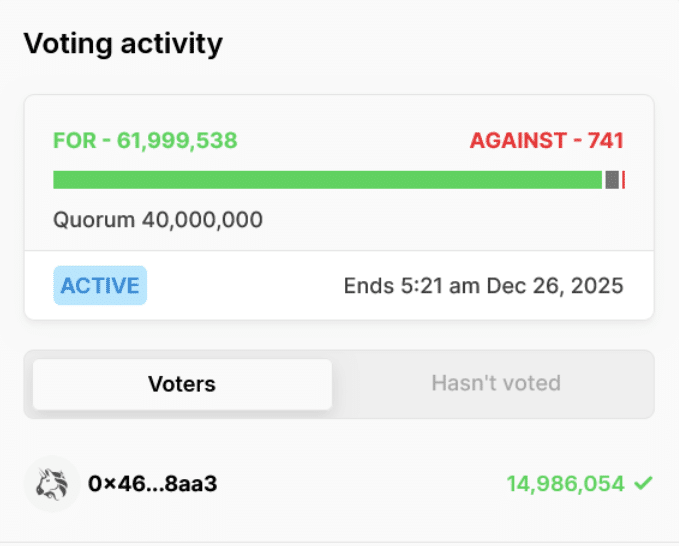
Uniswap Protocol Fee Switch Source: UniSwap

Governance Vote Signals Strong Alignment

The vote shows broad consensus among UNI holders. Only a very small number of votes opposed the proposal. A limited share abstained. 

Also Read: UNI plots fee switch and 100M burn as Uniswap price firms up

Large token holders overwhelmingly supported the Uniswap protocol fee switch. The outcome suggests confidence in the long-term impact of the change.

Activation Timeline and Safeguards

After voting closes, the protocol will enter a mandatory delay period. This timelock is part of Uniswap’s governance framework.

It allows for final review before execution. When the delay ends, fee switches on Uniswap v2 and v3 will turn on. The Uniswap protocol fee switch will then begin operating on-chain.

UNI Token Burn and Supply Impact

A key element of the proposal is a major token burn. The Uniswap Foundation plans to burn 100 million UNI from its treasury. This reduces overall supply. 

The move is designed to improve token scarcity. Many observers see the Uniswap protocol fee switch as a shift toward stronger supply discipline.

Liquidity Provider Incentive Changes

The proposal also introduces a Protocol Fee Discount Auctions system. The mechanism aims to improve returns for liquidity providers. It changes how protocol fees are distributed. 

Uniswap expects this system to support deeper liquidity. The Uniswap protocol fee switch is central to this new incentive structure.

Market Response to the Proposal

UNI’s price reacted positively during the voting period. The token gained around 25% after voting began. It recently traded near $6.26 and down by 1.23% over the past day.. 

That move helped UNI recover from a prolonged decline. Earlier news of the Uniswap protocol fee switch proposal in November also drove a sharp rally.

Uniswap’s Scale in DeFi Markets

Uniswap remains the largest decentralized exchange by total volume. It has processed more than $4 trillion in trades since launching in 2018. 

UNI ranks among the top 40 tokens by market capitalization. Because of this scale, the Uniswap protocol fee switch has wider implications for decentralized finance.

Influential Voters Back the Measure

Several well-known industry figures supported the proposal. These include Variant founder Jesse Walden. Synthetix and Infinex founder Kain Warwick also voted in favor. 

Former Uniswap Labs engineer Ian Lapham backed the change. Their support added credibility to the Uniswap protocol fee switch.

Builder Funding and Growth Plans

The Uniswap Foundation addressed concerns from developers early in the process. It confirmed that grant programs would continue. A new Growth Budget is planned. 

The budget involves distributing 20 million UNI. The Foundation said the Uniswap protocol fee switch would not reduce support for builders.

Conclusion

The activation of the Uniswap protocol fee switch marks a major shift in how the protocol operates. It links governance decisions to token economics more directly. 

The upgrade combines token burns, revised incentives, and ongoing ecosystem funding. These changes signal a new phase in Uniswap’s evolution.

Also Read: Uniswap Breaks EVM Boundaries with Solana Integration

Appendix: Glossary of Key Terms

Uniswap protocol fee switch: A mechanism that enables protocol-level fee collection on Uniswap.
UNIfication: A governance proposal designed to activate protocol fees and adjust token economics.
UNI token: The governance asset used for voting and ecosystem incentives on Uniswap.
Unichain: The network where the fee switch is scheduled to activate first.
Governance vote: A token-holder decision process used to approve protocol changes.
Timelock period: A delay that allows review before approved upgrades take effect.
Token burn: The permanent removal of tokens from circulation to reduce supply.

Frequently Asked Questions About Uniswap Protocol Fee Switch

1- What is the Uniswap protocol fee switch?

It is a mechanism that enables protocol-level fees and changes how value flows through Uniswap.

2- When will it activate?

Activation is expected shortly after voting ends, following a two-day timelock.

3- How many UNI tokens will be burned?

The proposal includes burning 100 million UNI from the Uniswap Foundation’s treasury.

4- Will developer grants continue?

Yes. The Foundation plans a Growth Budget funded with 20 million UNI.

Reference

CoinTelegraph

Read More: Uniswap Protocol v2 and v3 Set for Fee Activation After UNIfication Passes">Uniswap Protocol v2 and v3 Set for Fee Activation After UNIfication Passes

Market Opportunity
SecondLive Logo
SecondLive Price(LIVE)
$0,00004064
$0,00004064$0,00004064
-2,82%
USD
SecondLive (LIVE) Live Price Chart
Disclaimer: The articles reposted on this site are sourced from public platforms and are provided for informational purposes only. They do not necessarily reflect the views of MEXC. All rights remain with the original authors. If you believe any content infringes on third-party rights, please contact service@support.mexc.com for removal. MEXC makes no guarantees regarding the accuracy, completeness, or timeliness of the content and is not responsible for any actions taken based on the information provided. The content does not constitute financial, legal, or other professional advice, nor should it be considered a recommendation or endorsement by MEXC.

You May Also Like

Bitcoin Has Taken Gold’s Role In Today’s World, Eric Trump Says

Bitcoin Has Taken Gold’s Role In Today’s World, Eric Trump Says

Eric Trump on Tuesday described Bitcoin as a “modern-day gold,” calling it a liquid store of value that can act as a hedge to real estate and other assets. Related Reading: XRP’s Biggest Rally Yet? Analyst Projects $20+ In October 2025 According to reports, the remark came during a TV appearance on CNBC’s Squawk Box, tied to the launch of American Bitcoin, the mining and treasury firm he helped start. Company Holdings And Strategy Based on public filings and company summaries, American Bitcoin has accumulated 2,443 BTC on its balance sheet. That stash has been valued in the low hundreds of millions of dollars at recent spot prices. The firm mixes large-scale mining with the goal of holding Bitcoin as a strategic reserve, which it says will help it grow both production and asset holdings over time. Eric Trump’s comments were direct. He told viewers that institutions are treating Bitcoin more like a store of value than a fringe idea, and he warned firms that resist blockchain adoption. The tone was strong at times, and the line about Bitcoin being a modern equivalent of gold was used to frame American Bitcoin’s role as both miner and holder.   Eric Trump has said: bitcoin is modern-day gold — unusual_whales (@unusual_whales) September 16, 2025 How The Company Went Public American Bitcoin moved toward a public listing via an all-stock merger with Gryphon Digital Mining earlier this year, a deal that kept most of the original shareholders in control and positioned the new entity for a Nasdaq debut. Reports show that mining partner Hut 8 holds a large ownership stake, leaving the Trump family and other backers with a minority share. The listing brought fresh attention and capital to the firm as it began trading under the ticker ABTC. Market watchers say the firm’s public debut highlights two trends: mining companies are trying to grow by both producing and holding Bitcoin, and political ties are bringing more headlines to crypto firms. Some analysts point out that holding large amounts of Bitcoin on the balance sheet exposes a company to price swings, while supporters argue it aligns incentives between miners and investors. Related Reading: Ethereum Bulls Target $8,500 With Big Money Backing The Move – Details Reaction And Possible Risks Based on coverage of the launch, investors have reacted with both enthusiasm and caution. Supporters praise the prospect of a US-based miner that aims to be transparent and aggressive about building a reserve. Critics point to governance questions, possible conflicts tied to high-profile backers, and the usual risks of a volatile asset being held on corporate balance sheets. Eric Trump’s remark that Bitcoin has taken gold’s role in today’s world reflects both his belief in its value and American Bitcoin’s strategy of mining and holding. Whether that view sticks will depend on how investors and institutions respond in the months ahead. Featured image from Meta, chart from TradingView
Share
NewsBTC2025/09/18 06:00
UK Looks to US to Adopt More Crypto-Friendly Approach

UK Looks to US to Adopt More Crypto-Friendly Approach

The post UK Looks to US to Adopt More Crypto-Friendly Approach appeared on BitcoinEthereumNews.com. The UK and US are reportedly preparing to deepen cooperation on digital assets, with Britain looking to copy the Trump administration’s crypto-friendly stance in a bid to boost innovation.  UK Chancellor Rachel Reeves and US Treasury Secretary Scott Bessent discussed on Tuesday how the two nations could strengthen their coordination on crypto, the Financial Times reported on Tuesday, citing people familiar with the matter.  The discussions also involved representatives from crypto companies, including Coinbase, Circle Internet Group and Ripple, with executives from the Bank of America, Barclays and Citi also attending, according to the report. The agreement was made “last-minute” after crypto advocacy groups urged the UK government on Thursday to adopt a more open stance toward the industry, claiming its cautious approach to the sector has left the country lagging in innovation and policy.  Source: Rachel Reeves Deal to include stablecoins, look to unlock adoption Any deal between the countries is likely to include stablecoins, the Financial Times reported, an area of crypto that US President Donald Trump made a policy priority and in which his family has significant business interests. The Financial Times reported on Monday that UK crypto advocacy groups also slammed the Bank of England’s proposal to limit individual stablecoin holdings to between 10,000 British pounds ($13,650) and 20,000 pounds ($27,300), claiming it would be difficult and expensive to implement. UK banks appear to have slowed adoption too, with around 40% of 2,000 recently surveyed crypto investors saying that their banks had either blocked or delayed a payment to a crypto provider.  Many of these actions have been linked to concerns over volatility, fraud and scams. The UK has made some progress on crypto regulation recently, proposing a framework in May that would see crypto exchanges, dealers, and agents treated similarly to traditional finance firms, with…
Share
BitcoinEthereumNews2025/09/18 02:21
Won-pegged stablecoin KRW1 launches in South Korea on Avalanche

Won-pegged stablecoin KRW1 launches in South Korea on Avalanche

Stablecoin development in South Korea has advanced with the launch of KRW1, a won-pegged token issued on the Avalanche blockchain. Seoul-based digital asset firm BDACS announced the launch of KRW1 on September 17, a stablecoin fully backed by South Korean…
Share
Crypto.news2025/09/18 15:48