The crypto market has entered a cautious consolidation phase just as the Federal Reserve prepares for one of its most politically charged transitions in decadesThe crypto market has entered a cautious consolidation phase just as the Federal Reserve prepares for one of its most politically charged transitions in decades

What Could Be the Federal Reserve’s Impact on the Crypto Market in 2026?

The crypto market has entered a cautious consolidation phase just as the Federal Reserve prepares for one of its most politically charged transitions in decades. Jerome Powell’s term as Fed Chair ends in May 2026, and President Donald Trump is already positioning allies for key board seats. This shift could redefine the monetary tone of the next cycle — and with it, the trajectory of risk assets like crypto.

Reading the Chart: Calm Before the Policy Storm
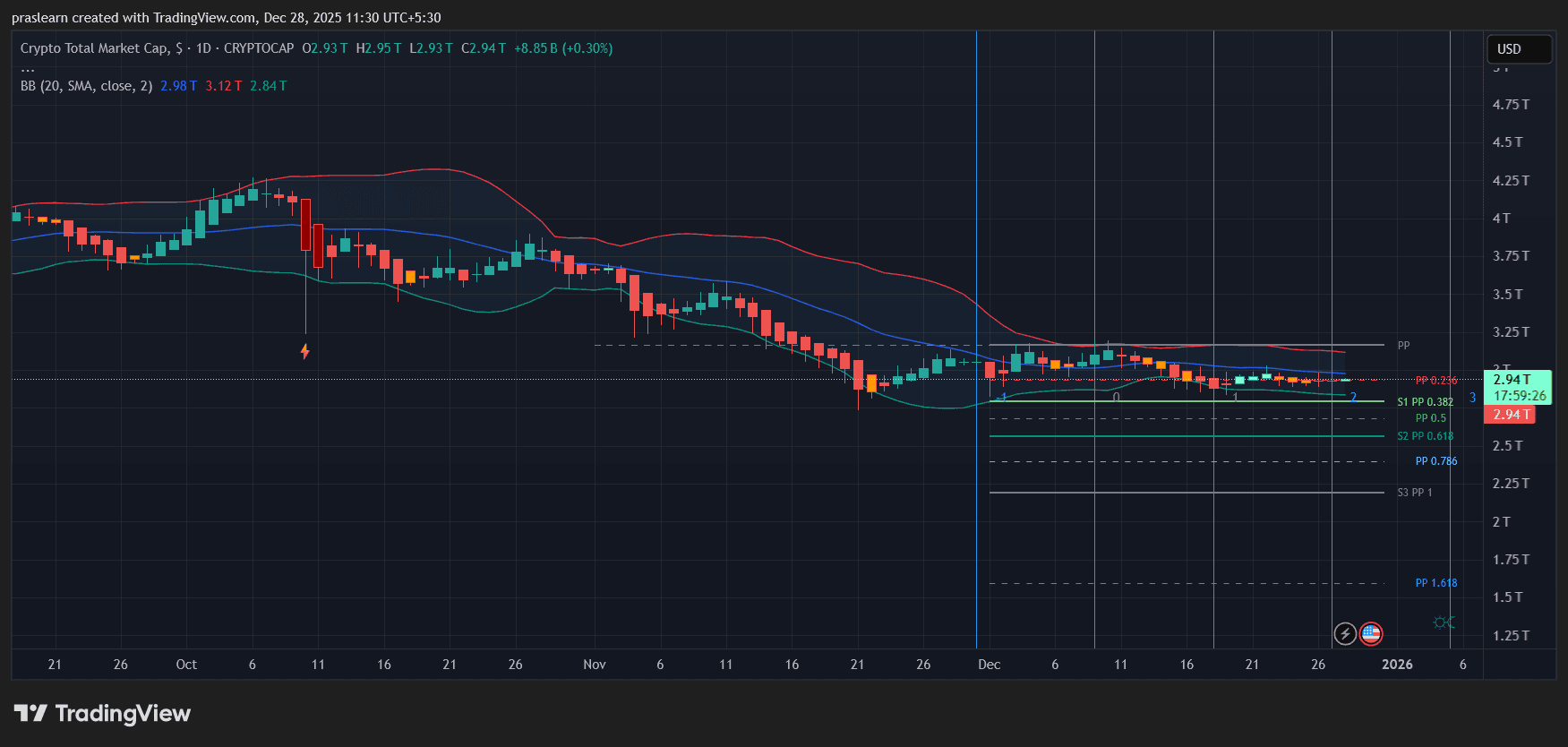
Crypto MarketTotal Crypto Market: TradingView

Historically, crypto market thrives in liquidity-rich environments. Bitcoin’s bull runs in 2017, 2021, and mid-2024 were all underpinned by dovish Fed conditions or balance sheet expansion. As the chart shows, the total crypto market cap is now hovering around $2.94 trillion, with volatility squeezed inside the Bollinger Bands and price action sliding just below the 20-day moving average (blue line). Traders appear to be in a wait-and-see mode, reflecting macro uncertainty more than sector-specific weakness.

The Bollinger Bands have tightened considerably — a classic sign of impending volatility. The upper band sits around $3.12T, while the lower support hovers near $2.84T, creating a narrow trading corridor. This compression suggests that markets are anticipating a breakout but lack a clear catalyst in the short term.

Momentum indicators point to declining selling pressure but no confirmed reversal yet. The market’s failed attempts to reclaim the mid-band resistance since early December indicate fading confidence. If the Fed signals early rate cuts or a more accommodative tone, a move above $3.0T–$3.1T could trigger a renewed bull leg targeting $3.25T–$3.5T. Conversely, if hawkish rhetoric resurfaces, we may see a retest of $2.8T, followed by deeper liquidity sweeps toward $2.5T (the 0.618 Fibonacci zone).

Political Influence Meets Monetary Policy

While Trump’s new Fed appointments might lean toward rate cuts, the institutional inertia of the central bank remains strong. Economists from Morgan Stanley and Wells Fargo expect the Fed’s policy framework to remain largely intact through 2026–2027, even with leadership turnover. That means no abrupt U-turn in rate policy — just a gradual easing, likely tied to inflation cooling and employment stability.

Still, markets trade on expectations, not realities. If investors believe Trump’s new appointees will prioritize growth over inflation control, risk appetite could surge prematurely — igniting a speculative wave across crypto assets, especially Bitcoin and Ethereum, as traders price in cheaper capital and weaker USD outlooks.

The Macro-Crypto Connection in 2026

Crypto’s correlation with U.S. monetary policy has tightened since 2022. The chart’s muted price action since November aligns with broader dollar resilience and real yields staying positive. As yields begin to compress in mid-2026 — a probable outcome under a more dovish Fed — capital could rotate back into risk assets. In such a case, stablecoins, DeFi tokens, and large-cap altcoins might see inflows similar to the 2020–2021 liquidity cycle.

Meanwhile, the psychological barrier at $3 trillion remains crucial. A confirmed close above that mark, with expanding volume, would signal market readiness for another leg higher. Below $2.8T, however, sentiment could flip, pushing total market capitalization toward the $2.5T–$2.6T support cluster, where long-term buyers may re-enter.

What This Means for Traders and Investors

The 2026 Fed transition introduces both policy risk and opportunity. If Jerome Powell’s successor prioritizes growth and lowers rates faster than expected, crypto could front-run traditional markets, sparking an early rally. But if the Fed’s continuity narrative holds, expect sideways accumulation well into Q2 2026.

For now, traders should watch for a volatility breakout from the current Bollinger squeeze. Positioning ahead of the February–May policy window could be key. The broader takeaway? The crypto market is coiling for a macro-driven move, and the next Fed chair may decide its direction more than any halving or ETF approval.

Forecast: Crypto Market Scenarios for 2026

  • Bullish Case: Dovish Fed transition triggers liquidity rebound → Total market cap breaks $3.2T, targets $3.8T by late 2026.
  • Base Case: Gradual easing with steady inflation → Range-bound between $2.7T and $3.2T until Q3 2026.
  • Bearish Case: Inflation resurgence or policy conflict → Retest of $2.5T before recovery in 2027.

The chart’s compression and muted volatility mirror investor hesitation ahead of a potentially seismic shift in Fed leadership. Whether Trump’s influence accelerates rate cuts or not, the next twelve months will determine whether crypto’s consolidation morphs into expansion — or deeper correction. The market’s next breakout won’t be technical alone; it’ll be political.

Market Opportunity
MAY Logo
MAY Price(MAY)
$0.01293
$0.01293$0.01293
-0.15%
USD
MAY (MAY) Live Price Chart
Disclaimer: The articles reposted on this site are sourced from public platforms and are provided for informational purposes only. They do not necessarily reflect the views of MEXC. All rights remain with the original authors. If you believe any content infringes on third-party rights, please contact service@support.mexc.com for removal. MEXC makes no guarantees regarding the accuracy, completeness, or timeliness of the content and is not responsible for any actions taken based on the information provided. The content does not constitute financial, legal, or other professional advice, nor should it be considered a recommendation or endorsement by MEXC.

You May Also Like

Trump Administration Aligned Regulators To Reduce Crypto Uncertainty and Enable Growth

Trump Administration Aligned Regulators To Reduce Crypto Uncertainty and Enable Growth

The Trump administration aligned U.S. crypto regulators in 2025 to reduce uncertainty and integrate digital assets with the financial system. The United States
Share
LiveBitcoinNews2025/12/28 16:30
Top 3 Trusted Platforms for Betting with BTC and USDT
Top 3 Trusted Platforms for Betting with BTC and USDT

Cryptocurrency betting has moved far beyond being a niche option for tech enthusiasts. Today, betting with BTC and USDT is a mainstream choice for players who value
Share
Coinstats2025/12/28 16:00
Jerome Powell’s Press Conference: Crucial Insights Unveiled for the Market’s Future

Jerome Powell’s Press Conference: Crucial Insights Unveiled for the Market’s Future

BitcoinWorld Jerome Powell’s Press Conference: Crucial Insights Unveiled for the Market’s Future The financial world, including the dynamic cryptocurrency market, often hangs on every word from the Federal Reserve. Recently, Jerome Powell’s press conference following the Federal Open Market Committee (FOMC) meeting concluded, leaving investors and analysts dissecting his remarks for clues about the future economic direction. This event is always a pivotal moment, shaping expectations for inflation, interest rates, and the overall stability of global markets. What Were the Key Takeaways from Jerome Powell’s Press Conference? During Jerome Powell’s press conference, the Fed Chair provided an update on the central bank’s monetary policy decisions and its economic outlook. His statements often reiterate the Fed’s dual mandate: achieving maximum employment and stable prices. This time was no different, with a strong emphasis on managing persistent inflation. Key points from the recent discussion included: Inflation Control: Powell emphasized the Fed’s unwavering commitment to bringing inflation back down to its 2% target. He reiterated that the fight against rising prices remains the top priority, even if it entails some economic slowdown. Interest Rate Policy: While the Fed’s stance on future interest rate adjustments was discussed, the path remains data-dependent. Powell indicated that decisions would continue to be made meeting-by-meeting, based on incoming economic data. Economic Projections: The updated Summary of Economic Projections (SEP) offered insights into the Fed’s forecasts for GDP growth, unemployment, and inflation. These projections help market participants gauge the central bank’s expectations for the economy’s trajectory. Quantitative Tightening (QT): The ongoing process of reducing the Fed’s balance sheet, known as quantitative tightening, was also a topic. This reduction in liquidity in the financial system has broad implications for asset prices. How Did Jerome Powell’s Remarks Impact Cryptocurrency Markets? The conclusion of Jerome Powell’s press conference often sends ripples through traditional financial markets, and cryptocurrencies are increasingly sensitive to these macroeconomic shifts. Digital assets, once thought to be uncorrelated, now frequently react to the Fed’s monetary policy signals. Higher interest rates, for instance, tend to make riskier assets like cryptocurrencies less attractive. This is because investors might prefer safer, interest-bearing investments. Consequently, we often see increased volatility in Bitcoin (BTC) and Ethereum (ETH) prices immediately following such announcements. The tightening of financial conditions, driven by the Fed, reduces overall liquidity in the system, which can put downward pressure on asset valuations across the board. However, some argue that this growing correlation signifies crypto’s increasing integration into the broader financial ecosystem. It suggests that institutional investors and mainstream finance are now paying closer attention to digital assets, treating them more like other risk-on investments. Navigating the Economic Landscape After Jerome Powell’s Press Conference For cryptocurrency investors, understanding the implications of Jerome Powell’s press conference is crucial for making informed decisions. The Fed’s policy trajectory directly influences the availability of capital and investor sentiment, which are key drivers for crypto valuations. Here are some actionable insights for navigating this environment: Stay Informed: Regularly monitor Fed announcements and economic data releases. Understanding the macroeconomic backdrop is as important as analyzing individual crypto projects. Assess Risk Tolerance: In periods of economic uncertainty and tighter monetary policy, a reassessment of personal risk tolerance is wise. Diversification within your crypto portfolio and across different asset classes can mitigate potential downsides. Focus on Fundamentals: While market sentiment can be swayed by macro news, projects with strong fundamentals, clear use cases, and robust development teams tend to perform better in the long run. Long-Term Perspective: Cryptocurrency markets are known for their volatility. Adopting a long-term investment horizon can help weather short-term fluctuations driven by macro events like Fed meetings. The challenges include potential continued volatility and reduced liquidity. However, opportunities may arise from market corrections, allowing strategic investors to accumulate assets at lower prices. In summary, Jerome Powell’s press conference provides essential guidance on the Fed’s economic strategy. Its conclusions have a profound impact on financial markets, including the dynamic world of cryptocurrencies. Staying informed, understanding the nuances of monetary policy, and maintaining a strategic investment approach are paramount for navigating the evolving economic landscape. The Fed’s actions underscore the interconnectedness of traditional finance and the burgeoning digital asset space. Frequently Asked Questions (FAQs) Q1: What is the Federal Open Market Committee (FOMC)? A1: The FOMC is the monetary policy-making body of the Federal Reserve System. It sets the federal funds rate target and directs open market operations, influencing the availability of money and credit in the U.S. economy. Q2: How do the Fed’s interest rate decisions typically affect cryptocurrency markets? A2: Generally, when the Fed raises interest rates, it makes borrowing more expensive and reduces liquidity in the financial system. This often leads investors to shy away from riskier assets like cryptocurrencies, potentially causing prices to decline. Conversely, lower rates can stimulate investment in riskier assets. Q3: What does “data-dependent” mean in the context of Fed policy? A3: “Data-dependent” means that the Federal Reserve’s future monetary policy decisions, such as interest rate adjustments, will primarily be based on the latest economic data. This includes inflation reports, employment figures, and GDP growth, rather than a predetermined schedule. Q4: Should I change my cryptocurrency investment strategy based on Jerome Powell’s press conference? A4: While it’s crucial to be aware of the macroeconomic environment shaped by Jerome Powell’s press conference, drastic changes to a well-researched investment strategy may not always be necessary. It’s recommended to review your portfolio, assess your risk tolerance, and consider if your strategy aligns with the current economic outlook, focusing on long-term fundamentals. If you found this analysis helpful, please consider sharing it with your network! Your insights and shares help us reach more readers interested in the intersection of traditional finance and the exciting world of cryptocurrencies. Spread the word! To learn more about the latest crypto market trends, explore our article on key developments shaping Bitcoin price action. This post Jerome Powell’s Press Conference: Crucial Insights Unveiled for the Market’s Future first appeared on BitcoinWorld.
Share
Coinstats2025/09/18 16:25