BitcoinWorld Revealing: QCP Capital’s $36.3 Million Crypto Deposit to Binance Signals Key Market Move A significant on-chain movement has captured the attentionBitcoinWorld Revealing: QCP Capital’s $36.3 Million Crypto Deposit to Binance Signals Key Market Move A significant on-chain movement has captured the attention

Revealing: QCP Capital’s $36.3 Million Crypto Deposit to Binance Signals Key Market Move

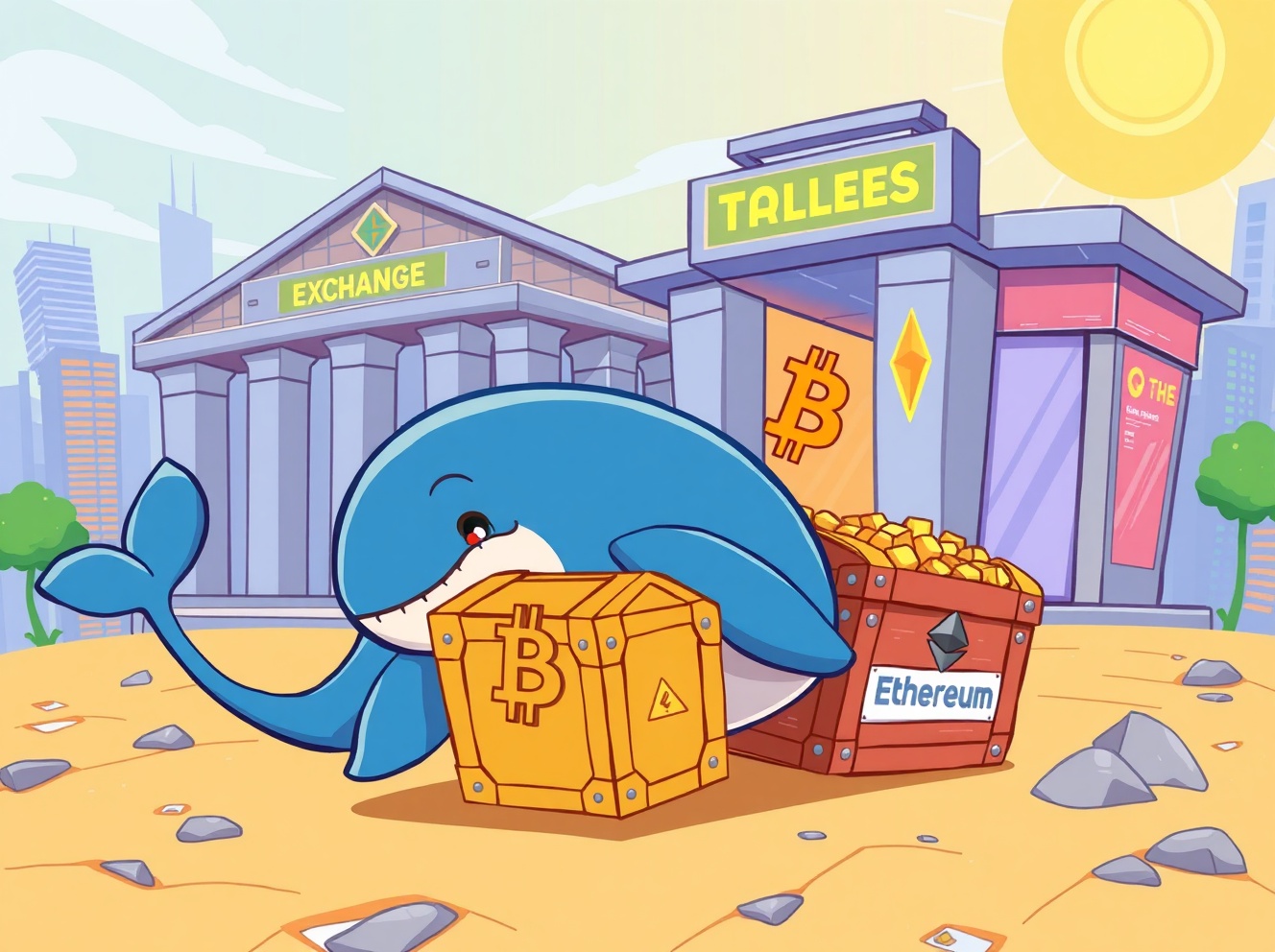
Cartoon illustration of a QCP Capital deposit as a whale moving crypto treasure to an exchange, symbolizing a major market transfer.

BitcoinWorld

Revealing: QCP Capital’s $36.3 Million Crypto Deposit to Binance Signals Key Market Move

A significant on-chain movement has captured the attention of crypto analysts. Trading firm QCP Capital executed a substantial QCP Capital deposit of Bitcoin and Ethereum to Binance, a move often scrutinized for its potential market implications. This transaction, involving tens of millions in value, provides a real-time case study in institutional behavior and its ripple effects.

What Does the QCP Capital Deposit to Binance Mean?

On-chain analytics provider OnchainLenz reported the transaction. A wallet linked to QCP Capital transferred 400 BTC (worth ~$35.7M) and 200 ETH (worth ~$597K) to the Binance exchange. In the crypto ecosystem, large deposits from private wallets to centralized exchanges are frequently interpreted as preparatory steps for selling. This QCP Capital deposit therefore acts as a potential indicator of near-term selling pressure, offering a glimpse into the strategic moves of a major player.

Why Do Large Exchange Deposits Matter for Crypto Prices?

Understanding this flow is crucial for market sentiment. When assets move to an exchange, they typically become more liquid and readily available for sale. Consequently, the market often views such movements with caution. However, it’s not a definitive sell signal. The deposit could also precede other activities like:

  • Collateralization for trading derivatives or loans.
  • OTC (Over-the-Counter) desk facilitation for a large private sale.
  • Simple portfolio rebalancing between cold storage and active trading accounts.

Therefore, while the QCP Capital deposit is a significant data point, it requires context alongside other market factors.

How Can Traders Interpret Institutional Moves Like This?

For individual investors, reacting to single transactions is risky. The key is to integrate this information into a broader analysis. This specific QCP Capital deposit highlights the importance of monitoring on-chain data. By watching the flows of large holders, often called “whales,” traders can gauge potential shifts in supply and demand. The actionable insight here is vigilance, not immediate action. Watch for follow-up on-chain activity, such as if the funds are withdrawn back to cold storage or if large sell orders appear on Binance’s order books.

What Are the Broader Implications for Bitcoin and Ethereum?

This event underscores the mature, institutional nature of today’s crypto markets. Firms like QCP Capital manage enormous portfolios, and their operational moves can influence short-term volatility. For Bitcoin and Ethereum, such deposits test market depth and resilience. A successful absorption of potential selling pressure from a $36.3 million QCP Capital deposit would demonstrate strong underlying demand. Conversely, it could trigger a brief downturn if the market sentiment is already fragile.

Conclusion: Decoding the Signal from the Noise

The recent QCP Capital deposit to Binance is a powerful reminder that crypto markets are transparent ledgers. Major moves are visible to all, providing valuable, if sometimes ambiguous, signals. While it suggests a potential increase in sell-side liquidity, smart traders will use it as one piece of a larger puzzle, combining it with technical analysis, macroeconomic trends, and other on-chain metrics before making decisions.

Frequently Asked Questions (FAQs)

Q1: Is the QCP Capital deposit a guaranteed sign they will sell?
A: Not guaranteed. While often a precursor to selling, large exchange deposits can also be for collateral, OTC trades, or fund management.

Q2: How was the wallet identified as belonging to QCP Capital?
A: Analytics firms use clustering heuristics, past transaction patterns, and known addresses to label wallets, though it’s often an educated presumption.

Q3: Should I sell my Bitcoin because of this news?
A> Making a trading decision based on a single transaction is not advisable. Use it as contextual data within your overall strategy.

Q4: What is the difference between an exchange deposit and a transfer?
A: A deposit to an exchange moves funds into its custodial wallet for trading. A transfer between two private wallets does not directly increase immediate sell pressure.

Q5: Where can I track similar on-chain transactions?
A: Platforms like Etherscan, Blockchain.com explorers, and dedicated analytics services like Glassnode or Nansen provide this data.

Found this analysis of the QCP Capital deposit insightful? Help others navigate the crypto markets by sharing this article on X (Twitter), LinkedIn, or Telegram. Your share helps build a more informed community!

To learn more about the latest crypto market trends, explore our article on key developments shaping Bitcoin and Ethereum price action and institutional adoption.

This post Revealing: QCP Capital’s $36.3 Million Crypto Deposit to Binance Signals Key Market Move first appeared on BitcoinWorld.

Market Opportunity
Movement Logo
Movement Price(MOVE)
$0.03528
$0.03528$0.03528
-7.52%
USD
Movement (MOVE) Live Price Chart
Disclaimer: The articles reposted on this site are sourced from public platforms and are provided for informational purposes only. They do not necessarily reflect the views of MEXC. All rights remain with the original authors. If you believe any content infringes on third-party rights, please contact service@support.mexc.com for removal. MEXC makes no guarantees regarding the accuracy, completeness, or timeliness of the content and is not responsible for any actions taken based on the information provided. The content does not constitute financial, legal, or other professional advice, nor should it be considered a recommendation or endorsement by MEXC.

You May Also Like

Why 100 Percent Test Coverage is Not Possible — Lessons from Testing Banking and Healthcare Systems

Why 100 Percent Test Coverage is Not Possible — Lessons from Testing Banking and Healthcare Systems

Quality is not about testing everything; quality is about testing what is most important.
Share
Hackernoon2025/12/26 16:05
US eyes crypto mining at disputed nuclear plant in Russia-Ukraine conflict: report

US eyes crypto mining at disputed nuclear plant in Russia-Ukraine conflict: report

The plant is located in Ukraine and has been under Russian control since 2022, with its future management a key issue in peace talks.
Share
Coinstats2025/12/26 18:58
Google's AP2 protocol has been released. Does encrypted AI still have a chance?

Google's AP2 protocol has been released. Does encrypted AI still have a chance?

Following the MCP and A2A protocols, the AI Agent market has seen another blockbuster arrival: the Agent Payments Protocol (AP2), developed by Google. This will clearly further enhance AI Agents' autonomous multi-tasking capabilities, but the unfortunate reality is that it has little to do with web3AI. Let's take a closer look: What problem does AP2 solve? Simply put, the MCP protocol is like a universal hook, enabling AI agents to connect to various external tools and data sources; A2A is a team collaboration communication protocol that allows multiple AI agents to cooperate with each other to complete complex tasks; AP2 completes the last piece of the puzzle - payment capability. In other words, MCP opens up connectivity, A2A promotes collaboration efficiency, and AP2 achieves value exchange. The arrival of AP2 truly injects "soul" into the autonomous collaboration and task execution of Multi-Agents. Imagine AI Agents connecting Qunar, Meituan, and Didi to complete the booking of flights, hotels, and car rentals, but then getting stuck at the point of "self-payment." What's the point of all that multitasking? So, remember this: AP2 is an extension of MCP+A2A, solving the last mile problem of AI Agent automated execution. What are the technical highlights of AP2? The core innovation of AP2 is the Mandates mechanism, which is divided into real-time authorization mode and delegated authorization mode. Real-time authorization is easy to understand. The AI Agent finds the product and shows it to you. The operation can only be performed after the user signs. Delegated authorization requires the user to set rules in advance, such as only buying the iPhone 17 when the price drops to 5,000. The AI Agent monitors the trigger conditions and executes automatically. The implementation logic is cryptographically signed using Verifiable Credentials (VCs). Users can set complex commission conditions, including price ranges, time limits, and payment method priorities, forming a tamper-proof digital contract. Once signed, the AI Agent executes according to the conditions, with VCs ensuring auditability and security at every step. Of particular note is the "A2A x402" extension, a technical component developed by Google specifically for crypto payments, developed in collaboration with Coinbase and the Ethereum Foundation. This extension enables AI Agents to seamlessly process stablecoins, ETH, and other blockchain assets, supporting native payment scenarios within the Web3 ecosystem. What kind of imagination space can AP2 bring? After analyzing the technical principles, do you think that's it? Yes, in fact, the AP2 is boring when it is disassembled alone. Its real charm lies in connecting and opening up the "MCP+A2A+AP2" technology stack, completely opening up the complete link of AI Agent's autonomous analysis+execution+payment. From now on, AI Agents can open up many application scenarios. For example, AI Agents for stock investment and financial management can help us monitor the market 24/7 and conduct independent transactions. Enterprise procurement AI Agents can automatically replenish and renew without human intervention. AP2's complementary payment capabilities will further expand the penetration of the Agent-to-Agent economy into more scenarios. Google obviously understands that after the technical framework is established, the ecological implementation must be relied upon, so it has brought in more than 60 partners to develop it, almost covering the entire payment and business ecosystem. Interestingly, it also involves major Crypto players such as Ethereum, Coinbase, MetaMask, and Sui. Combined with the current trend of currency and stock integration, the imagination space has been doubled. Is web3 AI really dead? Not entirely. Google's AP2 looks complete, but it only achieves technical compatibility with Crypto payments. It can only be regarded as an extension of the traditional authorization framework and belongs to the category of automated execution. There is a "paradigm" difference between it and the autonomous asset management pursued by pure Crypto native solutions. The Crypto-native solutions under exploration are taking the "decentralized custody + on-chain verification" route, including AI Agent autonomous asset management, AI Agent autonomous transactions (DeFAI), AI Agent digital identity and on-chain reputation system (ERC-8004...), AI Agent on-chain governance DAO framework, AI Agent NPC and digital avatars, and many other interesting and fun directions. Ultimately, once users get used to AI Agent payments in traditional fields, their acceptance of AI Agents autonomously owning digital assets will also increase. And for those scenarios that AP2 cannot reach, such as anonymous transactions, censorship-resistant payments, and decentralized asset management, there will always be a time for crypto-native solutions to show their strength? The two are more likely to be complementary rather than competitive, but to be honest, the key technological advancements behind AI Agents currently all come from web2AI, and web3AI still needs to keep up the good work!
Share
PANews2025/09/18 07:00