Dogecoin enters 2026 stuck in a quiet downtrend, trading near $0.12 as Wall Street forecasts another cautious year of gains.Dogecoin enters 2026 stuck in a quiet downtrend, trading near $0.12 as Wall Street forecasts another cautious year of gains.

Will 2026 Be Dogecoin’s Comeback Year Amid Wall Street Optimism?

The closing stretch of 2025 hasn’t been kind to Dogecoin holders. Once a retail favorite, Dogecoin price has quietly slid into a prolonged downtrend, trading near $0.125 with little sign of strong accumulation. Yet, as Wall Street heads into 2026 with guarded optimism—driven by expectations of rate cuts, resilient U.S. growth, and another leg in the AI-driven rally—crypto investors are asking the same question: could this macro momentum lift DOGE price out of its slump, or will it remain a laggard?

Dogecoin Price Prediction: What Wall Street’s 2026 Outlook Means for Crypto

Analysts across major institutions see 2026 as a continuation of the current bull cycle in equities, though with growing caution. The Federal Reserve’s expected rate cuts, a looser fiscal stance, and AI-related capital spending are seen as catalysts for another year of gains. Historically, crypto tends to benefit from liquidity expansion and lower real yields—conditions that often follow rate cuts.

However, the nuance lies in risk appetite. While the S&P 500 eyes modest 5% upside, the growing skepticism around tech valuations and the AI “bubble” narrative signals possible volatility. For crypto, that means correlation spikes: any equity pullback or tech-driven selloff could quickly spill over to digital assets. Dogecoin price, being more sentiment-driven than fundamentally tied to revenue-generating projects, remains especially vulnerable to those swings.

Dogecoin Price Prediction: Weak Momentum and Sideways Drift
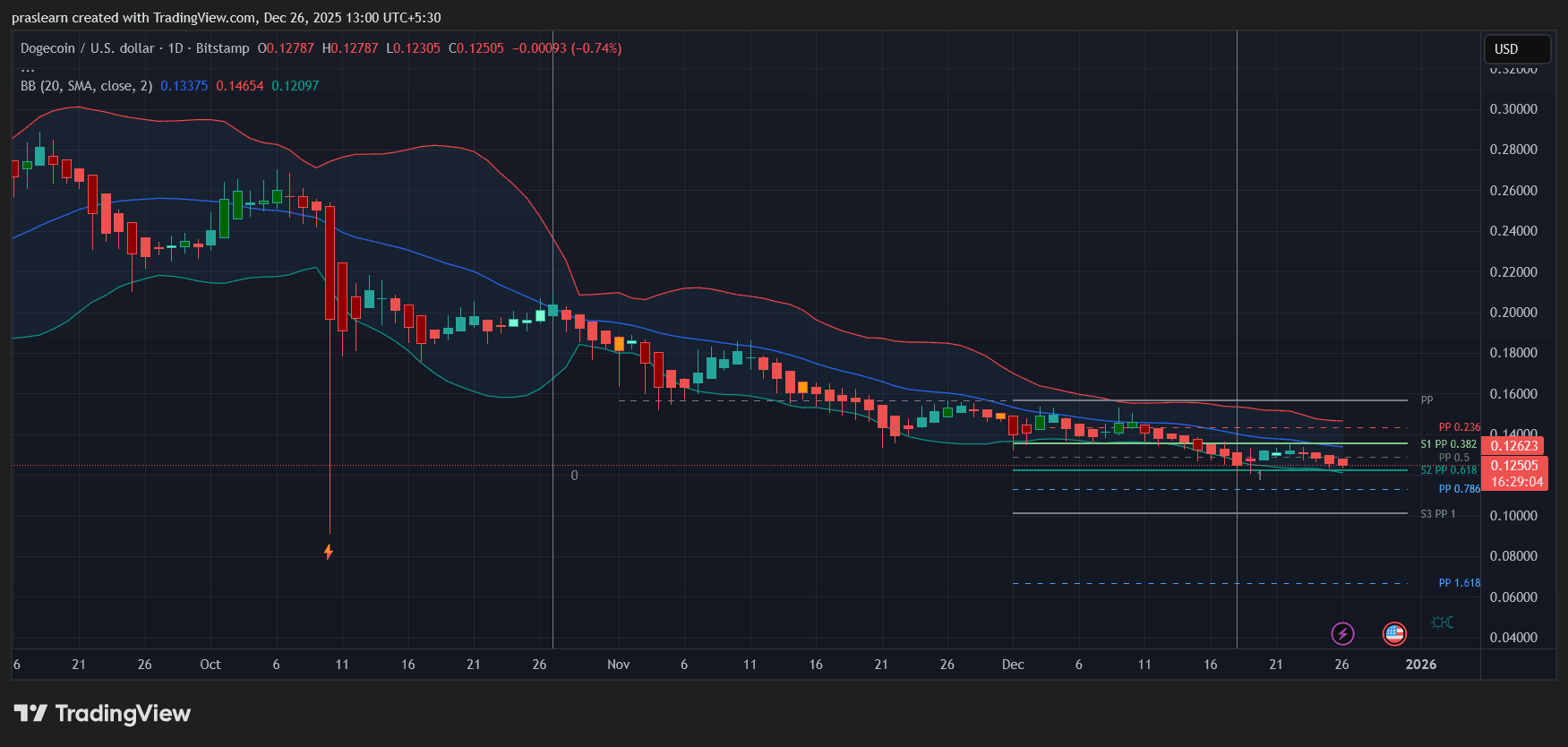
Dogecoin Price PredictionDOGE/USD Daily Chart- TradingView

The daily TradingView chart paints a clear picture of exhaustion. Dogecoin price continues to hover below both its 20-day and 50-day moving averages, signaling that bearish pressure remains dominant. The Bollinger Bands have narrowed sharply—a textbook sign of volatility compression that often precedes a breakout.

Right now, DOGE price trades near the lower midline of the Bollinger Band ($0.125), showing weak momentum and lack of volume spikes. The pivot levels drawn on the chart highlight $0.13–$0.14 as the near-term resistance zone, while $0.12 and $0.10 act as key supports. Repeated tests of this lower range without strong rebounds suggest that sellers are still in control.

Unless Dogecoin price decisively closes above $0.145, any short-term bounce is likely to be sold into. The technical posture is neutral-to-bearish, with the risk of retesting $0.10 if macro sentiment turns risk-off.

Sentiment Check: Retail Fades, Liquidity Thins

Unlike early bull runs driven by retail frenzy, current DOGE price participation metrics tell a quieter story. Trading volumes have steadily declined since November, while social mentions are down compared to last year. The fading meme narrative, combined with competition from other AI-themed or DeFi tokens, has pushed Dogecoin price lower on traders’ priority lists.

That said, there’s still a subtle bullish argument: the token is holding above its psychological support near $0.10, and long-term holders haven’t significantly capitulated. Historically, such quiet phases often precede trend reversals—but only after broader market confirmation.

Key Levels to Watch in Early 2026

  • Resistance: $0.135 → $0.145 – closing above this range could trigger a short-term relief rally toward $0.16.
  • Support: $0.12 → $0.10 – breaking below $0.10 risks a deeper slide toward $0.085.
  • Volatility signal: Watch the Bollinger Band breakout direction in January. A decisive move outside the current squeeze could define the first-quarter trend.

Momentum indicators like RSI (not shown on this chart) likely hover near the neutral 40–45 zone, hinting at consolidation rather than a reversal. A breakout accompanied by a volume spike would be the first sign of renewed accumulation.

2026 Dogecoin Price Prediction: Modest Gains, Cautious Optimism

Assuming Wall Street’s expectations play out—rate cuts, stable growth, and controlled inflation—DOGE price could slowly climb back toward $0.18–$0.20 by mid-2026. But that recovery hinges on Bitcoin maintaining above $70K and altcoin rotations picking up again.

If macro volatility rises or risk assets correct in the first half of 2026, Dogecoin price might revisit the $0.10 region before rebounding later in the year. A breakout beyond $0.20 would require a fresh retail narrative, possibly linked to social media adoption or a new meme cycle.

In short: 2026 may not be $DOGE breakout year, but it could be a year of quiet rebuilding. Patience will matter more than hype.

Market Opportunity
NEAR Logo
NEAR Price(NEAR)
$1.528
$1.528$1.528
+1.93%
USD
NEAR (NEAR) Live Price Chart
Disclaimer: The articles reposted on this site are sourced from public platforms and are provided for informational purposes only. They do not necessarily reflect the views of MEXC. All rights remain with the original authors. If you believe any content infringes on third-party rights, please contact service@support.mexc.com for removal. MEXC makes no guarantees regarding the accuracy, completeness, or timeliness of the content and is not responsible for any actions taken based on the information provided. The content does not constitute financial, legal, or other professional advice, nor should it be considered a recommendation or endorsement by MEXC.

You May Also Like

Why 100 Percent Test Coverage is Not Possible — Lessons from Testing Banking and Healthcare Systems

Why 100 Percent Test Coverage is Not Possible — Lessons from Testing Banking and Healthcare Systems

Quality is not about testing everything; quality is about testing what is most important.
Share
Hackernoon2025/12/26 16:05
US eyes crypto mining at disputed nuclear plant in Russia-Ukraine conflict: report

US eyes crypto mining at disputed nuclear plant in Russia-Ukraine conflict: report

The plant is located in Ukraine and has been under Russian control since 2022, with its future management a key issue in peace talks.
Share
Coinstats2025/12/26 18:58
Google's AP2 protocol has been released. Does encrypted AI still have a chance?

Google's AP2 protocol has been released. Does encrypted AI still have a chance?

Following the MCP and A2A protocols, the AI Agent market has seen another blockbuster arrival: the Agent Payments Protocol (AP2), developed by Google. This will clearly further enhance AI Agents' autonomous multi-tasking capabilities, but the unfortunate reality is that it has little to do with web3AI. Let's take a closer look: What problem does AP2 solve? Simply put, the MCP protocol is like a universal hook, enabling AI agents to connect to various external tools and data sources; A2A is a team collaboration communication protocol that allows multiple AI agents to cooperate with each other to complete complex tasks; AP2 completes the last piece of the puzzle - payment capability. In other words, MCP opens up connectivity, A2A promotes collaboration efficiency, and AP2 achieves value exchange. The arrival of AP2 truly injects "soul" into the autonomous collaboration and task execution of Multi-Agents. Imagine AI Agents connecting Qunar, Meituan, and Didi to complete the booking of flights, hotels, and car rentals, but then getting stuck at the point of "self-payment." What's the point of all that multitasking? So, remember this: AP2 is an extension of MCP+A2A, solving the last mile problem of AI Agent automated execution. What are the technical highlights of AP2? The core innovation of AP2 is the Mandates mechanism, which is divided into real-time authorization mode and delegated authorization mode. Real-time authorization is easy to understand. The AI Agent finds the product and shows it to you. The operation can only be performed after the user signs. Delegated authorization requires the user to set rules in advance, such as only buying the iPhone 17 when the price drops to 5,000. The AI Agent monitors the trigger conditions and executes automatically. The implementation logic is cryptographically signed using Verifiable Credentials (VCs). Users can set complex commission conditions, including price ranges, time limits, and payment method priorities, forming a tamper-proof digital contract. Once signed, the AI Agent executes according to the conditions, with VCs ensuring auditability and security at every step. Of particular note is the "A2A x402" extension, a technical component developed by Google specifically for crypto payments, developed in collaboration with Coinbase and the Ethereum Foundation. This extension enables AI Agents to seamlessly process stablecoins, ETH, and other blockchain assets, supporting native payment scenarios within the Web3 ecosystem. What kind of imagination space can AP2 bring? After analyzing the technical principles, do you think that's it? Yes, in fact, the AP2 is boring when it is disassembled alone. Its real charm lies in connecting and opening up the "MCP+A2A+AP2" technology stack, completely opening up the complete link of AI Agent's autonomous analysis+execution+payment. From now on, AI Agents can open up many application scenarios. For example, AI Agents for stock investment and financial management can help us monitor the market 24/7 and conduct independent transactions. Enterprise procurement AI Agents can automatically replenish and renew without human intervention. AP2's complementary payment capabilities will further expand the penetration of the Agent-to-Agent economy into more scenarios. Google obviously understands that after the technical framework is established, the ecological implementation must be relied upon, so it has brought in more than 60 partners to develop it, almost covering the entire payment and business ecosystem. Interestingly, it also involves major Crypto players such as Ethereum, Coinbase, MetaMask, and Sui. Combined with the current trend of currency and stock integration, the imagination space has been doubled. Is web3 AI really dead? Not entirely. Google's AP2 looks complete, but it only achieves technical compatibility with Crypto payments. It can only be regarded as an extension of the traditional authorization framework and belongs to the category of automated execution. There is a "paradigm" difference between it and the autonomous asset management pursued by pure Crypto native solutions. The Crypto-native solutions under exploration are taking the "decentralized custody + on-chain verification" route, including AI Agent autonomous asset management, AI Agent autonomous transactions (DeFAI), AI Agent digital identity and on-chain reputation system (ERC-8004...), AI Agent on-chain governance DAO framework, AI Agent NPC and digital avatars, and many other interesting and fun directions. Ultimately, once users get used to AI Agent payments in traditional fields, their acceptance of AI Agents autonomously owning digital assets will also increase. And for those scenarios that AP2 cannot reach, such as anonymous transactions, censorship-resistant payments, and decentralized asset management, there will always be a time for crypto-native solutions to show their strength? The two are more likely to be complementary rather than competitive, but to be honest, the key technological advancements behind AI Agents currently all come from web2AI, and web3AI still needs to keep up the good work!
Share
PANews2025/09/18 07:00