US Markets Retreat Amid Contradictory Messaging on Iran Conflict

TLDR
- Major US equity indices declined Tuesday, with both the Dow and S&P 500 dropping approximately 0.5% amid uncertainty over Iran military operations.
- President Trump suggested the conflict might conclude “very soon,” while Defense Secretary Hegseth vowed continued operations until Iran’s defeat.
- A tanker explosion occurred near Abu Dhabi, and the UAE’s largest refinery suspended operations following a drone attack.
- Brent crude retreated to approximately $91 per barrel after approaching $120 on Monday, still up over 50% year-to-date.
- Critical inflation data arrives this week with Wednesday’s CPI and Friday’s PCE reports, though recent oil price surges won’t be reflected.
Wall Street experienced losses Tuesday morning as market participants struggled to interpret contradictory narratives emerging from both Washington officials and developments in the Iran theater. The inconsistent messaging created challenges for investors attempting to assess the conflict’s duration and its implications for energy markets and economic conditions.
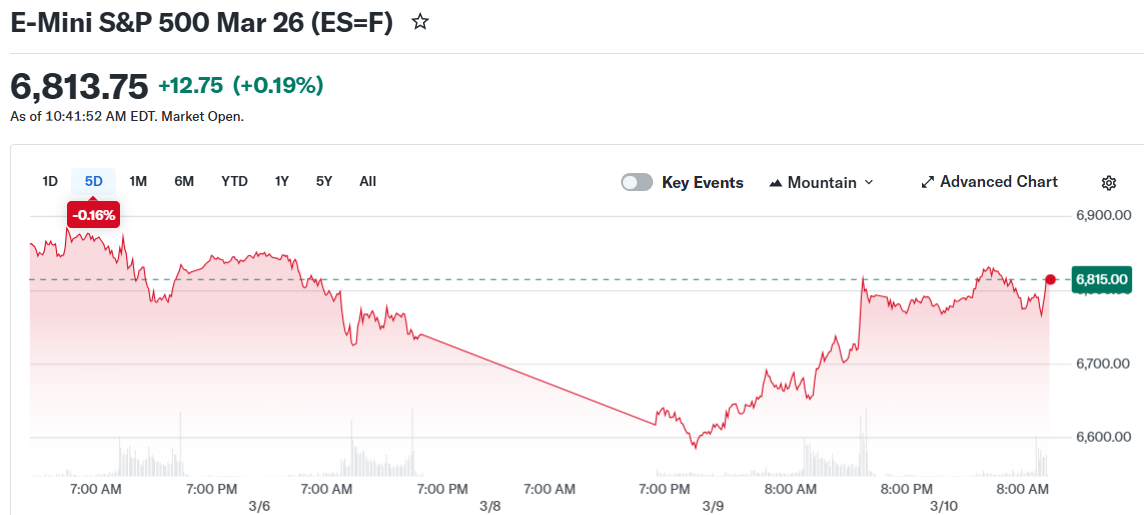 E-Mini S&P 500 Mar 26 (ES=F)
The Dow Jones Industrial Average declined approximately 0.5%, while the S&P 500 posted similar losses. The Nasdaq Composite fell roughly 0.3%. These declines followed Monday’s volatile trading session that ultimately closed with marginal gains.
Market sentiment deteriorated after Iranian state media outlets confirmed an oil tanker detonation near Abu Dhabi. This development undermined earlier optimistic statements from President Trump suggesting the conflict might conclude “very soon.”
During discussions with Republican congressional members, Trump indicated US forces had struck 5,000 Iranian targets, reducing the nation’s missile capabilities to approximately one-tenth of previous levels. He characterized the military goals as “pretty well complete.”
However, Defense Secretary Pete Hegseth delivered contrasting remarks during a Tuesday briefing. He announced the US was executing its “most intense” strike operations against Iran and pledged forces would “not relent” until achieving the Islamic Republic’s defeat.
Oil Prices and Global Supply Under Pressure
Israeli Prime Minister Benjamin Netanyahu declared operations were “not done yet” and initiated additional strikes targeting Tehran on Tuesday. Iran countered with drone and missile operations throughout the Middle East region, impacting the UAE, Bahrain, and Kuwait.
The UAE’s most significant refining facility at Ruwais ceased operations after a drone strike ignited a fire in proximity to the complex. Abu Dhabi National Oil Co. initiated damage assessments at the location.
Brent crude had surged to nearly $120 per barrel during early Monday trading before moderating to roughly $91 following Trump’s statements. West Texas Intermediate traded near $89. Both benchmarks remain elevated more than 50% compared to early January prices.
Saudi Arabia, Iraq, the UAE, and Kuwait have collectively reduced output by as much as 6.7 million barrels daily — representing approximately 6% of worldwide supply. The CEO of Saudi Aramco characterized the disruption as “the biggest crisis the region’s oil and gas industry has faced.”
Trump announced US Navy vessels would provide escort services for tankers navigating the Strait of Hormuz to maintain oil transportation. He also mentioned the possibility of waiving specific oil-related sanctions to support price reduction, though specific details remained unspecified.
Iran’s New Leadership and Path Forward
Iran appointed Mojtaba Khamenei as its new supreme leader on Sunday. His father, Ali Khamenei, perished when combined US-Israeli military operations commenced on February 28. The younger Khamenei maintains robust connections to the Islamic Revolutionary Guard Corps.
Iranian President Pezeshkian indicated Iran’s willingness to de-escalate hostilities, conditional upon neighboring nations ceasing to permit their territories for launching attacks against Iran. Iran’s foreign minister stated discussions with the US were not “on our agenda.”
The military operations have now extended to 11 days. Casualties exceed 1,300 Iranians, alongside seven US military personnel, two Israeli soldiers, and additional fatalities in Persian Gulf nations.
Two significant US inflation indicators arrive this week — Wednesday’s CPI release and Friday’s PCE data — though neither measurement will incorporate the recent petroleum price escalation.
Remember: Preserve all tokens like [[EMBED_0]], [[IMG_0]], [[LINK_START_0]], [[LINK_END_0]], [[SCRIPT_0]], [[FIGURE_0]] etc. exactly as they appear. These are placeholders for embeds, images, and links that must not be changed.
The post US Markets Retreat Amid Contradictory Messaging on Iran Conflict appeared first on Blockonomi.
You May Also Like

SDNY October retrial date for Tornado Cash’s Storm draws Uniswap comparison

Polymarket, Peter Thiel’s Palantir Eye ‘Surveillance Models’ for Sports Prediction Markets