

‘Bago pumutok ang Pinatubo, walang Aeta na nanglilimos’
This is the first of a three-part series examining how the Aeta resettlement community in Kalangitan in Capas, Tarlac fares 35 years after the eruption of Mount Pinatubo.
CAPAS, Tarlac – The road to the Kalangitan resettlement area doesn’t lead home for the Aetas who live here.
It starts from Bamban, just past the multi-story complex inextricably tied to the Alice Guo controversy, then runs into a four-lane stretch of road. A few months ago, lines of trucks lumbered down there to dump the collective filth of Central Luzon in the vast Kalangitan Sanitary Landfill.
On the other side of the road is Prayer Mountian, now stripped of its glory. Balding patches dot the landmark, and mounds of dirt and gravel pile up before it; word has it that it’s the beginnings of yet another golf course.
Then the road ends. Impeccably paved concrete gives way to a dry dirt path that rattles the wheels of any vehicle that dares to go over it. Here, the sun presses hard on our backs, and dust swirls up in gusts. And here, a community has been forced to make their home.
For those like Nelson de Guzman, old enough to remember another life, this was not the place their people first belonged to.
Yes, it inherited the same name – Kalangitan – and the same was true for the sitios Gayaman and Bagingan. But names can only carry slivers of memory, not recreate what had been lost. There were no more centipedes in Gayaman, no vines in Bagingan. This new Kalangitan, though named too after the sky, came with many earthly burdens.
“Nanibago kami dahil hindi namin lugar ito. Galing kamin doon e noong pumutok ‘yung Pinatubo,” Nelson said, remembering their ancestral lands along the slopes of the volcano. “Sa pinanggalingan namin, sagana kami sa kabuhayan. Hindi kami problemado, ‘di kagaya ditong maraming iniisip.”
(We were strangers to this place. We came from somewhere else, the land we had before Pinatubo erupted. Where we came from, livelihood was abundant. We didn’t worry the way we do here, where there’s always so much on our minds.)
The village elder of Gayaman, whose body bears the marks of six decades of work, spoke of those old days with fondness.
“Bago pumutok ‘yung Pinatubo, wala kaming problema sa buong baryo kung sa kabuhayan. Masisipag kami. Marami kaming alaga, at lahat ng pwedeng pakinabangan o ibenta, tinatamin namin.”
(Before Pinatubo erupted, no one in the barrio worried about how to make a living. We worked hard. We raised plenty of livestock, and we planted everything that could be useful or sold.)
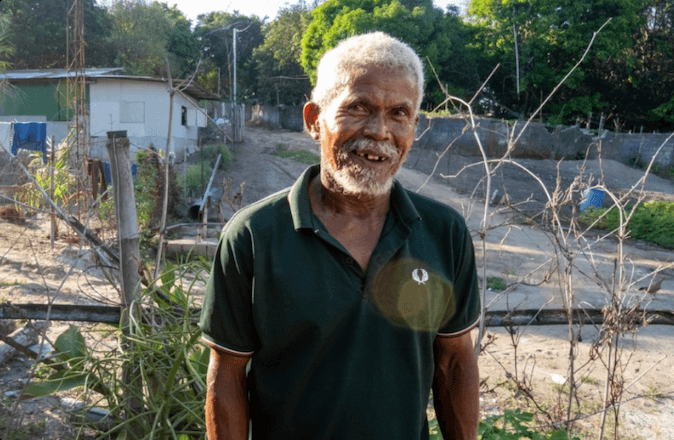 RESPECTED. Nelson de Guzman, village elder of Sitio Gayaman, poses in front of his house. Photo by Lance Spencer Yu.
In their ancestral lands, they grew rice, sweet potato, taro, corn, bananas, mangoes. The land was so rich that they had no need for fertilizers. Planting could be as simple as scattering seeds; irrigation as simple as blocking the stream with a banana leaf to bring the cool mountain water into the field. Before they even finished harvesting their first crop, another was already growing, soon ready to be gathered. They raised chickens, pigs, carabaos, and goats. If they wanted variety, they went to the river, which teemed with fish.
“Luta ay biyay (Land is life),” as the Aeta Mag-antsi say.
Then the land began to shake.
When the skies turned ashen
Thirty-five years after the eruption, those June days when the sky turned black remain scarred in the memories of those that lived through it.
Mount Pinatubo had lain dormant for centuries before its violent reawakening. But disaster already preceded the eruption. A magnitude 7.8 earthquake jolted Central Luzon in July 1990, causing landslides and a spike in steam emissions at Pinatubo before it settled back into a tenuous calm.
Months later came sulfur dioxide emissions and the march of magma to the surface. The government had sent out warnings, which did reach remote communities and led to some early evacuations. Nelson recalled listening to news reports on his transistor radio, warning of lava, smoke, and an imminent eruption. But for the Aetas who remained on the mountainside, the eruption came suddenly.
“Totoo naman, umapoy talaga ‘yung Pinatubo,” he said, describing a giant, cauliflower-like plume that reached into the heavens and the fire that spewed out. “Bago kami lumikas, sumabog na. Noong sinabi ng reporter na sumabog na, doon kami tumakbo.”
(It’s true, Pinatubo really did catch fire. Before we fled, it had already erupted. When the reporter said that it had exploded, that’s when we ran.)
After that came a dizzying list of relocations. First, they fled to Camp O’Donnell, carrying what clothes they could. Some tried to save their carabaos before lahar buried everything. A few weeks later, they were again on the move, this time on a dump truck to Camp Servillano Aquino.
The government finally resettled Nelson’s group to Sitio Dueg in San Clemente, by the border of Pangasinan. Dueg was also up in the mountains, which should have made it feel closer to home. But Nelson remembered it as an unwelcome place – cold, steep, deeply strange.
“Mataas ang lugar doon. Bundok din. Kaya lang ayaw namin doon, kahit tag-araw na ganito, malamig ang klima ng panahon,” he said, as the noontime sun seared our skin. “Matarik ‘yung daan. Hindi namin kabisado ‘yung lugar. Ibig sabihin, hindi kami naman tiga doon e. Puro mga ibang tao doon.”
(It’s also high up in the mountains too. But what we didn’t like about the place was the cold weather even during the day. The roads were trecherously steep and we were unfamiliar with the land. In other words, we didn’t come from this place. It was filled with other people.)
 PHONE. Aeta children crowd over a phone. Photo by Liwanag at Dunong.
Back then, Nelson was young, strong enough to endure the constant uprooting of his life. Others were not. The community still remembered how the cold of Dueg had claimed the life of one of their own. The elders eventually appealed to the mayor and governor to move them again. After more negotiations, they were brought to what is now Sitio Kalangitan – still far from perfect, Nelson said, but at least closer to their homeland.
‘Hindi namin alam kung mamatay na kami’
Over in neighboring Sitio Bagingan, Minda de la Cruz likewise remembered how easy life in the mountains was before the eruption.
“Mas maganda ang pakiramdam namin noong hindi pa pumutok ang bulkan,” Minda said. “Ulam ng bundok ang kinakain namin. Kahit na kamote, gabi, o ano […] Magtanim ka lang ng gulay, kahit hindi mo lagyan ng abono, pwede. Talagang sagana ang mga Aeta sa bundok, hindi tulad ngayon.”
(We were much better off before the volcano erupted. We ate the food of the mountains. Whether that was sweet potatos, taro, or anything else […] You just had to plant some crops, and it’d grow, even without fertilizers. Life for the Aetas of the mountains was abundant, unlike today.)
Minda came from another side of Mount Pinatubo, in the Zambales area. The Aeta community she belonged to spoke Botolan, not Mag-Antsi. Yet like Nelson and his group, their lives were also rooted in the land and its abundance.
That, too, changed after June 1991.
“Ang naaalala ko talaga, ‘yung putok ng Pinatubo, talagang halos hindi namin alam kung mamatay na kami, hindi namin alam kung saan kami pupuntang lugar,” Minda said. “Dumilim na ang panahon. Hindi na namin alam kung saan na kami. Grabe talaga.”
(I remember when Pinatubo erupted, we really didn’t know whether we’d live or die, or even where to go. Everything turned dark. We didn’t even know where we were. It was terrible.)
In the confusion, Minda recalled, families were scattered. There were children left behind, children whose parents had died, children remembered only after the adults had already fled to safety. By then, all anyone could do was go back, hoping for a miracle.
“Ang hirap talaga nang dinaan namin sa putok ng bulkan. Kung saan-saan kami umabot,” she said. (We endured such tough times when the volcano erupted. We ended up in all kinds of places.)
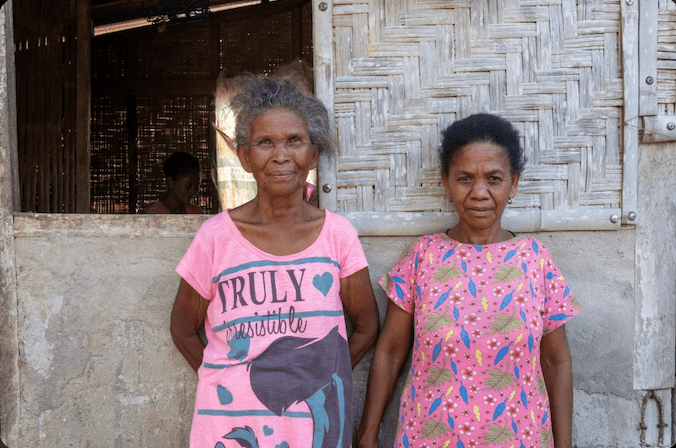 RELOCATED. Minda de la Cruz poses in front of her home in Sitio Bagingan, alongside Teresa. Photo by Lance Spencer Yu.
Minda was moved around too. From Zambales, she was brought to Camiling in Tarlac. After a while, the local government would have them relocated again, telling them they had to return closer to where they came from – an impossible ask when the place they came from had already been ruined by the eruption. At one point, she said, they were brought to what she remembered as Green City, likely a resettlment area near New Clark City.
“Noong naglipat kami sa Green City, putik-putik ‘yan. Banigan mo na lang ng mga sako para matulog kami doon. Walang silungan,” she said.
(When we were moved to Green City, the ground was all mud. We had to lay sacks on the soil just to have somewhere to sleep. There was no shelter.)
The moves continued. Sometimes, they stayed in one place for less than two months before being told to leave again. Like Nelson, she eventually reached Dueg before finally settling in Sitio Bagingan in Kalangitan.
Every move came the familiar struggle of finding a place to sleep, looking for livelihood, learning the ways of a new community and people, dreading the possibility that it could all fall apart once more.
It also meant learning to live among some unat — a term Aetas use for non-Aetas, literally referring to those with straight hair — who did not always want to live with them.
Minda recalled Kapampangan locals who taunted them as baluga or dark-skinned. All she could do was respond in kindness until they learned to accept her.
“Sabi namin, kahit baluga kami, hindi naman maitim ang budhi namin. Kahit na ganito kami naman, tama naman ang ginagawa namin, hindi katulad ng iba na magnakaw para lang kumain. Pero nagsawa na rin sila. Araw-araw na nila kaming nakikita. Marami na rin kaming mga kaibigan sa bayan.”
(We told them that even if we were baluga, our conscience was not dark. We were doing what was right. We were not stealing just to eat. Eventually, they got used to us. They saw us every day. Now, we have many friends in town.)
Even now, Minda and her friend Teresa remain, in some ways, migrants among the displaced. Most residents in Sitio Bagingan and Sitio Gayaman are Aeta Mag-Antsi. Back home in Zambales, Minda had identified as part of the Aetas from Botolan. But to live with the community, and to be understood by it, she learned to speak Mag-Antsi.
“Ngayon, nalipat kami dito, Aeta na kami ng Mag-antsi. Dito na rin kami nakipamuhay kaya nalipat ang lingwahe,” Minda said.
(Now that we were moved here, we became Aeta Mag-antsi. We’ve made our lives here, so we’ve adapted their language too.)
Despite it all, Minda has begun to make a life in Sitio Bagingan. She markets goods from farmlands, bringing them around the community and into town. On slower Sundays, she attends literacy classes at the nearby learning center. With little government support, she is slowly building a concrete house and putting her grandchildren through school.
But after years of moving from one place to another, the fear of being forced away looms. Some in the community whisper about the possibility that Bagingan may be affected by a road cutting through the area to New Clark City. There are no definite plans yet — just talk — but for Minda, even the possibility is enough to bring back old nightmares.
“Kung mawawala kami dito, kailangan ‘yung totoo talagang meron kaming paglipatan. Kasi kung tatamaan lang kami at sisirain, gigibain, at babayaran lang, saan na naman kami?” she said, her voice growing tired. “Kaya sinasabi namin sa manunungkulan: saan kami lilipat? Saan kami naman lilipat ulit?”
(If we’re going to be evicted from here, there has to be a real place set up for us. If the road hits our homes, if they’re just torn down, and we’re just paid off, then where are we supposed to move again? So we say to those in power: where will we move? Where will we be made to move again?)
‘Wala na kaming mga lupa na taniman’
Pinatubo’s eruption devastated broad swathes of Central Luzon, but the Aeta, who have built their economic and cultural life around the volcano, were hit especially hard. The stories of Nelson and Minda are only two accounts from a much larger displacement.
The Kalangitan resettlement area alone houses 400 displaced Aetas. Across the provinces of Zambales, Tarlac, Pampanga, an estimated 7,840 Aeta families, or more than 35,000 people, were impacted by the disaster.
The eruption was a natural calamity, but the government response compounded the difficulty faced by evacuees. In evacuation sites, tents offered only minimal shelter from heat during the day and damp conditions at night, while basic sanitation was absent. By early August 1991, 156 Aeta children had died in evacuation centers in Tarlac and Zambales from treatable diseases like measles, bronchopneumonia, and diarrhea, the Department of Social Welfare and Development reported. A more enduring wound is the issue of livelihood. Studies reviewing the Pinatubo resettlement process found it was often top-down driven and technocratic, with little meaningful consultation of those who would have to live through it. More than three decades after being evacuated, many in the Aeta community still struggle to recover the ease and abundance that elders associate with their ancestral lands.
“Bago pumutok ang Pinatubo, walang Aeta na nanglilimos (Before Pinatubo erupted, there were no Aeta begging),” Nelson said.
The village elder could not remember a single Aeta who begged before the eruption. After all, begging was never in their custom; they were always a close-knit community. They helped each other. They survived from the bountiful land that had sustained their ancestors.
“Kahit isang tao na katutubo, wala. Hindi namin ugali ‘yun,” he said. “Ang Pinatubo kasi ang gumawa ng paraan para makapaglimos ‘yung mga katutubo e, kasi walang hanapbuhay nga ‘yung tao dito.”
(Not even one of us – none. That’s not the way we do things. It was Pinatubo that made it so that some of us have to beg because people here were left without livelihood.)
In the resettlement areas, the soil is dry and poor; fertile farmland lies far away. Aeta farmers who still have access to parts of their ancestral land have to travel five hours by motorbike or as long as 12 hours by foot. Once there, they may stay for weeks to work the land.
“Hindi kami makapagtanim ngayon dahil kung hindi uulan ng malakas, hindi basa ang lupa,” Minda said, the dusty ground around us baked by the sun. “Wala na kaming mga lupa na taniman.”
(We can’t plant now because unless it rains hard, the soil doesn’t even get wet. We don’t have land to plant on anymore.)
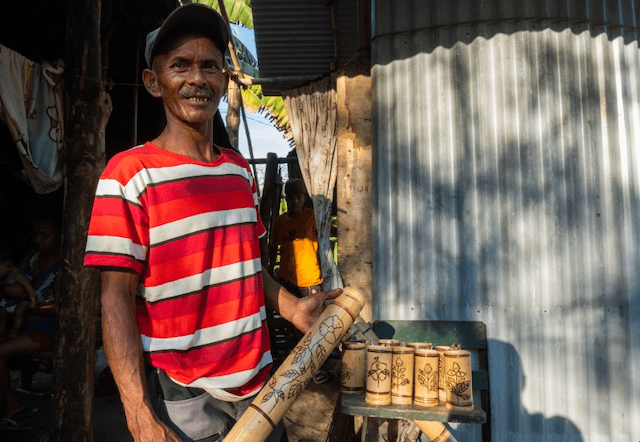 HANDCRAFTED. Some residents, like Kuya Oliver, earn by selling handmade items such as mugs decorated with local flowers and bows that come with a quiver of unsharpened arrows. Photo by Lance Spencer Yu.
The work available nearby the resettlement area is vastly different from the skills the Aeta had honed over centuries. Much of it is low-paid and insecure. Some resort to construction jobs. Others wash clothes, sell small goods like bracelets or handcrafted mugs, or work on nearby development projects.
For Maningning Vilog, grassroots organizing and advocacy lead for Liwanag at Dunong, the irony is difficult to miss. She talks of Aetas hired to plant, water, and landscape grass for projects built over the very ancestral lands that they were made to surrender. Much of the surrounding area was folded into what was then called Clark Green City, now New Clark City. Among the developments in the area is Hann Reserve, a South Korean-led, 450-hectare luxury estate with championship golf courses.
“‘Yung nagagawa ng golf course, siyempre, sisira ito ng kalikasan,” Vilog said. “Pero sa hirap ng buhay, ‘yung sinaraan ng kalikasan, sila rin ‘yung magtratrabaho sa construction. Wala silang choice e. Ganoon ‘yung nakakalungkot na realidad dito sa komunidad.”
(What the golf course does, of course, is destroy the environment. But because life here is so difficult, the same people who have had their land destroyed end up working on the construction. They have no choice. That is the sad reality of the community.)
This manicured green came at an immense personal cost that hit even the most respected members of the community, like Nelson. The village elder now lives in a concrete house, with small steps leading to a quaint roofed terrace. It stands apart from many others in the community. But he does not speak of it as a sign of comfort. To him, the house came from a terrible bargain over land he did not want to give up.
In 2013, the ancestral land that used to sustain him and his family was caught in the path of the Bases Conversion and Development Authority’s (BCDA) plans. The project: to build a “Green City,” later renamed New Clark City – part of a larger government push to bring investment and development to Central Luzon.
Until his relatives began to reason with him. There was no winning, they told him, against the government. One way or another, the land would be taken.
“E kaso, sinabihan ako ng mga uncle ko, ‘yung paglalaban mo yung lupa mo, wala kang mapapala. Sabi nila, ‘May pera sila. Anong gusto mo: bayaran o kukunin na walang bayad yan?”
(But my uncles told me, even if you fight for your land, nothing will come from it. They said, ‘They have money. What would you prefer: that they pay you for your land or that they take it without any payment?)
By then, he was the only one still standing in the way. A fourth person had also agreed to be paid. To him, the fight felt hopeless. After a long and difficult discussion with his wife, they decided to accept the compensation and use the money to build their own house.
“Ipaglaban ko man ‘yung karapatan ko, wala rin silbi kasi kukunin pa rin kung hindi ko ipapabayad. Kesa naman lalaban ka ng dahas, walang mapapala kundi mamatay ka lang.”
(Even if I fight for my right, it’d be pointless since they’d still take my land if I didn’t agree to be paid for it. If I fought back with force, I’d still gain nothing. I’d just wind up dead.)
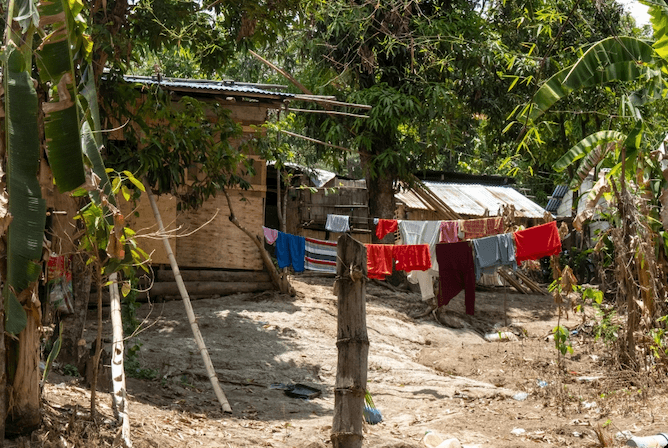 HOUSE. In Sitio Gayaman, wooden houses make up much of the community. Photo by Lance Spencer Yu.
According to Stum Casia, community organizing lead for Liwanag at Dunong, this sense of powerlessness is common in Kalangitan: that a government meant to uplift and protect becomes another source of fear.
They dread visits to the Tarlac Provincial Hospital, which, in the stories told here, can kill you straight away or slowly, through the financial burden left behind. They dread the low-paid work they take because there is little else to choose from. They dread the men from the city who arrive in their villages with papers they cannot read, asking for signatures or thumbmarks in exchange for relief goods – only for residents to later find out that they had given up their land in the process.
“Kung hindi natin ikukwento na mga katutubo dito, aagawin ‘yung lupa nila para gawing golf course, tapos sila yung gagawing taga-tanim ng bermuda grass sa golf course, wala pong makakaalam yan. Hindi po ‘yan aabot sa Maynila,” Casia said.
(If we don’t tell the story of the indigenous people here, how their land is taken and turned into a golf course, only for them to be hired afterward to plant Bermuda grass on the very same land, no one will know about it. It won’t reach Manila.)
But this is not a story of loss alone. The community has begun to fight back through education, with the heartfelt conviction that it is the road to reclaiming a true sense of home and abundance. – Rappler.com
Lance Spencer Yu is a former business journalist for Rappler. He previously covered how government policies and economic shocks affected vulnerable sectors, including onion farmers and jeepney drivers. He later worked as a private capital analyst at MSCI, and as an investment and strategy analyst at Dedale Intelligence, producing research for private equity funds and institutional investors.
Trisha Concepcion holds a Bachelor of Arts in Literature, major in Literary and Cultural Studies, from De La Salle University. Her experience spans education, cultural work, and research, including work in museum programming and indigenous heritage-related government projects. She has also taught under the Arts and Design Track at De La Salle University Senior High School, handling subjects in research, arts, culture, and literature. She is currently pursuing graduate studies in Anthropology.
Part 2 of this 3-part series will be published on Tuesday, June 16, and part 3 on Wednesday, June 17.
Philippines’ Aeta people ‘beggars’ in their own land
[ANALYSIS] Aetas and New Clark City: Trampling on human rights of our first peoples


You May Also Like

Oscar legend plans Jan. 6 film that could be 'nightmare' for Trump: report
This red state might attempt to alienate its Democratic voters

US ADP Employment Change 4-Week Average Dips to 25.5K, Signaling Cooling Labor Market



