

What we know so far about Samsung Galaxy Glasses
Table of contents
When and where
Why this launch matters more than usual
Design and specs of the Samsung Galaxy Glasses
At a glance
What’s next: the display model
Should you buy the Samsung Galaxy Glasses?
Samsung is getting ready to launch its first pair of smart glasses. Inside the company, the device is codenamed Jinju. In public materials, Samsung and Google currently refer to it as Intelligent Eyewear. You will probably know it by a simpler name once it ships, and most reports point to Samsung Galaxy Glasses.
This is a brand-new product category for Samsung. The company built these glasses with Gentle Monster and Warby Parker, two eyewear brands you have likely already seen in stores.
Here is everything we know about the Samsung Galaxy Glasses so far, including the price, release date, and specs.
When and where
Samsung is expected to unveil the glasses at Galaxy Unpacked on July 22, 2026, in London. This comes from a report by Seoul Economic Daily, a South Korean outlet with a strong track record on past Samsung announcements. Korea Economic Daily TV picked up the same date.
Samsung has not confirmed this date yet. The company usually sends out event invites two to three weeks ahead of Unpacked, so an official confirmation should land sometime in early July.
The same event is expected to introduce the Galaxy Z Fold 8, Galaxy Z Flip 8, Galaxy Z Fold 8 Wide, and Galaxy Watch 9 series. That puts five new products on one stage, making it one of Samsung’s biggest hardware days of the year.
Even if Samsung shows the glasses at Unpacked, you might not be able to buy them right away. Samsung’s own newsroom says the first collections are scheduled to launch this fall in select markets. Some reports expect a tease in July followed by a proper launch later, similar to how Samsung handled the Galaxy XR headset and Galaxy Ring before they reached stores.
Samsung has not announced pricing or availability for the UK, EU, or South Africa yet. Pound and euro prices you might come across online right now are simple currency conversions of the rumored US price, not confirmed regional pricing.
Why this launch matters more than usual
This launch carries more weight than a typical Samsung product reveal, for a few reasons.
This is Samsung’s second Android XR device, after the Galaxy XR headset, which launched on October 21, 2025, at $1,799.
Meta already controls most of this market. According to Counterpoint Research, Meta’s share of global smart glasses shipments rose to 82% in the second half of 2025, up from 73% in the first half of the year. AI-powered smart glasses made up 88% of all shipments during that period, and North America accounted for 37% of the market. Samsung is stepping into a space Meta already owns.
Samsung also beat Apple to market. Bloomberg’s Mark Gurman reported that Apple’s first smart glasses, known internally as N50, have slipped from a late 2026 introduction to a late 2027 launch. Apple is reportedly working through challenges with its visual AI and Siri, and its glasses are expected to cost between $200 and $500 once they ship. That gives Samsung and Google a big head start.
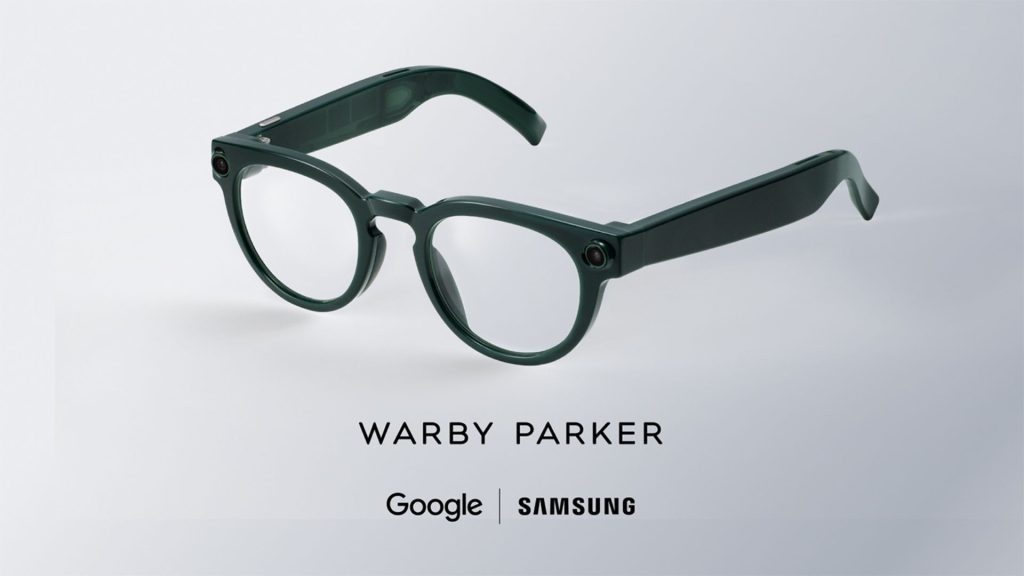 Image source: Samsung Mobile Press
Design and specs of the Samsung Galaxy Glasses
The first model skips a screen completely. There is no display and no AR overlay. Instead, the glasses lean on audio and a built-in camera that feeds visual information to Google Gemini. Leaked renders from Android Headlines and tipster OnLeaks show a pair of glasses that appear to be regular eyewear. They weigh around 50 grams, with thin temples and a camera built into the frame instead of sitting on top of it.
Samsung confirmed its partnership with Gentle Monster and Warby Parker for the glasses. Gentle Monster brings a bold, sharp look, while Warby Parker goes for a more classic style. Both brands showed off frames at Google I/O on May 19 and 20, 2026, and both companies say more styles and prescription lenses are coming later.
Here is what reports point to for the hardware, though none of this is officially confirmed by Samsung yet:
- A 12-megapixel Sony IMX681 camera with autofocus, placed at eye level
- A Qualcomm Snapdragon AR1 chip, possibly the newer AR1+ Gen 1 version
- Stereo speakers and multiple microphones for calls and voice commands
- Bluetooth 5.3 and Wi-Fi, with no built-in cellular connection
- Photochromic lenses that darken automatically in sunlight
- A touchpad on the right temple, plus an LED that lights up while the camera is recording
On software, the glasses run Android XR with Gemini built in. Gemini can translate signs and conversations as they happen, summarize your notifications, manage your calendar, play music, and take photos when your hands are full. The glasses pair with both Android phones and iPhones, and you can control some functions from a Galaxy Watch.
One spec that is still up in the air is battery size. Early leaks pointed to 155mAh. A more recent report from SamMobile, based on a certification filing, found a battery part numbered EB-BO200CAY rated at 245mAh, and Android Authority backed up the larger figure. The most likely explanation is that Samsung is building two different glasses models under the hood, with the smaller battery going to the basic version and the larger one going to a future model with a screen. For this first pair, the 245mAh figure is the better-sourced one right now, though you should treat it as unconfirmed until Samsung says otherwise. Outside estimates put battery life at around 6 to 8 hours of regular use, but that number has not come from Samsung either.
At a glance
What’s next: the display model
A second pair of Galaxy Glasses is already in the works, and this one adds a screen. Reports point to a micro-LED display built into the lenses for true AR overlays, with a launch sometime in 2027 and a price between $600 and $900. That would put it up against Meta’s Ray-Ban Display model.
The name for this second pair is not settled. Most outlets, including Android Headlines, The Verge, Engadget, and VR.org, use the codename Haean. A few sites use Hayen or Heian instead. Android Headlines reports that Haean was actually the name Samsung first used for the basic, no-display model before shifting it over to the display version, which likely explains the mix-up. Beyond the codename and rough price, details on this second pair are still thin.
Should you buy the Samsung Galaxy Glasses?
This is the first generation of Galaxy Glasses, so there is nothing older to compare it to. The question that matters is whether a screen-free, phone-connected pair of AI glasses is worth buying now.
Our take is that Samsung is playing it safe with this first release rather than swinging for something bigger. How worthwhile the glasses turn out to be will depend almost entirely on how well Gemini performs daily. The hardware itself, the AR1 chip, the 12-megapixel camera, the 50-gram frame, and the modest battery line up closely with what Meta already sells instead of beating it outright.
A few things work in Samsung’s favor:
- Frames designed with Gentle Monster and Warby Parker that actually look like something you would wear every day
- Deep integration with the rest of the Galaxy lineup
- Photochromic lenses and support for prescription lenses
- Compatibility with iPhones, not just Galaxy phones
A few things to keep in mind before you buy:
- You cannot see anything on a screen, since there is no display
- The glasses depend heavily on a paired phone to work
- Battery life looks modest based on information so far
- An always-on camera near your face raises privacy questions for the people around you
For most buyers, the smart move is to wait for hands-on reviews once the glasses ship and to wait for Samsung to confirm pricing. A few things would change our take: a confirmed price under $400, proof that Gemini performs better than Meta AI day-to-day, a verified battery life of eight hours or more, or a wider choice of frame styles at launch.


You May Also Like

Bitcoin World Reveals Top 5 Stunning Gainers And Losers

Cryptopolitan Launches Crypto Data Dashboards and Becomes the First Media Platform with Full Agentic AI Access

Hamster Kombat Daily Combo 20 June 2026: Play To Earn



