

What is Taiko (TAIKO)? Complete Guide for 2025
BitcoinWorld
What is Taiko (TAIKO)? Complete Guide for 2025
# What is Taiko (TAIKO)? Complete Guide for 2025
Taiko (TAIKO) is a decentralized, Ethereum-equivalent Layer-2 scaling solution that uses a novel “based rollup” architecture to achieve full Ethereum compatibility while dramatically reducing transaction costs and increasing throughput. Unlike traditional optimistic or ZK rollups, Taiko processes transactions in a way that mirrors Ethereum’s execution environment exactly, allowing developers to deploy existing Ethereum smart contracts without modification. For 2025, Taiko positions itself as a critical infrastructure for scaling Ethereum without sacrificing security or decentralization.
How Taiko Works: The Based Rollup Architecture
What Makes Taiko Different from Other Layer-2s?
Taiko employs a based rollup design, which means it relies on Ethereum’s Layer-1 validators for sequencing and proposing blocks, rather than running its own centralized sequencer. This approach eliminates the need for trust assumptions and reduces the risk of censorship or front-running that plagues some other rollups.
Key technical components include:
– Ethereum-equivalent execution: Taiko’s virtual machine (VM) is identical to Ethereum’s EVM, meaning any smart contract deployed on Ethereum runs on Taiko without changes.
– Decentralized proposers: Anyone can submit a Taiko block to Ethereum, ensuring no single entity controls transaction ordering.
– ZK-proofs for validation: While based rollups typically use optimistic fraud proofs, Taiko integrates zero-knowledge proofs to ensure faster finality and lower costs.
– Native bridging: Taiko uses Ethereum’s own validators for cross-chain messaging, reducing bridge-related risks.
This architecture results in transaction fees that are 90-95% lower than Ethereum mainnet while maintaining the same security guarantees.
Key Features of Taiko in 2025
1. Full EVM Compatibility
Developers can deploy existing Ethereum dApps on Taiko without rewriting code. This includes complex protocols like Uniswap, Aave, and MakerDAO. Taiko supports all Ethereum opcodes and precompiles, ensuring seamless migration.
2. Scalability and Throughput
Taiko can process 2,000+ transactions per second (TPS) on its current testnet, with plans to scale to 10,000 TPS by late 2025. This is achieved through parallel transaction execution and optimized proof generation.
3. Lower Fees with Security
Average transaction fees on Taiko are $0.01–$0.05, compared to Ethereum’s $1–$10 range. Despite this, the rollup inherits Ethereum’s full security model because validators must stake ETH to participate.
4. Decentralized Sequencing
Unlike Arbitrum or Optimism, Taiko does not rely on a single sequencer. Instead, anyone can become a proposer by staking TAIKO tokens, creating a permissionless environment that aligns with Ethereum’s ethos.
5. TAIKO Token Utility
The native TAIKO token serves multiple purposes:
– Staking: Proposers stake TAIKO to submit blocks and earn rewards.
– Governance: Token holders vote on protocol upgrades, fee parameters, and ecosystem grants.
– Gas fees: Users pay transaction fees in TAIKO, which are partially burned to create deflationary pressure.
Taiko vs. Other Layer-2 Solutions in 2025
| Feature | Taiko | Arbitrum | Optimism | zkSync |
|———|——-|———-|———-|——–|
| Architecture | Based rollup | Optimistic rollup | Optimistic rollup | ZK-rollup |
| Sequencer | Decentralized | Centralized | Centralized | Centralized |
| EVM compatibility | 100% | 99% | 99% | 95% |
| Finality | ~1 hour (ZK) | 7 days (fraud proof) | 7 days (fraud proof) | ~10 minutes |
| TPS | 2,000+ | 1,000 | 1,500 | 3,000 |
| Token | TAIKO | ARB | OP | ZK |
Taiko’s main advantage is its decentralized sequencing, which reduces centralization risks that other rollups face. However, it lags behind zkSync in finality and throughput.
How to Use Taiko in 2025
Getting Started
1. Set up a wallet: MetaMask, Rabby, or any EVM-compatible wallet works. Add the Taiko network (RPC details available on taiko.xyz).
2. Bridge assets: Use the official Taiko bridge to move ETH, USDC, or other tokens from Ethereum to Taiko. Bridge fees are typically $0.50–$2.
3. Explore dApps: Popular protocols like Curve, Aave, and Lens Protocol have deployed on Taiko. Check the ecosystem page for a full list.
4. Stake TAIKO: If you hold TAIKO, you can stake it via the Taiko staking interface to earn rewards (currently ~8% APY).
Use Cases
– DeFi trading: Swap tokens on decentralized exchanges with near-zero fees.
– NFT minting: Mint NFTs on Taiko for as little as $0.01.
– Gaming: Play blockchain games without high gas costs.
– Cross-chain applications: Build apps that use Ethereum for security and Taiko for execution.
Risks and Considerations for Taiko Investors
1. Competition from Established Players
Arbitrum and Optimism have massive liquidity and user bases. Taiko must attract developers and users to achieve network effects.
2. Tokenomics Uncertainty
TAIKO’s token supply is 1 billion, with 40% allocated to the community and ecosystem. However, inflation from staking rewards could dilute holders if adoption is slow.
3. Technical Complexity
Based rollups are relatively new, and the reliance on Ethereum validators introduces latency. If Ethereum faces congestion, Taiko’s throughput could suffer.
4. Regulatory Risks
As a scaling solution, Taiko may face scrutiny if regulators view it as an unregistered security or money transmitter.
5. Market Volatility
TAIKO’s price is highly correlated with Ethereum and the broader crypto market. A bear market could significantly impact returns.
Frequently Asked Questions
1. Is Taiko better than Arbitrum or Optimism?
Taiko offers full EVM compatibility and decentralized sequencing, which is superior to Arbitrum and Optimism in terms of trustlessness. However, Arbitrum and Optimism have larger ecosystems and more liquidity. For developers prioritizing security and decentralization, Taiko is a strong choice.
2. How do I buy TAIKO tokens?
TAIKO is available on centralized exchanges like Binance, Bybit, and KuCoin, as well as decentralized exchanges on Ethereum and Taiko itself. You can also earn TAIKO through staking or liquidity provision.
3. What is the TAIKO token price prediction for 2025?
Analysts predict TAIKO could trade between $5 and $15 by end of 2025, depending on adoption and market conditions. The token’s value is tied to network usage and the success of its based rollup model.
4. Is Taiko safe to use?
Yes, Taiko inherits Ethereum’s security through its based rollup design. However, as with any new protocol, there are risks from smart contract bugs or bridging exploits. Always use audited contracts and diversify your holdings.
5. Can I mine TAIKO tokens?
No, TAIKO is not mineable. It is distributed through staking, governance rewards, and ecosystem initiatives. However, you can earn TAIKO by running a proposer node or providing liquidity.
Conclusion
Taiko represents a paradigm shift in Layer-2 scaling by combining Ethereum’s security with decentralized sequencing and full EVM compatibility. For 2025, it offers a compelling alternative to centralized rollups, especially for developers who value trustlessness and users who want low fees without sacrificing security. While it faces stiff competition from established players, its unique architecture and growing ecosystem position it as a key player in Ethereum’s future. If you’re looking to scale your dApp or trade with minimal fees, Taiko is worth exploring. Start by bridging assets to the Taiko network today.
—
Frequently Asked Questions
What makes Taiko different from other Layer-2 solutions like Arbitrum or Optimism?
Taiko uses a ‘based rollup’ architecture that relies on Ethereum’s Layer-1 validators for sequencing, eliminating centralized sequencers and reducing risks like censorship or front-running.
Can I deploy my existing Ethereum smart contracts on Taiko without changes?
Yes, Taiko’s virtual machine is identical to Ethereum’s EVM, so any smart contract deployed on Ethereum runs on Taiko without any code modifications.
How much cheaper are transaction fees on Taiko compared to Ethereum mainnet?
Taiko offers transaction fees that are 90-95% lower than Ethereum mainnet while maintaining the same security guarantees.
Does Taiko use optimistic fraud proofs or zero-knowledge proofs?
Taiko integrates zero-knowledge proofs for faster finality and lower costs, though based rollups typically use optimistic fraud proofs.
How does Taiko handle cross-chain bridging and security?
Taiko uses Ethereum’s own validators for native cross-chain messaging, which reduces bridge-related risks compared to third-party bridges.
This post What is Taiko (TAIKO)? Complete Guide for 2025 first appeared on BitcoinWorld.


You May Also Like
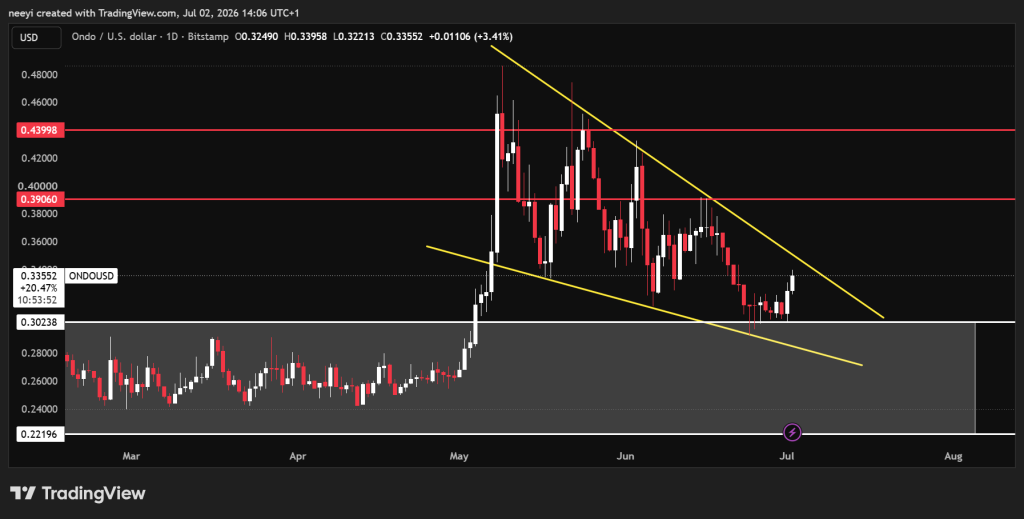
ONDO Price Jumps 8% Amid Bitcoin Recovery and RWA Catalysts: Is This a Trap for Buyers?

Gold Hits $3,700 as Sprott’s Wong Says Dollar’s Store-of-Value Crown May Slip


