

NVDA Stock Price Forecast as Nvidia Suffers Major Setback
Key Insights
- Nvidia stock has dropped substantially in the past few weeks.
- The company has suffered a setback by delaying its Vera Rubin rack system.
- The system, which was to be launched next year, will now be launched in 2028.
Nvidia stock price has pulled back sharply after reaching a record $236 in May. Shares recently traded near $194, leaving the stock largely flat for the year.
The retreat came as investors reassessed AI infrastructure spending and rising chip competition. Reports of delays to Nvidia’s Kyber rack architecture added another risk to the company’s hardware roadmap.
Nvidia Stock on Edge as it Delays AI Rack System
Nvidia, the biggest player in the GPU industry, is facing some major issues that may affect its growth in the coming years. Its Kyber rack-scale architecture, which is designed to house its next-generation Rubin Ultra chips, has been delayed by over 12 months to 2028.
Kyber is a key element that must be there when the company launches its Vera chip. That’s because it houses 144 of the chips into a single unit so that they can operate as one giant computer. Without it, Nvidia would have to sell the chip in 144 separate units.
A key part of the improvement from the current models is that it mounts its GPUs in vertical units instead of horizontally. By doing this, the company aims to reduce latency and boost its density.
Nvidia has suffered more setbacks recently, which explains why the stock has underperformed the market. For example, data center customers rejected its backup approach of bolting two of its current-generation racks together for similar power.
Competition is Rising and Signs of a Slowdown Emerging
There are other risks that the company is contending with today. For example, Nvidia is contending with signals that the AI business is slowing this year. For one, the Silicon Data LLM Token Expenditure Index has tumbled by nearly 20% from its peak in May. It had previously more than doubled since its launch in December.
This is an important metric that looks at the prices the sector commands for each unit of usage. A falling figure is a sign that there is too much computing power already, which is driving token prices lower. It could also be that demand is moving to cheaper AI models.
Just last week, there was a report that Meta Platforms was considering selling its extra space, a sign that it has reached internal capacity.
Meanwhile, there are signs that competition in the GPU industry is rising, a move that may affect its growth prospects in the future. A good example of this is OpenAI, one of the top consumers of Nvidia’s chips. The company recently unveiled its chip, which is built by Broadcom. If this chip is successful, OpenAI may shift some of its workloads there.
Another competition is coming from Google, which has built its TPU, which it now aims to sell to competitors. Top companies like Anthropic and Meta are some of the customers for these chips.
Microsoft and Amazon are also building their own chips, which they may use to replace Nvidia’s GPUs. Such a move would likely boost their shares, which have tumbled this year because of their robust spending.
NVDA Stock Price Technical Analysis
Technical analysis points to more NVDA stock retreat ahead of a rebound. On the positive side, the stock has formed the highly bullish falling wedge pattern, which normally leads to a strong rebound. Also, it sits above the 100 and 200-day moving averages.
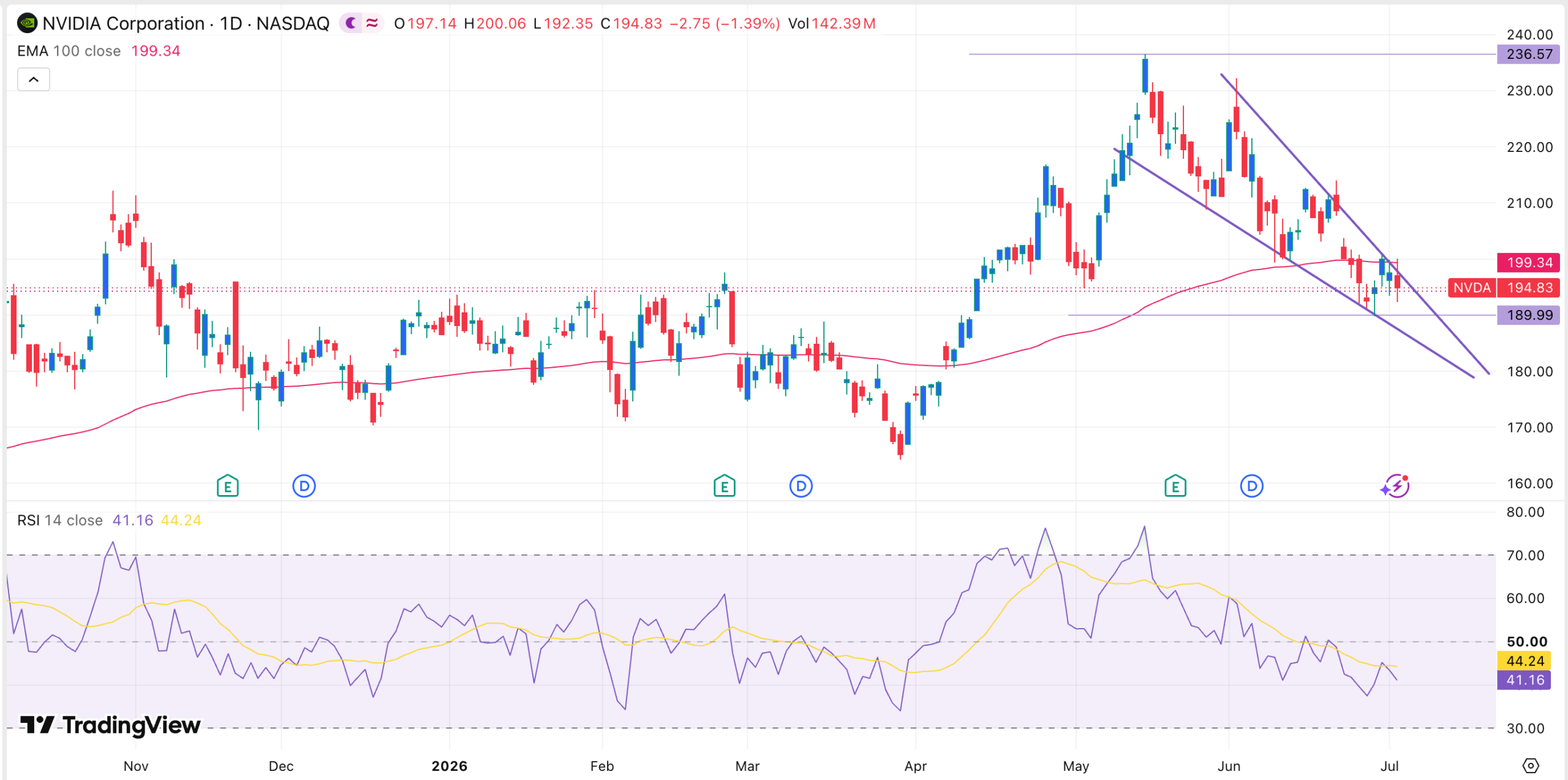 NVDA stock chart | Source: TradingView
However, oscillators suggest that the stock has some more downside in the near term. For one, the Relative Strength Index (RSI) has dropped from 75 to the current 41 and is pointing downwards. That is a sign that it is yet to get to the oversold level of 30.
As such, the stock may drop further in the near term as it approaches the extreme oversold level. If this happens, it will then bounce back and possibly retest the all-time high later this year.
The post NVDA Stock Price Forecast as Nvidia Suffers Major Setback appeared first on The Market Periodical.


You May Also Like

Son Bir Haftada En Fazla Aktif Kullanıcı Sayısına Sahip Altcoinler Açıklandı! Zirvede Sürpriz Var
Microsoft cuts 4,800 jobs as it revamps Xbox

Gold Spot Volume on Binance Surges to $80M as Demand Extends Beyond Futures



