

CLARITY Act Update: July 4 Goal Missed as Senate Vote Pressure Builds
Key Insights:
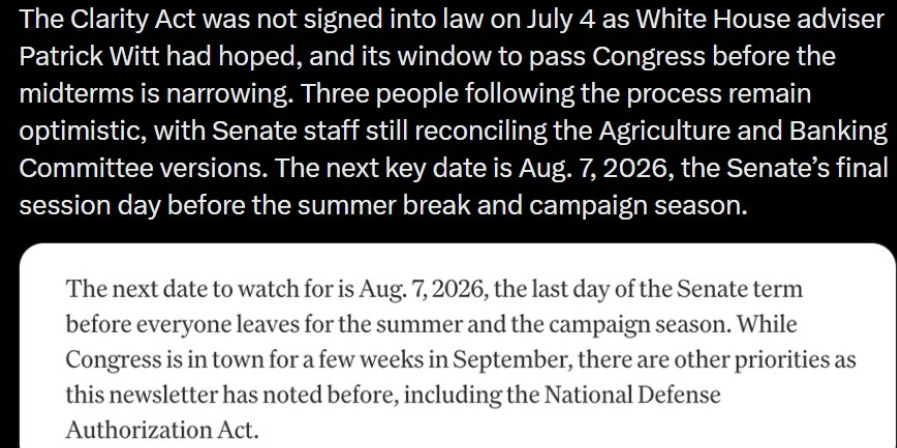
- July 4 passed without enactment, shifting CLARITY Act focus to the Senate’s Aug. 7 deadline.
- Senate staff still need to merge Banking and Agriculture versions before a full floor vote.
- Ethics rules, AML concerns, and the 60-vote threshold remain key Senate hurdles.
The CLARITY Act remains formally unfinished after missing the July 4 goal once linked to its passage. Senate attention has now shifted toward Aug. 7, the final session day before the summer break. Lawmakers still need to resolve committee differences before any floor vote can move ahead. The bill remains a central proposal for crypto market structure in Washington as negotiations continue.
CLARITY Act: Senate Work Continues After Missed July 4 Goal
The July 4 target passed without the CLARITY Act becoming law. The missed date has placed more attention on the Senate calendar, where lawmakers face limited time before leaving Washington. Supporters had hoped the bill could advance more quickly, but the process has remained tied up in committee work and vote counting.
Senate staff are still working to merge versions from the Banking and Agriculture committees. Both panels cover parts of digital asset policy, which makes a single Senate text necessary before floor action. A clean version would help senators review the final language before any vote.
 Clarity Act | Source: X
The bill has already cleared earlier stages in Congress. Reports said the measure passed the House, moved through the Senate Banking Committee, and reached the Senate calendar. It still needs a full Senate vote before it can move closer to the president’s desk.
Senate Text Remains the Next Step Before Floor Action
The Senate process now depends on whether staff can settle differences in the bill text. Lawmakers must align rules on digital asset trading, custody, consumer protection, and regulator authority. The bill seeks to divide oversight between the Securities and Exchange Commission and the Commodity Futures Trading Commission.
The measure would also set rules for crypto exchanges and customer funds. Reports said it would support fraud investigations and add safeguards for digital asset platforms. These provisions remain part of the wider attempt to create a clearer federal crypto framework.
Senator Bill Hagerty recently pointed to a Senate roadmap for the bill. That revived attention around whether final text could appear before lawmakers return from recess. Senator Cynthia Lummis has also urged Congress to keep the measure moving through the Senate process.
CLARITY Act Vote Count and Policy Disputes
The CLARITY Act likely needs 60 votes in the Senate to overcome procedural barriers. That means Republican sponsors need support from some Democrats before the measure can pass. The vote count remains a key issue as senators review the bill’s final form.
Policy disputes also remain part of the talks. Reports have pointed to ethics rules, anti-money laundering concerns, and political support as open questions. These issues could affect the pace of Senate action before the August break.
Section 604 has drawn close attention because it covers some non-custodial developers and software providers. Critics have raised concerns over law enforcement access and decentralized finance activity. Supporters say the section aims to protect builders who do not control customer funds.
Law Enforcement Positions Shift as Aug. 7 Deadline Nears
Backers gained more room after the Major County Sheriffs of America moved to a neutral position on the bill’s decentralized finance language. The group withdrew its objection while asking for more input from state and local law enforcement. That change reduced one area of public opposition to the Senate effort.
The National Organization of Black Law Enforcement Executives also supported the bill. Reports said the group viewed several provisions as useful for law enforcement while preserving existing criminal powers. The endorsement gave sponsors another public safety group to cite during talks.
The next test is Senate scheduling. If lawmakers do not act before Aug. 7, the bill may face a slower path as campaign activity rises.
The post CLARITY Act Update: July 4 Goal Missed as Senate Vote Pressure Builds appeared first on The Market Periodical.


You May Also Like

Was Michael Burry Right About Palantir? PLTR Is Still Down Over the Past Year

MAGA melts down as Bruce Springsteen torches Trump in new interview: 'He is a coward'

Microsoft (MSFT) Stock Drops as Company Announces 4,800 Layoffs Targeting Xbox



