

CLO Jumped 51% Today But The Order Flow Looks Automated, Not Organic.
CLO jumped 51% today on volume that looks bot-driven. One dormant wallet holds 56.8% of supply. Full on-chain research, verified.
Yei Finance’s CLO token gained more than fifty percent in twenty-four hours on July 8, 2026. Price moved from roughly $0.14 to $0.218, and trading volume on CoinGecko jumped over 400% against the day before.
That much is visible to anyone who opens a chart. What is less visible: the buy and sell counts behind that volume sit within a fraction of a percent of each other, a single dormant wallet controls more than half of everything in circulation, and nothing resembling a listing announcement or partnership news appears anywhere in the project’s official channels.
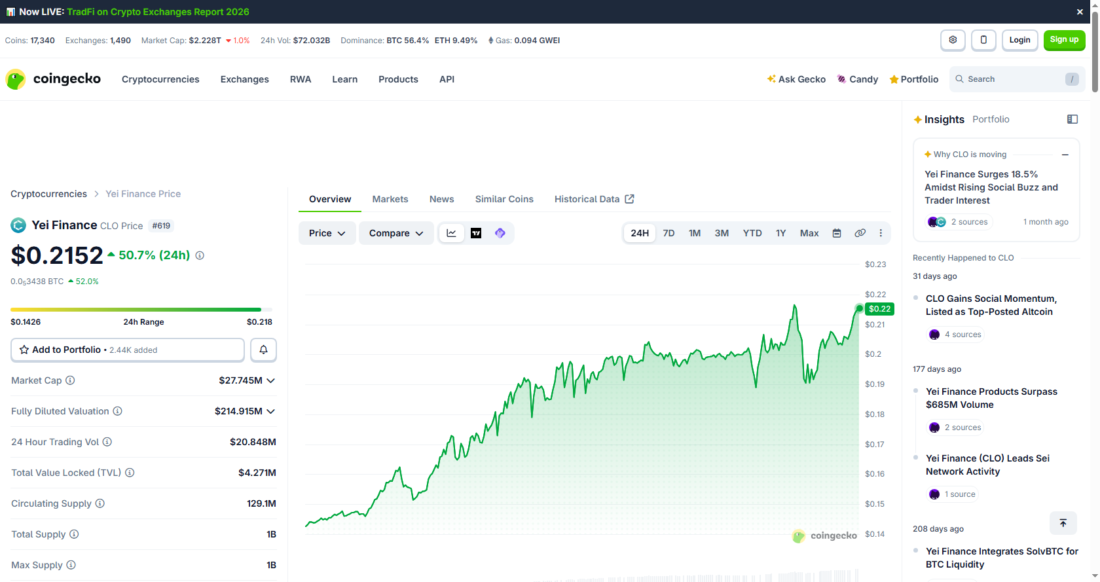
Yei Finance (CLO) on CoinGecko, July 8 2026: price $0.2152, up 50.7% in 24 hours, market cap $27.7M. Source: CoinGecko
Volume That Buys and Sells Itself
CLO’s real liquidity sits in a Pancakeswap Infinity CLMM pool that most standard DEX trackers miss entirely. DexScreener‘s API returns only a handful of thin secondary pools for this contract. The pool actually carrying the volume, a CLO/USDT pair, only shows up through GeckoTerminal.
That pool held about $1.7 million in liquidity and processed roughly $15.2 million in trades over 24 hours. Divide one by the other and volume equals 54.5% of the entire market cap turning over in a single day. High, but not automatically fake.
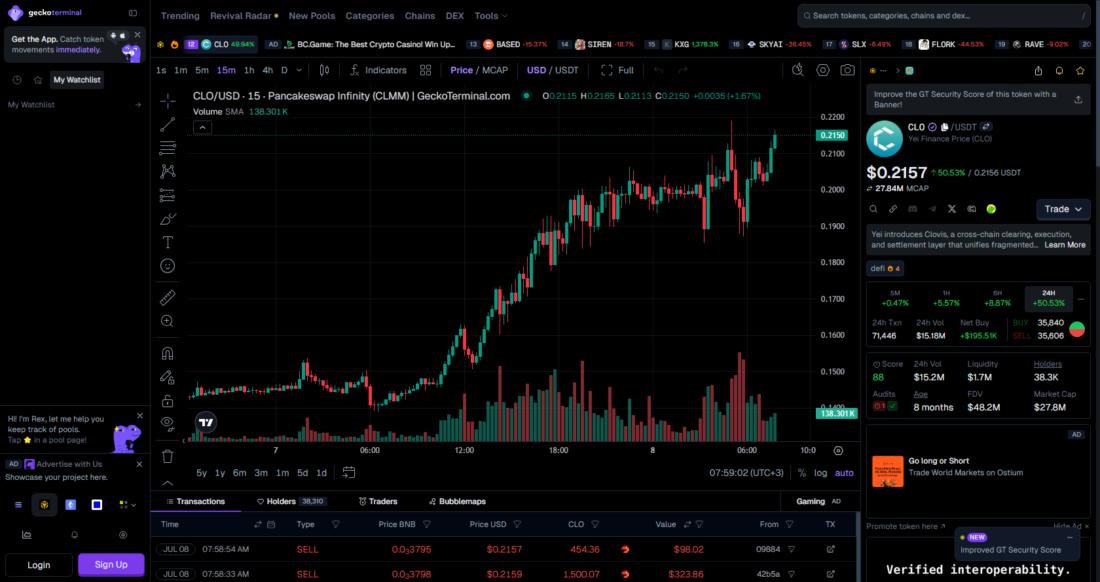
GeckoTerminal pool data for CLO/USDT on Pancakeswap Infinity CLMM: $15.2M 24h volume, 35,840 buys vs 35,606 sells. Source: GeckoTerminal
What tips it toward automated activity is the transaction count. Thirty-five thousand eight hundred and five buys against thirty-five thousand five hundred and forty-four sells in twenty-four hours. Move to the one-hour window and it holds: 1,362 buys, 1,422 sells. Net inflow across the whole day came to roughly $195,000, on $15.2 million of volume. One percent.
A single large buyer pushing a token up 50% usually leaves a lopsided buy-to-sell ratio behind. This pattern, buys and sells almost perfectly matched across multiple timeframes while price still climbs, is closer to what automated market-making or wash-trading activity produces. It does not prove either. It does mean the volume number by itself should not be read as organic demand.
The Wallet Holding More Than Half the Coins
The bigger structural fact sits in the holder table. BSCScan lists 38,057 CLO holders. Eleven of them own at least 1% of supply each. The Gini score for the distribution is 0.9984, close to the maximum possible inequality a token can have.
BSCScan top CLO holders: rank 1 wallet (unlabeled) holds 127,003,171 CLO, 56.82% of total supply. Source: BSCScan
One address, 0x5ECee36E…8c3EA7781, holds 127,003,171.84 CLO. That is 56.82% of everything that exists, worth about $27.4 million at current price. BSCScan has no label for it. It is not a known exchange wallet, and it is not tagged as a project treasury.
A quick call to the BNB Chain RPC settles one question fast: this address has no contract code attached to it. It is a plain wallet controlled by a private key, the kind that can move funds the instant its holder decides to, with no multisig, no timelock, no vesting schedule standing in the way.
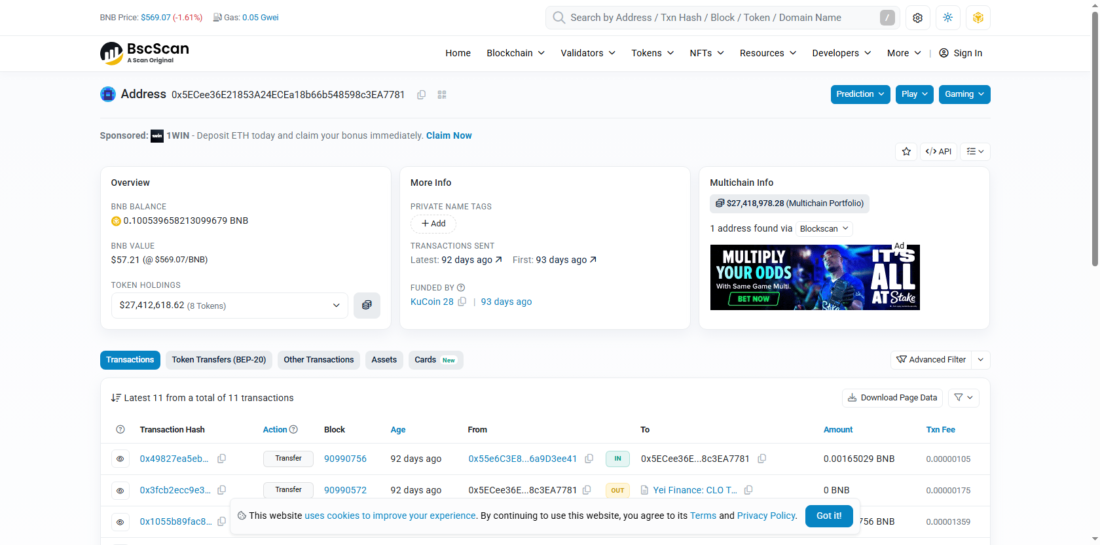
BSCScan address page for the top CLO holder: funded by KuCoin 28, first transaction 93 days before July 8 2026, dormant since. Source: BSCScan
Its history is short. The wallet received its first funding, a few cents worth of BNB for gas, from a labeled KuCoin wallet ninety-three days before this article, in early April 2026. Over the following nineteen hours it made eleven transactions. Then nothing. No outbound transfers, no swaps, no interaction with anything, for ninety-two straight days while sitting on a nine-figure position.
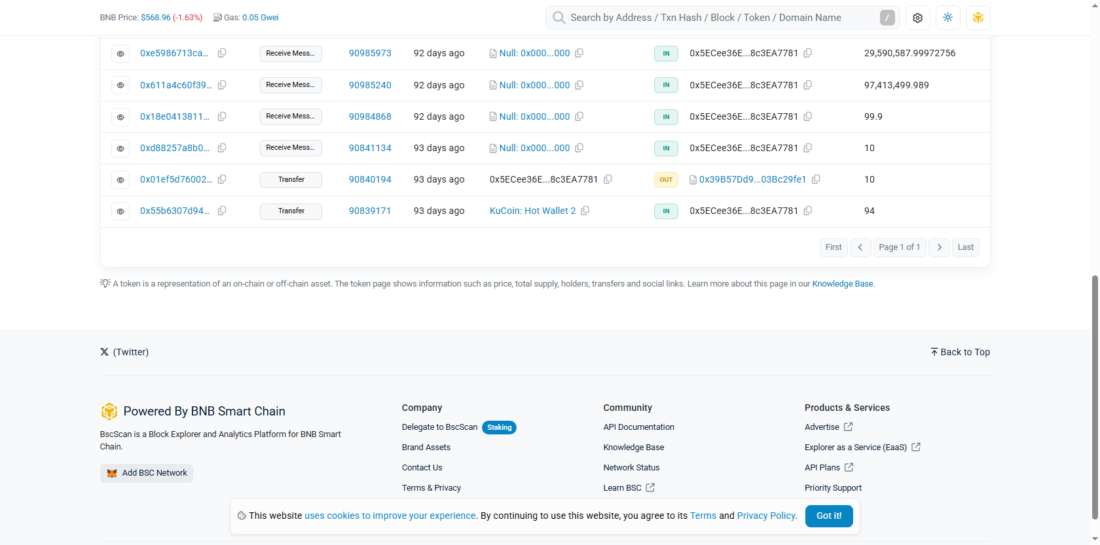
CLO token transfer history for the top holder wallet: two large inbound transfers from the null address totaling ~127 million CLO, labeled “Receive Message.” Source: BSCScan
The token transfer log explains where the balance came from. Two transfers, 29,590,587.99 CLO and 97,413,499.98 CLO, arrived from the null address under an action labeled “Receive Message.” That figure sums to almost exactly the wallet’s current holding. A transfer from the zero address with a message-relay label is the signature of a cross-chain mint, not a purchase or an internal transfer between holders. Reading the verified contract source confirms why: CLO implements Wormhole’s Native Token Transfer interface, the standard used to burn a token on one chain and mint the equivalent on another.
So this wallet most likely bridged a very large CLO position from another chain, probably Sei, into BSC six months after the token’s genesis, then went quiet. Whether it belongs to a market maker, an early backer, or someone connected to the team is not something the public record answers. Yei Finance’s own tokenomics documentation lists no specific wallet addresses for its allocation categories, so this position cannot be matched with certainty to Team, Treasury, or Ecosystem funds. It remains a large, real, currently inactive position that could move at any time with no on-chain restriction stopping it.
A Supply Number That Needed Checking Twice
CoinGecko lists CLO’s total and max supply at 1 billion tokens, producing a fully diluted valuation over $210 million against a $27.7 million market cap. That looked, on first pass, like a mismatch with what BSCScan shows on-chain. Yei’s own tokenomics documentation resolves it: the 1 billion figure is the project’s real, published, fixed cap. CoinGecko’s methodology is the correct one here.
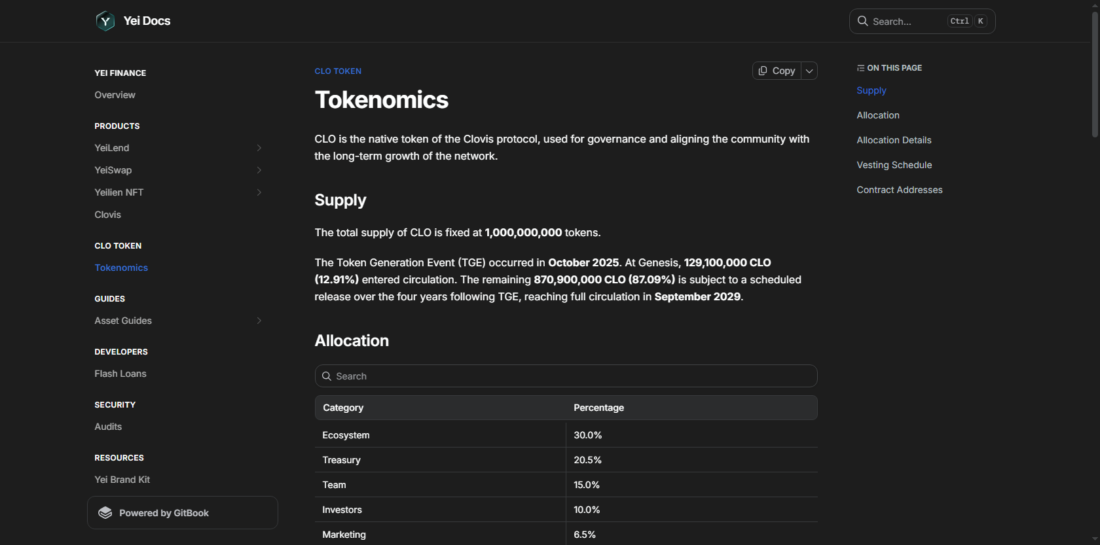
Yei Finance official tokenomics: total supply fixed at 1 billion CLO, 129.1 million (12.91%) circulating at TGE in October 2025. Source: docs.yei.finance
What the docs also show: the token generation event happened in October 2025, with 129.1 million CLO, 12.91% of total supply, unlocked at genesis. That figure matches CoinGecko’s reported circulating supply exactly. Nine months later, it still does. Ecosystem and Treasury allocations have no long cliff and should be releasing on a straight-line schedule the entire time. BSCScan’s on-chain total for CLO on BSC alone already sits at 223.5 million, well above the genesis number, which fits with some of that ongoing Ecosystem and Treasury unlock having been minted and bridged to BSC. CoinGecko’s circulating-supply figure, unchanged since October, looks stale rather than wrong.
Team Tokens Are Still Locked
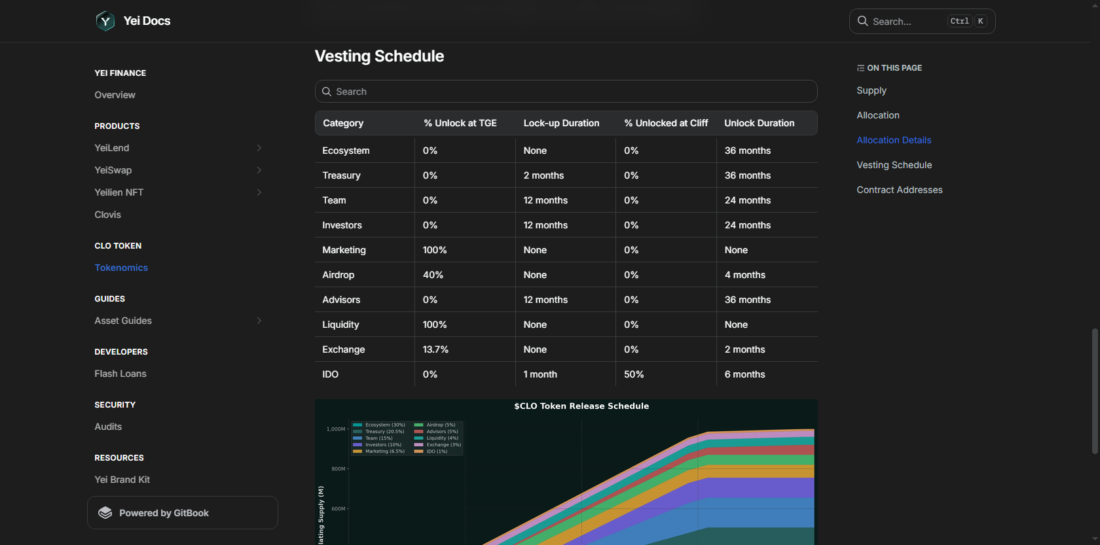
Yei Finance vesting schedule: Team, Investors, and Advisors allocations carry a 12-month cliff from TGE, not yet reached as of July 2026. Source: docs.yei.finance
Team (15% of supply), Investors (10%), and Advisors (5%) together make up 300 million tokens, and every one of those three categories carries a twelve-month cliff from the October 2025 genesis date. None of it has started vesting. The first unlock across all three arrives around October 2026, roughly three months from today. Nothing in this pump has anything to do with that supply yet. It will, eventually.
The Protocol Behind the Token Is Much Smaller Than It Was
Away from the token, the lending protocol itself tells a rougher story. DeFiLlama shows current total value locked at $4.26 million. Earlier in this token’s life, TVL ran into the hundreds of millions. The decline from that peak to today is close to total.
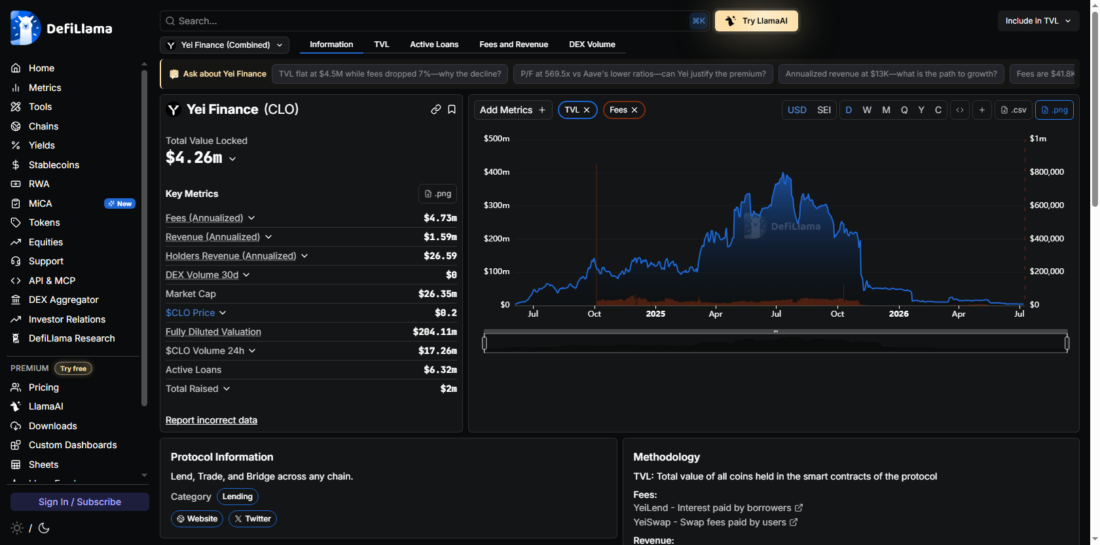
DeFiLlama TVL chart for Yei Finance: peaked near $400-450M in late 2025/early 2026, now at $4.26M. Source: DeFiLlama
Fees still run at $4.73 million annualized and revenue at $1.59 million, decent numbers for the current TVL, but DeFiLlama’s own price-to-fees ratio flags CLO as expensive relative to that income. YeiSwap, the protocol’s DEX arm, recorded eight dollars of volume in the last thirty days. Not eight million. Eight.
What Actually Happened in November
Part of that TVL story traces back to a specific event. On the evening of November 5, 2025, the Yei team paused YeiLend as a “precautionary measure” after pricing on its sfastUSD collateral, a yield-bearing stablecoin tied to Elixir’s deUSD and, one layer further out, Stream Finance’s XUSD, went erratic amid a wider depeg in that chain of assets. Reporting from Odaily, republished from CoinRank, lays out what the team disclosed the following morning: about $8.6 million in USDC had been lent out against that collateral, and its value had dropped.
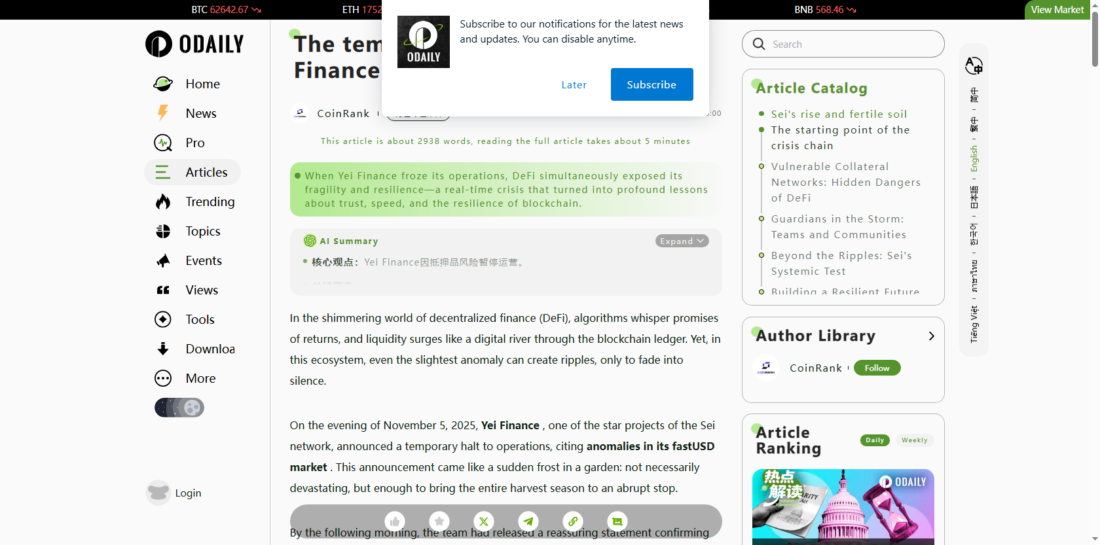
Odaily/CoinRank report on the November 5-6, 2025 Yei Finance pause: $8.6M bad debt from sfastUSD collateral, fully repaid from reserves. Source: odaily.news
The team used protocol reserves to repay the full $8.6 million and lifted the withdrawal pause once remediation was done, a little under twenty-four hours after the initial freeze. This was not a hack of Yei’s own code. DeFiLlama’s hacks database, searched directly for this piece, returns zero results for Yei Finance. It was bad debt from a collateral asset elsewhere in DeFi losing its peg, absorbed by the team rather than passed on to depositors. That response earned Yei a reasonably positive reputation at the time. It also coincides closely with when this protocol’s TVL stopped being what it was.
The Contract Itself Checked Out Clean
Running the CLO contract through honeypot.is returned a pass. Zero percent buy tax, zero percent sell tax, zero percent transfer tax, no wallet limits, and all 1,095 sampled holders in its test set were able to sell. This is one of the clean results the checklist for this piece calls for, and it is reported here exactly as clean as it came back.
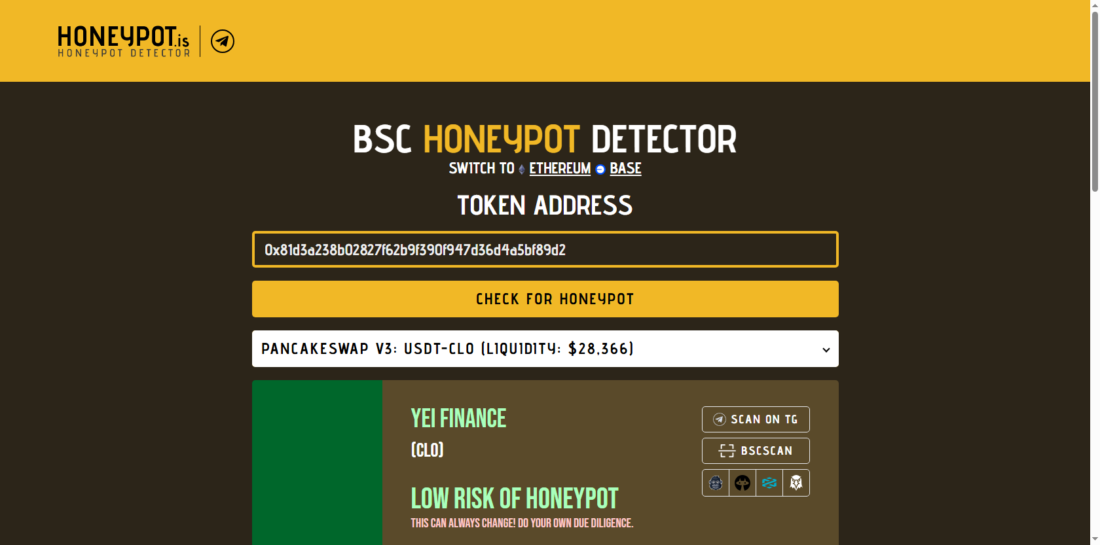
Honeypot.is simulation for CLO: PASSED, low risk, 0% buy/sell/transfer tax, all 1,095 sampled holders can sell. Source: honeypot.is
The source code, verified on BSCScan, shows a mint() function with no hard cap written into the code itself. Anyone holding the minter role can call it. What limits that in practice is who holds the role: setMinter() can only be called by the contract owner, and that owner address is not a personal wallet. It is itself a verified smart contract, and its transaction history is made up of “Schedule Batch” actions, the pattern a timelock or multisig produces rather than a single signer.
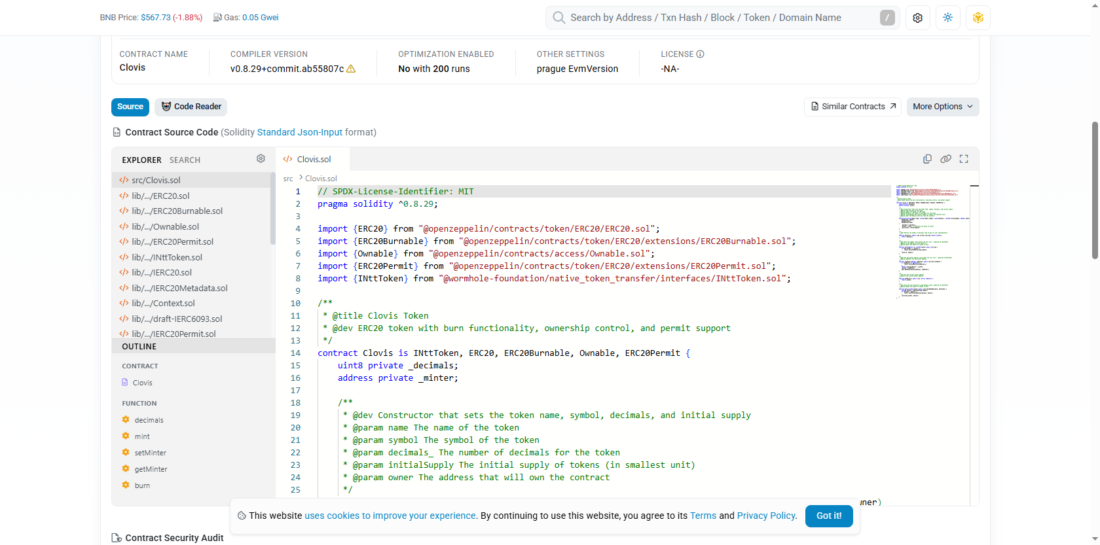
CLO Clovis.sol source code: mint() function gated by minter-address check, no on-chain supply cap, setMinter() restricted to owner. Source: BSCScan
Three separate audit engagements cover different parts of the stack: Zellic reviewed the core lending contracts and a separate oracle-specific pass, PeckShield and independent auditor billh reviewed YeiSwap, and billh separately reviewed the TGE contracts. The auditors found no critical or high-severity issues. They identified only minor issues, which the team acknowledged or fixed. That is a real, verifiable positive, and it sits next to the fact that the token’s stated 1 billion supply cap is a policy commitment rather than something the mint function enforces on its own.
No Listing, No Announcement, No Clear Trigger
Before writing any of this up, the obvious question is whether something simple explains today’s move. Checking CoinGecko’s Markets tab turns up trading on BitMart, KuCoin, MEXC, BYDFi, Toobit, XT.COM, KCEX, Ourbit, and BingX. None of the top-five exchanges by volume, Binance, OKX, Bybit, Coinbase, or Kraken, list the token. No fresh listing explains a 50% day.
The project’s official X account has 49,500 followers and posts regularly, but its pinned tweet dates to April 22 and its most recent relevant activity is a sixteen-hour-old repost about Sei network throughput, not anything specific to CLO. The project announced no partnerships, held no governance votes, and launched no products in the seventy-two hours before this piece was written. Whatever moved the price today, it was not accompanied by a public statement from the team.
What to Watch Next
Four dated items are worth tracking from here, each pulled directly from verified sources above rather than guessed at.
Around October 2026, roughly three months out, the 12-month cliff on Team, Investor, and Advisor allocations lapses, and 300 million CLO, 30% of total supply, becomes eligible to start vesting under its 24-to-36-month unlock schedules.
The rank-1 wallet holding 56.82% of supply has been dormant for 92 days as of this writing. Any outbound transfer from that address to an exchange deposit wallet would be visible on BSCScan in real time and would be the single most consequential on-chain event this token could produce.
DeFiLlama’s TVL and fee figures for Yei Finance update continuously; whether the current $4.26 million TVL stabilizes, keeps declining, or recovers will say more about the protocol’s actual health than the token price does.
CoinGecko’s circulating-supply figure has sat at 129.1 million for nine months without updating despite an active Ecosystem and Treasury unlock schedule; a correction to that number, whenever it happens, would materially change the token’s displayed market cap without any change in the underlying price.
Where the Setup Cuts Both Ways
For the bullish case to hold, today’s nearly identical buy and sell counts must reflect genuine two-sided trading rather than automated activity. The current volume should represent organic market participation instead of bot-driven transactions. The rank-1 wallet must also remain dormant. Alternatively, it must prove to belong to a long-term holder rather than an active seller. Finally, TVL would need to stop declining and begin rebuilding toward its earlier levels.
For the risk case to play out, the rank-1 wallet would first need to begin moving tokens toward an exchange. Such a transfer would become visible on-chain as soon as it occurred. In addition, the October 2026 token unlock would need to trigger meaningful selling by the Team or Investors. This selling would occur only after their tokens become liquid. Neither outcome is predictable from today’s data. Both are now specific, dated things a reader can actually watch for instead of guessing at.
The post CLO Jumped 51% Today But The Order Flow Looks Automated, Not Organic. appeared first on Live Bitcoin News.


You May Also Like

Bitcoin & Ethereum Inflows Hit 1-Year Low as Crypto Investors Brace for Fed Decision – BTC Eyes $120K

Critical USDT0 Response to Drift Hack Exposes Stark Contrast in Stablecoin Security Protocols

Metaplanet Stock Passes MARA to Become Third-Largest BTC Holder — Stock Slips Anyway



