

The Base Layer Identity Crisis: Why L2 Growth Actually Proves Ethereum's Value
Ethereum faces a narrative challenge. As Layer 2s grow in activity, a perception has emerged that the Ethereum blockchain is becoming invisible infrastructure. The base layer gets blamed when things break but is forgotten when they work.
This "Base Layer Identity Crisis" is identified in the Ethereum Foundation's Project Mirror report, which examined how different audiences perceive Ethereum's value and role in the broader ecosystem.
When L2 fees spike or a bridge fails, users often blame Ethereum. When an L2 succeeds, the credit typically flows to the L2's brand rather than to Ethereum. A common view holds that L2s are draining Ethereum's relevance.
But L2s depend fundamentally on Ethereum's capabilities. The technical architecture is sound—L2s rely on Ethereum for security, data availability, and settlement. L2 growth generates fees that flow to Ethereum validators and burns ETH supply. These mechanisms strengthen the base layer.
Yet a perception gap exists. Despite Ethereum's technical fundamentals and the value it provides through stablecoins, DeFi, and settlement infrastructure, many observers question whether L2 growth actually benefits Ethereum. When L2s like Base show significant TVL growth, the connection back to Ethereum's base layer isn't immediately obvious to casual observers.
This disconnect exists because value accrual happens invisibly. Fees burned and validator revenue don't create obvious visibility. L2 success can feel separate from Ethereum success. The technical dependencies aren't intuitive without deeper understanding. And markets are driven by sentiment and emotion, not always by technical fundamentals.
This article examines how L2 growth is enabled by the technical architecture that Ethereum's base layer provides—and why making these invisible value flows visible matters for Ethereum's future.
Technical Reality vs. Psychological Perception
The psychological perception is that L2s are siphoning value from Ethereum. ETH's price remains flat while L2 tokens pump. Activity is leaving the base layer. Ethereum is being hollowed out.
The technical reality is that L2s cannot function without Ethereum's infrastructure. Every L2 transaction ultimately depends on L1 capabilities. The architecture creates fundamental dependencies that contradict the perception of value extraction.
Examining the architectural dependencies provides one lens for understanding institutional deployments. BlackRock launched its first tokenized fund, BUIDL, on the Ethereum network. Robinhood launched stock tokenization on a Layer 2 blockchain built on Arbitrum. Deutsche Bank published its DAMA 2 litepaper outlining an institutional blueprint for asset tokenization and servicing on Ethereum Layer 2 built on the ZK stack.
The technical dependencies described below explain how these systems function on Ethereum's infrastructure.
Security Through Shared Infrastructure
L2s don't maintain their own validator sets or consensus mechanisms. Instead, they inherit Ethereum's security by posting cryptographic commitments to the base layer. Without Ethereum's $140+ billion in staked ETH and over 1 million validators, L2s would need to bootstrap their own security infrastructure.
This would mean fragmenting capital across multiple security budgets. This would create additional attack vectors. This would reduce the credibility that institutional adoption requires. When Base processes a transaction, Ethereum's validators provide the final security guarantee.
Consider Celo's transition to Ethereum as an L2. The network chose to inherit Ethereum's security rather than maintain its own consensus layer. This decision reflects how challenging and costly it is to replicate Ethereum's level of economic security independently.
Data Availability as Foundation
Every L2 transaction posts data back to Ethereum's blob space. This capability was introduced in EIP-4844 and expanded in EIP-7691. This isn't a convenience. It's fundamental architecture.
Without Ethereum's data availability layer, users can't prove their assets if an L2 fails. The technical improvements that enable cheap L2 transactions are Ethereum protocol upgrades. The L2 boom only happened because Ethereum built the infrastructure for it.
L2s benefit from years of Ethereum's R&D. Zero-knowledge proofs. Data availability sampling. Stateless clients. They get this without funding their own research teams or coordinating network upgrades. Ethereum provides the technical foundation that makes L2 innovation possible.
Exit Guarantees as Safety Net
L2s operate offchain for speed and cost efficiency. But users retain the ability to exit back to the Ethereum L1 at any time. This exit mechanism is fundamental to L2 security.
If an L2 operator censors transactions or stops functioning, users can submit a withdrawal directly to the Ethereum L1. The L1 smart contracts verify the user's ownership using cryptographic proofs. The assets are then released on L1 regardless of L2 cooperation.
This forced exit capability exists because the Ethereum L1 maintains the canonical state. Optimistic rollups allow users to prove their balances on the L1 if fraud occurs. ZK rollups use validity proofs that the L1 verifies mathematically.
Without the Ethereum L1 as the backstop, users would be entirely dependent on L2 operators. The exit guarantee transforms L2s from trusted systems into trustless extensions of Ethereum. The L1 provides the ultimate safety net that makes L2 experimentation possible without catastrophic user risk.
How L2 Growth Strengthens Ethereum
As L2 activity increases, several technical and economic mechanisms strengthen Ethereum's base layer. These mechanisms work together to enhance network security and stability.
Economic Security Through Fee Mechanisms
L2s pay fees to post data to Ethereum. These fees are denominated in ETH. Through EIP-1559, a portion of these fees gets burned, reducing the total ETH supply. The remaining fees go to validators as rewards for securing the network.
The mechanism creates a feedback loop. More L2 activity generates more data posting to Ethereum. More fees flowing to validators increases the economic incentive to secure the network honestly. A larger staked base makes attacks more expensive to execute.
According to DeFiLlama, Ethereum captured $30.52 million in fees over the past 30 days. This revenue supports the validator network that provides security for the Ethereum blockchain and all L2s building on top of it.
Capital Efficiency Through Shared Security
Ethereum's architecture allows multiple L2s to share the same security infrastructure. Over $140 billion in staked ETH secures not just Ethereum L1, but also hundreds of L2s simultaneously. This creates capital efficiency that individual chains cannot replicate.
Projects like EigenLayer extend this model through restaking. The same ETH staked to secure Ethereum can simultaneously secure additional protocols. This shared security model means capital does multiple jobs instead of sitting idle or fragmenting across separate validator sets.
Technical Resilience Through Modular Diversity
Ethereum's modular design separates concerns across layers. The base layer focuses on security and data availability. L2s handle execution and experimentation.
Different L2 approaches coexist in this model. Optimistic rollups like Arbitrum and Optimism use fraud proofs. ZK rollups like zkSync and Starknet use validity proofs. Some L2s experiment with alternative data availability solutions.
This diversity creates system resilience. If one approach encounters issues, others continue operating. L2s can test new features and optimizations without requiring changes to Ethereum's base layer. The L1 maintains stability while innovation happens at the execution layer.
This separation allows Ethereum to remain conservative in its core protocol while enabling rapid iteration in the layers above. The result is a system that balances security with innovation.
Closing the Gap Between Reality and Perception
The base layer identity crisis is about visibility, not function. L2s need Ethereum for security, data availability, exit options, and settlement. These needs are technical facts, not opinions.
When Base processes millions of transactions daily, Ethereum's $140+ billion in staked capital secures them. When users move assets between L2s, Ethereum settles the state. When an L2 needs to prove its data is available, Ethereum provides the foundation. The system works exactly as designed.
But the value flowing from L2s back to Ethereum stays hidden in block explorers and technical documentation. Base pays approximately $6,400 daily to Ethereum validators—roughly $2.3 million annually. This may sound modest, but it buys access to security infrastructure that would cost billions to replicate independently. Base receives over $60,000 in security value for every dollar it pays Ethereum.
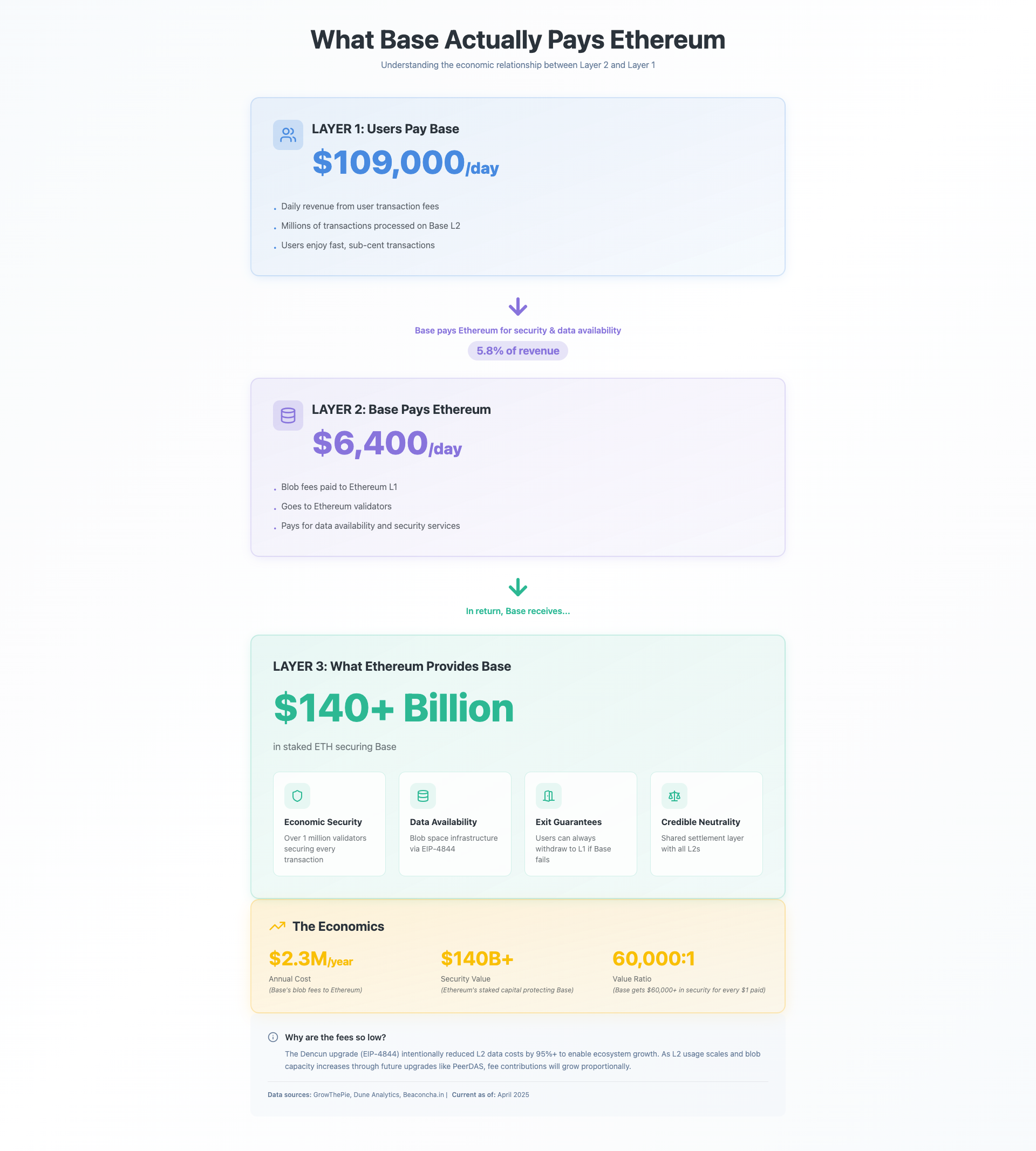 What Base Actually Pays Ethereum Infographic (data: GrowThePie, Dune Analytics - Blob Transactions, Beaconcha.in)
Making value visible needs better dashboards, clearer labels, and tools that show the L2-to-L1 connection in real time. The technical links exist whether people see them or not. The challenge is making perception match reality before other stories take hold.
But visibility alone won't solve everything. L2 token launches do capture value that might otherwise flow to ETH. Liquidity fragmentation creates real UX friction. The ecosystem must address these issues while highlighting the symbiotic relationship.
Ethereum's long-term thesis depends on L2s scaling to serve millions of users while strengthening, not weakening, the base layer. The technical architecture supports this vision. Every successful L2 validates Ethereum's modular design. Every institutional deployment on an L2 confirms that Ethereum's security and settlement guarantees are worth building on.
The question isn't whether the technical links exist – they do, and they're not going anywhere. The question is whether the ecosystem can make these connections visible and intuitive before alternative narratives solidify in public consciousness.
The perception problem is solvable, but it requires the same intentional design thinking that went into Ethereum's technical architecture. Build the tools. Tell the story. Make the invisible visible. The fundamentals are sound. Now it's time to ensure the narrative catches up to reality.
Elsewhere
 Blockhead
 Blockhead

 Blockhead

Podcast
Trends, Tokenization & Treasuries: Cardano's Frederik Gregaard Talks Enterprise Adoption
In town for Token2049, Fredrick Gregaard, CEO of the Cardano Foundation, joined host Takatoshi Shibayama in the studio to discuss the evolution of the crypto space, highlighting how Cardano is maturing into a decentralized critical infrastructure layer, designed to support a wide range of applications beyond simple value transfer.

We're a media partner for the upcoming Singapore Fintech Festival! Use the promo code SFFSMPBH for 20% off all delegate passes at this link!
You May Also Like

Republic Europe Offers Indirect Kraken Stake via SPV

cpwrt Limited Positions Customer Support as a Strategic Growth Function
