The top officials of the U.S. Securities and Exchange Commission and the Commodity Futures Trading Commission indicated increased consensus on crypto regulationThe top officials of the U.S. Securities and Exchange Commission and the Commodity Futures Trading Commission indicated increased consensus on crypto regulation

SEC & CFTC Chairs Break Silence: “Sensible Crypto Rules” Coming – Here’s What Changes

The top officials of the U.S. Securities and Exchange Commission and the Commodity Futures Trading Commission indicated increased consensus on crypto regulation this week, indicating that more consistent regulation could be at hand.

In an appearance on CNBC prior to a joint public appearance in Washington, SEC Chairman Paul Atkins and CFTC Chairman Mike Selig declared that the regulatory environment of crypto is nearing a tipping point following years of confusion due to the absence of clarity in jurisdiction and enforcement-based oversight.
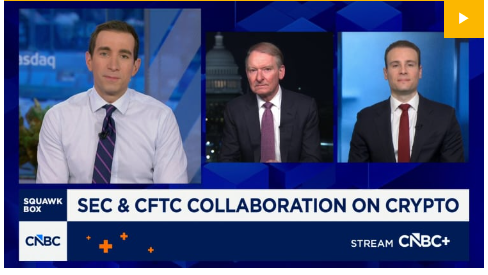
Source: CNBC

Their remarks coincide with Congress getting closer to enacting legislation that will help clarify whether a specific agency regulates various aspects of the digital asset market.

Atkins Emphasizes Narrow SEC Focus as Senate Hashes Out Crypto Rules

Atkins had admitted that the bill is at a sensitive stage. Following the approval of the House, the Senate is now debating it in both the Agriculture Committee and the Senate Banking Committee as lawmakers are trying to solve conflicting priorities in the policy.

He explained that the regulators no longer head the debate but rather assist legislators in a technical manner. Although the disagreements continue, the SEC has been collaborating with the two committees to help lawmakers develop a workable policy.

One of the areas of conflict is the intersection of crypto activity and traditional banking, specifically in the context of stablecoins, deposits, and yield-generating products.

Such a discussion has only stepped up over the past few months when Coinbase has made a more aggressive move into payments and financial services, attracting opposition from banks and even certain policymakers.

Atkins noted that stablecoins, in themselves, are not of much immediate concern to the SEC, since they had already been directly addressed in congressional action.

He emphasized that the SEC’s primary concern remains securities-related activity, including tokenized securities, and said the agency is prepared to operate within whatever boundaries Congress ultimately sets.

Selig Frames Crypto Legislation as a Reset for CFTC Authority

Selig echoed that position, noting that stablecoins and yield products do not fall squarely within the CFTC’s remit either.

He said the proposed legislation is more important for what it would do elsewhere, particularly by expanding the CFTC’s authority over crypto spot markets.

While the agency already has broad powers to pursue fraud and market manipulation involving commodities, Selig said the bill would allow the CFTC to move beyond enforcement and establish a formal regulatory framework for spot trading in digital assets.

The remarks reflected a major shift in tone between the two agencies, which have spent years in jurisdictional disputes over crypto oversight.

Atkins dismissed speculation about a potential merger, describing the SEC and CFTC as historically separate institutions.

He said the real problem has been the undefined space between them, where uncertainty over authority has stalled product development and driven companies offshore.

U.S. Crypto Regulators Hint at Reset After Years of Turf Wars

Atkins also addressed concerns raised by Senator Elizabeth Warren and other critics about crypto exposure in retirement accounts.

He said many Americans already have indirect exposure through professionally managed pension funds and that discussions around expanding access to crypto in retirement plans are focused on proceeding carefully, with protections in place for retirees.

To end the interview, Selig described the broader effort as an opportunity to reverse a decade-long trend that pushed crypto innovation offshore.

The comments come as lawmakers begin a key markup session on Thursday morning on the Senate Agriculture Committee’s portion of the crypto market structure bill.

The outcome of the markup is expected to offer an early indication of how much bipartisan support the legislation retains as it advances.

Later today, Atkins and Selig are scheduled to appear together at CFTC headquarters for a public event on regulatory harmonization, rescheduled from earlier this week.

Disclaimer: The articles reposted on this site are sourced from public platforms and are provided for informational purposes only. They do not necessarily reflect the views of MEXC. All rights remain with the original authors. If you believe any content infringes on third-party rights, please contact service@support.mexc.com for removal. MEXC makes no guarantees regarding the accuracy, completeness, or timeliness of the content and is not responsible for any actions taken based on the information provided. The content does not constitute financial, legal, or other professional advice, nor should it be considered a recommendation or endorsement by MEXC.

You May Also Like

Republic Europe Offers Indirect Kraken Stake via SPV

Republic Europe Offers Indirect Kraken Stake via SPV

Republic Europe launches SPV for European retail access to Kraken equity pre-IPO.
Share
bitcoininfonews2026/01/30 13:32
cpwrt Limited Positions Customer Support as a Strategic Growth Function

cpwrt Limited Positions Customer Support as a Strategic Growth Function

For many growing businesses, customer support is often viewed as a cost center rather than a strategic function. cpwrt limited challenges this perception by providing
Share
Techbullion2026/01/30 13:07
Unlocking Massive Value: Curve Finance Revenue Sharing Proposal for CRV Holders

Unlocking Massive Value: Curve Finance Revenue Sharing Proposal for CRV Holders

BitcoinWorld Unlocking Massive Value: Curve Finance Revenue Sharing Proposal for CRV Holders The dynamic world of decentralized finance (DeFi) is constantly evolving, bringing forth new opportunities and innovations. A significant development is currently unfolding at Curve Finance, a leading decentralized exchange (DEX). Its founder, Michael Egorov, has put forth an exciting proposal designed to offer a more direct path for token holders to earn revenue. This initiative, centered around a new Curve Finance revenue sharing model, aims to bolster the value for those actively participating in the protocol’s governance. What is the “Yield Basis” Proposal and How Does it Work? At the core of this forward-thinking initiative is a new protocol dubbed Yield Basis. Michael Egorov introduced this concept on the CurveDAO governance forum, outlining a mechanism to distribute sustainable profits directly to CRV holders. Specifically, it targets those who stake their CRV tokens to gain veCRV, which are essential for governance participation within the Curve ecosystem. Let’s break down the initial steps of this innovative proposal: crvUSD Issuance: Before the Yield Basis protocol goes live, $60 million in crvUSD will be issued. Strategic Fund Allocation: The funds generated from the sale of these crvUSD tokens will be strategically deployed into three distinct Bitcoin-based liquidity pools: WBTC, cbBTC, and tBTC. Pool Capping: To ensure balanced risk and diversified exposure, each of these pools will be capped at $10 million. This carefully designed structure aims to establish a robust and consistent income stream, forming the bedrock of a sustainable Curve Finance revenue sharing mechanism. Why is This Curve Finance Revenue Sharing Significant for CRV Holders? This proposal marks a pivotal moment for CRV holders, particularly those dedicated to the long-term health and governance of Curve Finance. Historically, generating revenue for token holders in the DeFi space can often be complex. The Yield Basis proposal simplifies this by offering a more direct and transparent pathway to earnings. By staking CRV for veCRV, holders are not merely engaging in governance; they are now directly positioned to benefit from the protocol’s overall success. The significance of this development is multifaceted: Direct Profit Distribution: veCRV holders are set to receive a substantial share of the profits generated by the Yield Basis protocol. Incentivized Governance: This direct financial incentive encourages more users to stake their CRV, which in turn strengthens the protocol’s decentralized governance structure. Enhanced Value Proposition: The promise of sustainable revenue sharing could significantly boost the inherent value of holding and staking CRV tokens. Ultimately, this move underscores Curve Finance’s dedication to rewarding its committed community and ensuring the long-term vitality of its ecosystem through effective Curve Finance revenue sharing. Understanding the Mechanics: Profit Distribution and Ecosystem Support The distribution model for Yield Basis has been thoughtfully crafted to strike a balance between rewarding veCRV holders and supporting the wider Curve ecosystem. Under the terms of the proposal, a substantial portion of the value generated by Yield Basis will flow back to those who contribute to the protocol’s governance. Returns for veCRV Holders: A significant share, specifically between 35% and 65% of the value generated by Yield Basis, will be distributed to veCRV holders. This flexible range allows for dynamic adjustments based on market conditions and the protocol’s performance. Ecosystem Reserve: Crucially, 25% of the Yield Basis tokens will be reserved exclusively for the Curve ecosystem. This allocation can be utilized for various strategic purposes, such as funding ongoing development, issuing grants, or further incentivizing liquidity providers. This ensures the continuous growth and innovation of the platform. The proposal is currently undergoing a democratic vote on the CurveDAO governance forum, giving the community a direct voice in shaping the future of Curve Finance revenue sharing. The voting period is scheduled to conclude on September 24th. What’s Next for Curve Finance and CRV Holders? The proposed Yield Basis protocol represents a pioneering approach to sustainable revenue generation and community incentivization within the DeFi landscape. If approved by the community, this Curve Finance revenue sharing model has the potential to establish a new benchmark for how decentralized exchanges reward their most dedicated participants. It aims to foster a more robust and engaged community by directly linking governance participation with tangible financial benefits. This strategic move by Michael Egorov and the Curve Finance team highlights a strong commitment to innovation and strengthening the decentralized nature of the protocol. For CRV holders, a thorough understanding of this proposal is crucial for making informed decisions regarding their staking strategies and overall engagement with one of DeFi’s foundational platforms. FAQs about Curve Finance Revenue Sharing Q1: What is the main goal of the Yield Basis proposal? A1: The primary goal is to establish a more direct and sustainable way for CRV token holders who stake their tokens (receiving veCRV) to earn revenue from the Curve Finance protocol. Q2: How will funds be generated for the Yield Basis protocol? A2: Initially, $60 million in crvUSD will be issued and sold. The funds from this sale will then be allocated to three Bitcoin-based pools (WBTC, cbBTC, and tBTC), with each pool capped at $10 million, to generate profits. Q3: Who benefits from the Yield Basis revenue sharing? A3: The proposal states that between 35% and 65% of the value generated by Yield Basis will be returned to veCRV holders, who are CRV stakers participating in governance. Q4: What is the purpose of the 25% reserve for the Curve ecosystem? A4: This 25% reserve of Yield Basis tokens is intended to support the broader Curve ecosystem, potentially funding development, grants, or other initiatives that contribute to the platform’s growth and sustainability. Q5: When is the vote on the Yield Basis proposal? A5: A vote on the proposal is currently underway on the CurveDAO governance forum and is scheduled to run until September 24th. If you found this article insightful and valuable, please consider sharing it with your friends, colleagues, and followers on social media! Your support helps us continue to deliver important DeFi insights and analysis to a wider audience. To learn more about the latest DeFi market trends, explore our article on key developments shaping decentralized finance institutional adoption. This post Unlocking Massive Value: Curve Finance Revenue Sharing Proposal for CRV Holders first appeared on BitcoinWorld.
Share
Coinstats2025/09/18 00:35