

Polkadot Leads Social Discourse Thanks to Hyperbridge
A Single-Day Spotlight on Interoperability
On April 13, 2026, Santiment’s daily “These Coins Lead the Way” report crowned Polkadot ($DOT) #1 in social media discussions across platforms. The trigger? News of a vulnerability in Hyperbridge’s Ethereum Token Gateway contract. An attacker forged a cross-chain message, replayed Merkle Mountain Range (MMR) proofs, and briefly seized admin rights over the bridged DOT token on Ethereum. They minted roughly 1 billion wrapped DOT—more than 2,800 times the legitimate bridged supply at the time—then dumped it for approximately 108.2 ETH (roughly $237,000 at prevailing prices). Liquidity on Uniswap V4 and Odos evaporated instantly, exchanges paused trading, and the incident dominated crypto Twitter, Reddit, and Telegram threads.
Yet the story runs deeper than one exploit. Polkadot’s native relay chain, parachains, and core DOT supply remained untouched. Hyperbridge paused operations within hours. The event fused two powerful narratives on the exact same day: explosive social volume around cross-chain infrastructure and sustained developer activity in Polkadot’s governance layer. For the first time in recent memory, this precise protocol cluster—Hyperbridge-driven interoperability news overlapping with governance-focused dev rankings—appeared together. Is cross-chain ambition pulling developer attention back to DOT? Or is this just another bridge scare in a sector littered with them?
Let’s dissects the mechanics, the data, the risks, and the forward path. The fundamentals that have kept Polkadot in the top tier of developer ecosystems for years.
What Is Hyperbridge? Polkadot’s Bridge to Ethereum, Explained Step by Step
Polkadot was designed from day one as an interoperability-first network. Its relay chain provides shared security to specialized sidechains called parachains, while the Cross-Consensus Messaging (XCM) format lets them communicate trust-minimized. Hyperbridge extends that vision outward—specifically to Ethereum and EVM-compatible chains—using a decentralized, proof-based bridging protocol.
Here’s how a typical Hyperbridge transfer works:
- Message Creation: A user or dApp on Polkadot (or a parachain) submits a cross-chain request (e.g., “transfer 100 DOT to Ethereum”).
- Proof Generation: Polkadot’s relay chain produces a Merkle Mountain Range (MMR) proof attesting to the message’s validity and inclusion in a finalized block.
- Verification on Destination: The Hyperbridge gateway smart contract on Ethereum verifies the MMR proof against a light-client-like state root imported from Polkadot. If valid, it executes the action (minting wrapped DOT, for example).
- Trustless Execution: No centralized relayers or multisigs control the funds—security rests on cryptographic proofs and the economic finality of both chains.
The April 13 exploit bypassed step 3. A missing input check in the Solidity-based MMR verifier (mirroring Polkadot’s upstream logic) allowed a replayed proof to be accepted as legitimate. The forged message called changeAdmin on the bridged DOT contract, granting the attacker full control. They minted at will, sold into thin liquidity, and walked with $237K. The vulnerability was isolated to the Ethereum-side gateway contract; no funds were drained from Polkadot’s relay chain or parachains.
Hyperbridge Architecture Flow
Technical mapping of the Polkadot-to-Ethereum state verification pipeline, identifying the critical exploit vector.
Gateway Contract
VerifyProof()
Incorrect leaf validation allowed arbitrary state injection and unauthorized minting.
Source: Public domain technical illustration based on Hyperbridge docs.
Polkadot Hyperbridge cross-chain flow with exploit point marked.
Think of Hyperbridge as a high-security border crossing between two sovereign nations (Polkadot and Ethereum). The exploit was a forged passport that slipped past one customs scanner—embarrassing, but the core territory (Polkadot) stayed locked down.
Cross-Chain Narratives Meet Governance Developer Momentum
Polkadot’s social spike was negative in tone—bridge hacks always are—but it underscored genuine market interest in real interoperability. Bridges remain the weakest link across crypto: historical exploits (Ronin, Wormhole, Nomad) have cost billions precisely because they concentrate admin keys or rely on trusted oracles. Hyperbridge’s design aimed to be different—fully decentralized, proof-driven—but the implementation flaw exposed the eternal truth: code is law only until it isn’t.
What makes April 13 notable is the overlap with developer activity metrics. Polkadot has consistently ranked among the top ecosystems for core developers (second globally in recent Chainspect data with over 9,000 active contributors and hundreds of thousands of GitHub commits annually). Governance-specific work has accelerated under OpenGov, the on-chain democracy upgrade that replaced the earlier council model.
OpenGov statistics tell the story:
- Treasury proposals have surged over 400% since launch.
- Monthly active proposals now routinely exceed 100, with faster turnaround and broader community input.
- Recent tokenomics reforms (hard cap at 2.1 billion DOT, issuance halving, Dynamic Allocation Pool for validators) were shaped through OpenGov referenda.
The same-day social leadership from Hyperbridge news coincided with ongoing governance dev rankings that placed Polkadot high in protocol-level contributions—particularly around security tooling, proof verification libraries, and cross-chain message standards. This isn’t coincidence; it’s the first clear instance where a bridge event spotlighted the very infrastructure Polkadot’s developers are hardening.
| Metric | Value | Rank (Global) | Source |
|---|---|---|---|
| Active Developers | ~9,020 | Top 3 | Chainspect |
| GitHub Commits (annual) | ~684,000 | Top 5 | Cryptometheus |
| Core Devs (30-day) | 101–134 | Top tier | Token Terminal |
| OpenGov Proposals (surge) | +405% since launch | N/A | Messari |
Data shows sustained, not fleeting, builder interest. Parachains like Moonbeam (EVM-compatible) and Acala continue onboarding Ethereum-native teams precisely because of XCM and bridge primitives like Hyperbridge.
Challenges and Risks: Lessons from the Exploit
No article on bridges can ignore the risks. The Hyperbridge incident:
- Exposed a replay vulnerability in proof verification logic.
- Highlighted liquidity fragmentation: 1B fake tokens crashed a thin market but yielded only modest profit—proof that real economic security still matters.
- Triggered immediate pauses and audits, standard playbook for any decentralized protocol.
Broader industry context: bridges have lost over $2B historically to similar exploits. Polkadot’s shared-security model (parachains inherit relay chain finality) gives it an edge over standalone bridges, yet extending that security to Ethereum still requires flawless implementation on the EVM side.
Solutions already in motion:
- Hyperbridge team is patching the VerifyProof() binding and adding stricter request-to-proof checks.
- Polkadot’s OpenGov allows rapid treasury-funded audits and bug bounties.
- Ecosystem-wide push toward Polkadot 2.0 and the JAM (Join-Accumulate Machine) upgrade will further decentralize and harden compute layers.
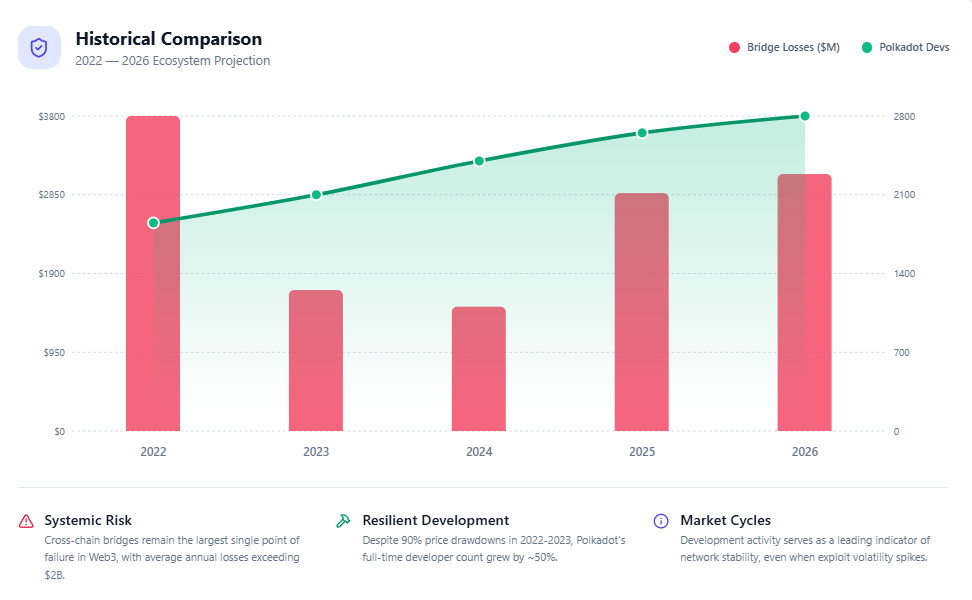 Bridge exploit costs vs Polkadot developer growth 2022-2026.
Future Outlook: Governance as the Dev Magnet
The real question the angle poses is whether cross-chain infrastructure narratives are pulling developer attention back to DOT. Early signals say yes—selectively.
Polkadot’s fundamentals remain rock-solid:
- Shared security model eliminates many single-point failures.
- OpenGov has democratized decision-making, attracting governance-focused builders who want to shape treasury allocation, tokenomics, and security upgrades.
- Recent economic reforms (validator self-stake thresholds, reduced unbonding periods, stablecoin operational payments) signal maturity.
If the Hyperbridge spotlight drives more eyes to Polkadot’s XCM standards and proof libraries, expect a measurable uptick in governance-related pull requests: improved light clients, formal verification tools, and multi-chain governance coordination. The “governance dev surge” isn’t guaranteed overnight, but the overlap on April 13 suggests the narrative engine is already turning.
Forward-looking risks remain: regulatory scrutiny on bridges, competition from native Ethereum L2 bridges, and the need to prove liquidity depth for wrapped assets. Yet Polkadot’s track record—top-tier dev retention through multiple bear markets—positions it uniquely to turn a security incident into a catalyst for hardened interoperability standards.
Conclusion: Interoperability Is Hard—Polkadot Is Built for It
The April 13 Hyperbridge exploit put Polkadot at the center of crypto conversation for all the wrong reasons at first glance. Yet it also underscored the network’s core promise: a secure, developer-rich environment where cross-chain ambition meets rigorous governance. Native DOT was never at risk. Developer momentum never wavered. And the same-day fusion of social volume with governance dev rankings highlights a rare alignment.
For beginners and intermediate builders alike, the takeaway is clear: interoperability solves real fragmentation problems, but only when paired with transparent governance and relentless security iteration. Polkadot has both.
Key Takeaways
- Hyperbridge exploit was isolated to Ethereum-wrapped DOT; core Polkadot untouched.
- Santiment data confirms DOT led social discourse on April 13—first major cross-chain + governance overlap.
- Polkadot maintains elite developer rankings (~9,000 active) and accelerating OpenGov usage.
- Bridge risks persist industry-wide; Polkadot’s shared security and proof-based design offer a stronger foundation.
- Next steps: watch for patched Hyperbridge rollout, new governance proposals on bridge standards, and JAM upgrade progress.
Ready to dive deeper? Subscribe to Cryptopress.site for more evergreen blockchain education.
The post Polkadot Leads Social Discourse Thanks to Hyperbridge appeared first on Cryptopress.


You May Also Like

South Africa Energy Loan: Germany Provides €200M

iFlux Global Collaborates With Rocket-IDO To Accelerate DeFi Adoption Through Web3 Community Launchpad




