

What Is DRAM and Why Is It Back in Focus Amid the AI Infrastructure Rally?
DRAM is back in the market spotlight as the AI infrastructure trade expands beyond GPUs.
For months, market attention has focused heavily on AI chips. But as data center demand grows, the discussion is moving deeper into the supply chain. Memory is becoming one of the key bottlenecks, and DRAM is now part of that conversation.
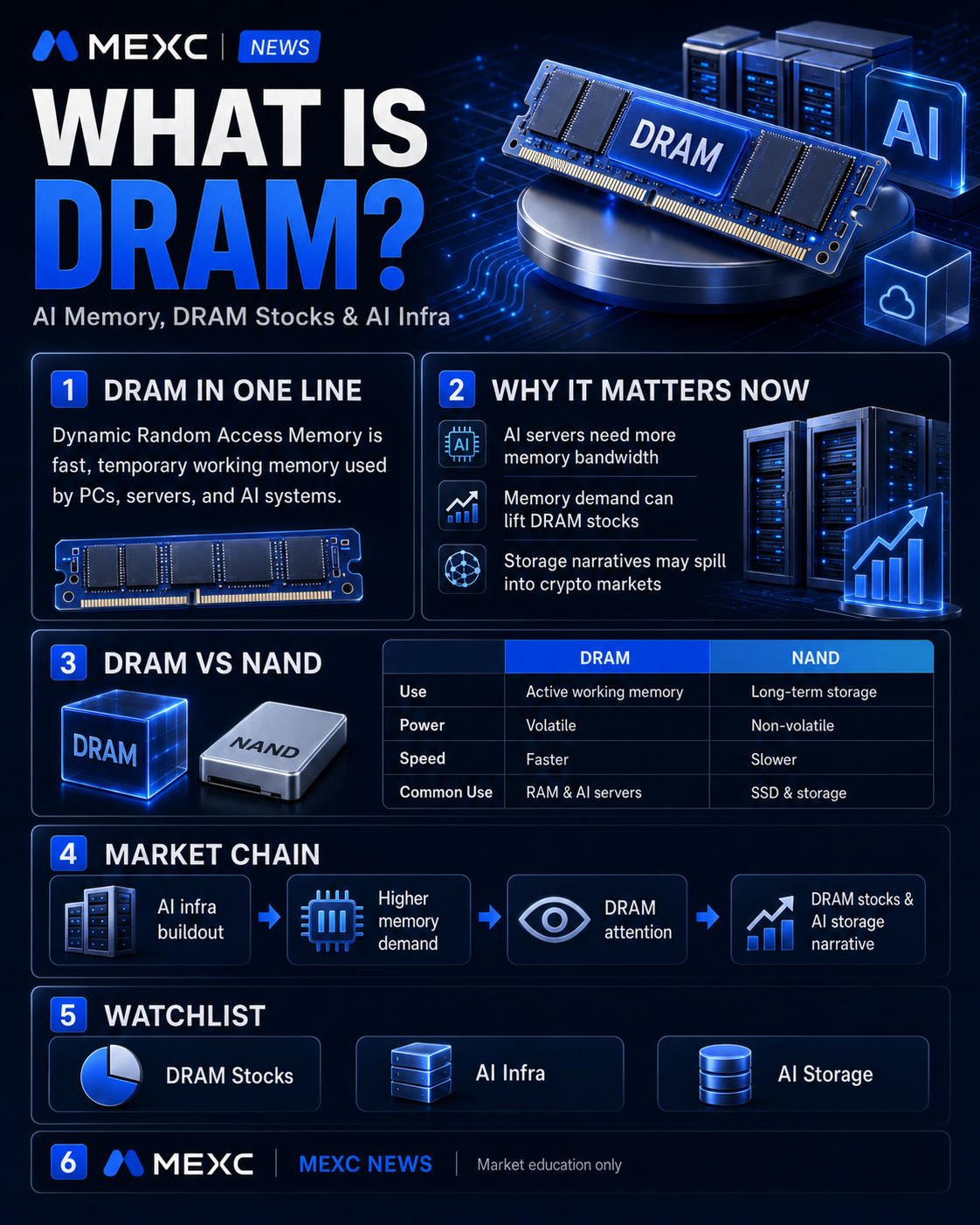
DRAM, short for Dynamic Random Access Memory, is fast temporary memory used by computers, servers, smartphones, and AI systems. It helps systems access and process data quickly while running workloads. Unlike long-term storage, DRAM does not keep data after power is turned off. Its role is speed.
Why DRAM Matters Now
AI infrastructure does not rely on processors alone. Servers also need high-speed memory to move data between chips, storage systems, and applications.
As AI workloads become larger, memory bandwidth and capacity become more important. This is why DRAM and related memory components have started to receive more attention from market participants.
The simple chain looks like this:
AI infrastructure buildout
Higher server and data center demand
More need for high-performance memory
Renewed attention on DRAM suppliers and memory stocks
This does not mean DRAM stocks move in one direction automatically. Memory markets are still affected by supply cycles, pricing, inventories, capital spending, and broader risk sentiment. But the AI infrastructure narrative has made DRAM easier for the market to understand as a key component, not just a background hardware term.
Why DRAM Stocks Are Being Watched
DRAM stocks tend to receive attention when the market expects stronger demand for servers, data centers, and semiconductor components.
Recent memory market updates have pointed to tight supply conditions and stronger pricing expectations, especially as suppliers allocate more capacity toward server-related applications. This has helped bring DRAM and memory-linked companies back into focus.
For market participants, the key shift is that AI infrastructure is no longer only about GPUs. It is also about memory, storage, networking, power, cooling, and data center capacity.
That broader view is why DRAM stocks and storage-linked equities may appear in the same conversation as AI chips.
How This Connects to AI Storage Narratives
DRAM is not the same as crypto storage, decentralized storage, or AI storage tokens. DRAM is a hardware memory technology. Crypto storage narratives usually relate to data infrastructure, decentralized networks, or storage-related blockchain use cases.
Still, market narratives often spread across adjacent themes.
When AI infrastructure becomes a major market focus, attention may move from chips to memory, then to storage systems, data centers, cloud infrastructure, and eventually to crypto sectors linked to storage or data availability.
That is why terms such as DRAM, AI memory, storage stocks, and AI storage may appear together during the same market cycle.
The connection is not technical equivalence. It is narrative spillover.
Explore Storage Tokenized Stocks in MEXC
What to Watch Next
The DRAM narrative may continue to depend on several signals:
Memory pricing trends Server and data center demand AI infrastructure spending from major technology companies Supply allocation by memory manufacturers Market attention on storage stocks and AI data infrastructure themes Crypto storage and data availability narratives
For MEXC News readers, the key point is simple: DRAM is becoming part of a wider AI infrastructure discussion. As the market looks beyond GPUs, memory and storage-related themes may continue to attract attention across both traditional technology stocks and crypto narratives.


You May Also Like

TAP, Inc. Launches TAP Pay, a Verified Payments Layer for Peer and SMB Payments

Ruby red state Republicans fear new White House map would accidentally help Dems




