

Must Read
'The Constitution only designated a specific presiding officer for the impeachment of a president... But it doesn’t say who will preside for all other trials,''The Constitution only designated a specific presiding officer for the impeachment of a president... But it doesn’t say who will preside for all other trials,'
Gatchalian is right — Chiz may preside over Sara Duterte’s trial. Here’s why.
For feedback or concerns regarding this content, please contact us at crypto.news@mexc.com
It was no surprise that Senator Chiz Escudero presided over Vice President Sara Duterte’s impeachment trial, given Senator Ping Lacson’s earlier pronouncement.
He was formally elected as the presiding officer during the trial’s opening on Monday, July 6.
But still, the senators from the minority bloc led by Cayetano siblings gave their all to block his election. Senator Alan Peter Cayetano insisted that the Senate president — in the present case, Sherwin Gatchalian — should preside over Duterte’s impeachment trial, based on the 1987 Constitution.
He even cited records from the constitutional commission to argue his case.
But his argument is faulty. Here’s why.
What the Constitution says
The issue of the impeachment presiding officer is vital because of the power he/she holds. The minority bloc would want a presiding officer who would be advantageous to them, given their inclination toward the Vice President on trial.
A presiding officer basically dictates the rhythm of an impeachment trial.
He/she is mandated to “make and issue, by himself or by the Secretary of the Senate, all orders, mandates, and writs authorized by these rules or by the Senate, and to make and enforce such other regulations and orders in the premises as the Senate may authorize or provide.” This is based on the Senate’s impeachment rules.
Article XI, Section 3 of the 1987 Constitution explains how an impeachment should proceed.
A plain reading of Section 3’s paragraph 6 states: “When the President of the Philippines is on trial, the Chief Justice of the Supreme Court shall preside, but shall not vote. No person shall be convicted without the concurrence of two-thirds of all the Members of the Senate.”
In other words, there was no specific rule that says that only a Senate President can preside over an impeachment trial, apart from a Chief Justice.
“My view is it’s not unconstitutional,” University of the Philippines College of Law associate dean and constitutional law professor Paolo Tamase told Rappler. “The Constitution only designated a specific presiding officer for the impeachment of a President, taking that from the US Constitution. But it doesn’t say who will preside for all other trials.”
“If the Constitution is clear that it is only when the President [is impeached] that the Chief Justice will preside and everything else is open to the Senate and Impeachment Court, you follow the text because the text of the Constitution follows,” UP law professor and consitutional law expert John Molo said in a Rappler interview.
Play Video 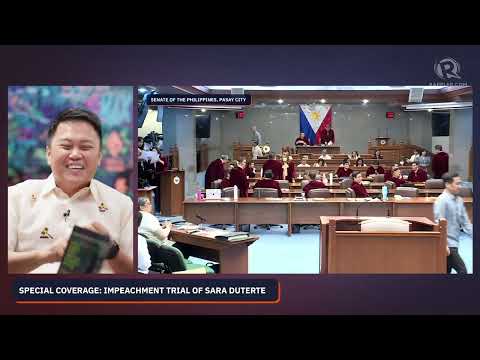
Senate’s revised rules
“In fact, the Constitution clearly provides that the Senate shall ‘promulgate its rules on impeachment to effectively carry out the purpose of this section,'” Tamase explained.
Section 3 (8) of the 1987 Constitution’s Article XI indeed states that the Congress — the House of Representatives and the Senate — shall have its rules on impeachment “to effectively carry out the purpose of [the Article XI].”
As explained by Senate President Sherwin Gatchalian, the Senate also amended its impeachment rules to allow another senator to preside over the trial, other than the Senate president.
Senate Resolution No. 48, adopted on June 3, made this amendment possible.
“The president of the Senate shall preside in all other cases of impeachment unless the Senate, by a majority vote of the members present, elects another senator as the presiding officer,” the new rule says.
Historically, it’s either a chief justice or the Senate president who presides over an impeachment trial.
Former chief justice Hilario Davide Jr. presided over former president Joseph Estrada’s impeachment trial from December 2000 to January 2001.
Senate presidents presided over the impeachment that reached the Senate: former Senate president Juan Ponce Enrile in former chief justice Renato Corona’s trial, and former Senate president Chiz Escudero in Duterte’s 2025 impeachment.
This is actually Escudero’s second time taking on the task.
The first one was controversial due to the delays in the trial and the remanding of the articles of impeachment to the House of Representatives which further delayed the proceedings. The Supreme Court ultimately killed the 2025 impeachment after it ruled in favor of Duterte, finding that the House’s articles of impeachment were unconstitutional. – Rappler.com


Disclaimer: The articles reposted on this site are sourced from public platforms and are provided for informational purposes only. They do not necessarily reflect the views of MEXC. All rights remain with the original authors. If you believe any content infringes on third-party rights, please contact crypto.news@mexc.com for removal. MEXC makes no guarantees regarding the accuracy, completeness, or timeliness of the content and is not responsible for any actions taken based on the information provided. The content does not constitute financial, legal, or other professional advice, nor should it be considered a recommendation or endorsement by MEXC.
You May Also Like

Trump tells Netanyahu, ‘You’re f—ing crazy’ and Wall Street sees it as a sign he’s losing patience with the war and wants it done
President Donald Trump looks on during a Cabinet meeting in the Cabinet Room of the White House on May 27, 2026.
Share
Fortune2026/06/02 18:17
Biden's Illegal Alien Invasion Sparked 30% Home Price Growth, 20% Rent Growth: Fed Paper
Biden's Illegal Alien Invasion Sparked 30% Home Price Growth, 20% Rent Growth: Fed Paper A new Federal Reserve working paper adds hard data to a dire
Share
ZeroHedge2026/07/07 04:40
SPARC AI Overwatch Platform Demonstrates Long-Range Maritime Targeting in Major Test
SPARC AI achieves milestone with Overwatch platform maritime demonstration, validating long-range targeting for defense applications. Learn how this software-only
Share
Citybuzz2026/07/07 03:55



