Ethereum co-founder Vitalik Buterin has signaled a renewed commitment to decentralized social networks for 2026, arguing that platforms built on shared, open dataEthereum co-founder Vitalik Buterin has signaled a renewed commitment to decentralized social networks for 2026, arguing that platforms built on shared, open data

Vitalik Buterin Says He’ll Return to Decentralized Social in 2026

Vitalik Buterin Says He'll Return To Decentralized Social In 2026

Ethereum co-founder Vitalik Buterin has signaled a renewed commitment to decentralized social networks for 2026, arguing that platforms built on shared, open data layers are essential to fostering real competition and mass communication that serves users rather than engagement metrics. In a year marked by broader interest in SocialFi, Buterin has redirected much of his online activity toward decentralized platforms, noting that his 2026 posts have been accessed through Firefly, a cross-client interface that unifies access to X, Lens, Farcaster and Bluesky.

“If we want a better society, we need better mass communication tools,” Buterin said, arguing that decentralization enables competition by allowing multiple clients to operate on a shared social data layer. He criticized many crypto-native social projects for relying on speculative tokens as a substitute for meaningful innovation, arguing that SocialFi experiments have repeatedly failed by rewarding pre-existing social capital and short-term price speculation instead of content quality and constructive discourse. He contrasted these efforts with creator-subscription models such as Substack, which he said better align incentives around high-quality content. Calling for broader community participation, he urged users and builders to spend more time in decentralized social ecosystems, saying the industry must move beyond a single centralized “info warzone” and toward a more competitive frontier where new forms of online interaction can emerge.

The state of decentralized social media

Decentralized social media, or SocialFi, refers to platforms built on open or blockchain-based networks where user identities, content and social graphs are not controlled by a single company. While protocols such as Lens and Farcaster have gained early traction, the sector has so far struggled to translate that momentum into sustained mass-market adoption.

On Wednesday, core infrastructure provider Neynar acquired Farcaster from Merkle. Farcaster co-founder Dan Romero announced the news, saying that “after five years, it’s clear Farcaster needs a new approach and leadership to reach its full potential.”

Lens also underwent a leadership transition this week, as Aave transferred stewardship of the open-source social protocol to Mask Network, tasking the Web3 social company with advancing consumer-ready, on-chain social applications.

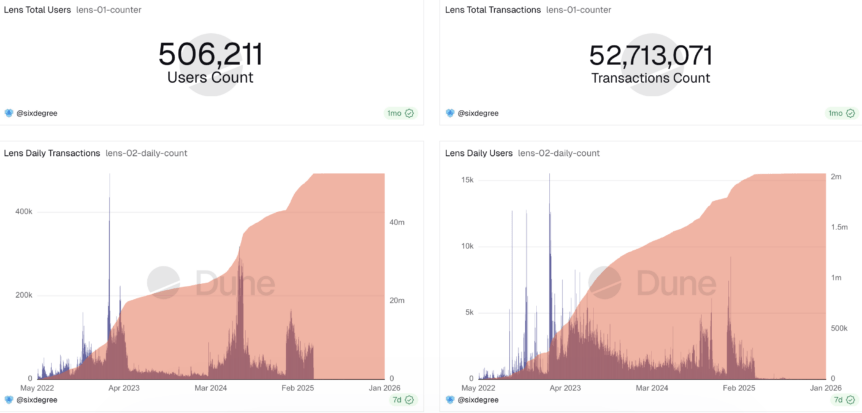
Farcaster features more than two million total registered users and hundreds of thousands of daily interactions, measured by posts and reactions. Lens has accumulated about 506,000 users, according to Dune Analytics data.

Source: Dune Analytics Ethereum, Vitalik Buterin, SocialFiSource: Dune Analytics
This article was originally published as Vitalik Buterin Says He’ll Return to Decentralized Social in 2026 on Crypto Breaking News – your trusted source for crypto news, Bitcoin news, and blockchain updates.

Market Opportunity
LightLink Logo
LightLink Price(LL)
$0.004421
$0.004421$0.004421
0.00%
USD
LightLink (LL) Live Price Chart
Disclaimer: The articles reposted on this site are sourced from public platforms and are provided for informational purposes only. They do not necessarily reflect the views of MEXC. All rights remain with the original authors. If you believe any content infringes on third-party rights, please contact service@support.mexc.com for removal. MEXC makes no guarantees regarding the accuracy, completeness, or timeliness of the content and is not responsible for any actions taken based on the information provided. The content does not constitute financial, legal, or other professional advice, nor should it be considered a recommendation or endorsement by MEXC.

You May Also Like

SEC Delays Crypto Innovation Exemptions, Citing Further Study

SEC Delays Crypto Innovation Exemptions, Citing Further Study

SEC postpones crypto innovation exemptions for blockchain products pending further analysis and congressional input.
Share
CoinLive2026/01/31 11:15
Crypto Market Crash To 6-Month Low Amid Rising Tensions Between Iran and The US

Crypto Market Crash To 6-Month Low Amid Rising Tensions Between Iran and The US

The post Crypto Market Crash To 6-Month Low Amid Rising Tensions Between Iran and The US appeared on BitcoinEthereumNews.com. Key Insights: President Trump induces
Share
BitcoinEthereumNews2026/01/31 11:02
If you put $1,000 in Intel at the start of 2025, here’s your return now

If you put $1,000 in Intel at the start of 2025, here’s your return now

The post If you put $1,000 in Intel at the start of 2025, here’s your return now appeared on BitcoinEthereumNews.com. Intel (NASDAQ: INTC) and Nvidia (NASDAQ: NVDA) announced a new partnership on Thursday, September 18, working on several generations of custom data center and computing chips designed to boost performance in hyperscale, enterprise, and consumer applications. As part of the collaboration, Nvidia, the undisputed leader of the semiconductor sector, will also invest $5 billion in Intel by purchasing its common stock at a price of $23.28 per share. Following the news, Intel stock jumped more than 30% in pre-market trading, while Nvidia saw a 3% uptick, a welcome change following weeks of shaky performance and controversies regarding its Chinese sales. Trading at $31.34 at the time of writing, INTC shares are up 54.99% year-to-date (YTD). INTC YTD stock price. Source: Google Accordingly, a $1,000 investment in the tech company at the start of the year would now be worth $1,549.90, giving you a return of $549.90. ‘The next era of computing’ The move follows a wave of fresh backing for the struggling Intel, including a nearly $9 billion U.S. government purchase of a 10% stake just weeks ago and a $2 billion investment from Japan’s SoftBank. As such, the deal has the potential to put Intel back into the game after years of trying to catch up not just with Nvidia but also AMD (NASDAQ: AMD) and Broadcom (NASDAQ: AVGO). “This historic collaboration tightly couples NVIDIA’s AI and accelerated computing stack with Intel’s CPUs and the vast x86 ecosystem — a fusion of two world-class platforms. Together, we will expand our ecosystems and lay the foundation for the next era of computing,” wrote Nvidia founder and chief executive officer (CEO), Jensen Huang.  However, the U.S. government’s direct involvement suggests that more is at stake than simply propping up Intel, as it likely reflects a broader concern about keeping America competitive…
Share
BitcoinEthereumNews2025/09/18 22:47