

EC-Council’s ADG Framework Signals a Shift Toward Operational AI Governance for Enterprise Trust
Artificial intelligence deployment continues accelerating across enterprises, yet governance maturity remains inconsistent. Against this backdrop, EC-Council’s ADG Framework arrives as organizations increasingly search for structured methods to operationalize AI safely while protecting customer trust and service continuity. The cybersecurity certification provider launched the framework alongside a free AI Readiness Self-Assessment Tool designed to help organizations evaluate governance readiness before scaling deployments.
The announcement reflects a broader enterprise challenge. Organizations increasingly deploy autonomous systems across customer interactions, workflow automation, analytics, and support environments. However, governance structures often struggle to keep pace.
Why EC-Council’s ADG Framework Matters Beyond Compliance
AI governance discussions frequently focus on regulation. However, governance failures increasingly create customer experience failures.
Poorly governed AI can generate inaccurate outputs, expose sensitive data, amplify operational disruptions, and weaken trust. Consequently, enterprises increasingly require governance architectures that move beyond policy documents into operational implementation.
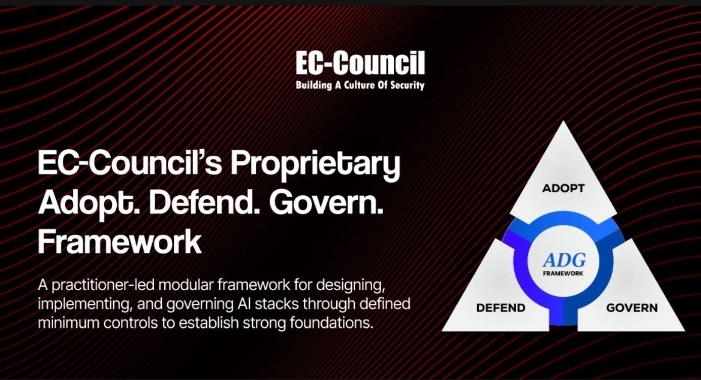
EC-Council’s ADG Framework introduces a three-pillar operating model built around Adopt, Defend, and Govern. The structure introduces 12 minimum controls, governance surfaces, deployment overlays, and autonomy tiers designed for practical implementation.
The framework also aligns with multiple global standards including EU AI regulations, ISO/IEC 42001, NIST AI RMF, OWASP guidance for LLM security, and MITRE ATLAS references.
EC-Council’s ADG Framework Focuses on Execution Rather Than Theory
Many frameworks explain governance principles. Fewer frameworks explain operational execution.
EC-Council positions its model as practitioner-built infrastructure designed for deployment realities. Contributors include professionals from major enterprises spanning financial services, consulting, healthcare, and enterprise technology sectors.
Jay Bavisi, Group President, EC-Council, said:
“Most organizations approached AI with a deploy-first mindset, prioritizing speed while governance and security struggled to keep pace. The result is that organizations are now scaling AI systems faster than they can securely govern them. The ADG Framework was developed to restore operational discipline, establish accountability, and help organizations operationalize AI responsibly before governance failures become systemic business liabilities.”
This framing directly addresses a growing enterprise tension: balancing innovation speed with operational control.
Governance Architecture and Enterprise Deployment Readiness
The framework organizes governance across three operational pillars.
Adopt focuses on deployment readiness, workforce capabilities, and business alignment.
Defend emphasizes protection against emerging AI threats including prompt injection, model exploitation, adversarial attacks, supply chain compromise, and data poisoning.
Govern introduces oversight structures, accountability mechanisms, risk management processes, and auditability requirements.
Together, these functions attempt to establish lifecycle governance across increasingly autonomous environments.
Kathy Baxter, Principal Architect, VP of Responsible AI & Tech at Salesforce, AI Advisory Board Member, and Contributor to the ADG Framework, said:
“The framework’s three pillars reflect the cross-functional model that leading AI organizations like Salesforce have used to scale AI responsibly. It establishes a solid, replicable blueprint across any industry, deployment model, or regulatory environment.”
Importantly, the framework also introduces governance overlays intended for multi-model environments and agentic systems, where governance complexity expands significantly.
AI Readiness Assessments Create Visibility Into Risk Exposure
Alongside the governance model, EC-Council introduced a free AI Readiness Self-Assessment Tool.
The tool measures organizational maturity across governance readiness, resilience, security posture, accountability structures, and implementation practices. As regulatory scrutiny expands, organizations increasingly require measurable evidence demonstrating governance preparedness.
This assessment approach reflects an important market shift.
Enterprises increasingly seek visibility before deployment problems become operational failures. Governance assessments create structured baselines that help organizations prioritize investments and reduce implementation fragmentation.
Lewis V. Adams, VP, Enterprise AI & Capital Productivity Transformation at Citi, AI Advisory Board Member, and Contributor to the ADG Framework, said:
“The ADG Framework is the operating model that enterprise AI has been missing. It turns abstract standards into auditable practices and resolves the real tension between delivery speed and safety. For a board, that is the difference between scaling a fleet of agents with confidence and taking a leap of faith.”
Workforce Development and the Expansion of AI Governance Roles
Enterprise AI governance increasingly requires specialized capabilities.
To support implementation, EC-Council launched three certifications:
- Certified AI Program Manager (CAIPM)
- Certified Offensive AI Security Professional (COASP)
- Certified Responsible AI Governance and Ethics Professional (CRAGE)
These certifications indicate another broader market trend.
Organizations increasingly recognize that governance frameworks alone cannot solve operational gaps. Skilled practitioners remain necessary for implementation, auditing, risk management, and security validation.
ShanShan Pa, Global Head of AI & Data Governance at GlobalLogic, AI Advisory Board Member, and Contributor to the ADG Framework, said:
“The industry doesn’t lack AI frameworks; it lacks operational clarity. The ADG framework places a strong emphasis on AI security, particularly in addressing adversarial risks and model vulnerabilities, while also mapping broader governance and regulatory expectations. What’s especially valuable is its inclusion of measurable indicators, which helps organizations move from high-level principles to more actionable and trackable AI risk management as they transition into real-world deployment.”
As enterprises accelerate AI adoption, governance maturity increasingly shapes customer trust, resilience, and experience reliability. Consequently, frameworks that operationalize accountability may become essential infrastructure for large-scale AI deployment rather than optional governance exercises.
The post EC-Council’s ADG Framework Signals a Shift Toward Operational AI Governance for Enterprise Trust appeared first on CX Quest.


추천 콘텐츠

200+ Firms Urge Senate to Enact CLARITY Act for Crypto Regulation

Gold continues to hit new highs. How to invest in gold in the crypto market?

Lexston Mining Engages Dentons Delany to Explore Mineral Opportunities in Guyana



