

Foreign investment: Why telecom operators disagree with NBS and why both may be right
On Friday, June 5, the Nigerian Bureau of Statistics’ (NBS) capital importation reports said the telecoms sector’s foreign investment crashed by 91% in Q1 2026, the biggest drop in four years.
For telecom operators, the hit typically signals a sector struggling to attract foreign investment for infrastructure upgrades and the deployment of new connectivity tools. It comes when the industry is trying to reposition its face value and redefine its standing as a critical sector to Nigeria’s economy and daily operations.
That such a sector only contributed a 0.07% share (₦9.8 billion or $7.24 million) of the entire foreign investment inflows during the quarter is bad for its branding and will only portray a struggling industry. Telecom players know this; they understand it gives prospective investors an intuition to stay back and watch; investors typically lose confidence, as most will do.
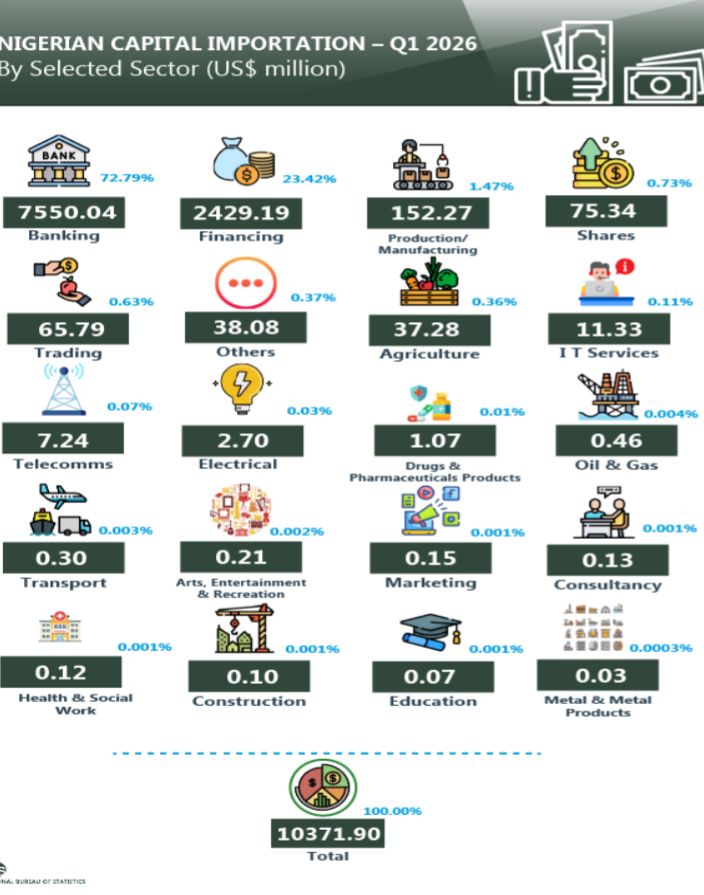 Capital Imporation in Q1 2026
In comparison, the Nigerian telecoms industry received $80.78 million from foreign investors a year ago and also ended the year on a high note with $103.36 million in Q4 2025.
The Association of Licensed Telecommunications Operators of Nigeria (ALTON) has questioned the report. In its statement on Monday, June 8, 2026, it claimed that the NBS data didn’t capture the strength of its investment source, which is domestic capital. It also called for a revisit of the data metrics, with claims that the sector operates differently in terms of investment.
While both parties might be right from their own end, ALTON is pointing at a critical argument NBS needs to carefully consider.
How NBS collates this data
The NBS capital importation report tracks the total financial and physical investment inflow from abroad. These investments are broken down by type, originating country and receiving sector.
Notably, the NBS does not collect the data independently. It relies on the Central Bank of Nigeria (CBN) for the data and only verifies and validates it for publication.
 NBS-CBN
From the CBN end, it uses two tools in accumulating this data. First is the Electronic Financial Analysis and Surveillance System (e-FASS), a software used to track and automatically report all foreign banking transactions.
Second is the Certificates of Capital Importation (CCIs), a document issued by authorised banks to foreign investors for bringing capital into the country. This document serves as statutory evidence of the inflow.
So, the NBS capital importation report solely tracks foreign investment, which is necessary for both sector-based performance in terms of foreign investors’ confidence in that sector and overall economic activities.
What ALTON is saying
ALTON’s statement questioning the metrics used for the capital importation data is a wake-up call, but put forward at the wrong time.
In its submission, the association argued that the bulk of the sectors’ investment comes from domestic capital, reinvested operational earnings, which are spaces that are not included in the foreign capital importation metrics.
Meanwhile, operators are only making the point when they record low numbers. Perhaps they wouldn’t have if Q1 2026 had delivered a huge foreign investment. They only made a voice by questioning the metrics when it was unfavourable to the industry’s value.
“This disparity between reported foreign capital inflows and actual infrastructure investment highlights a gap in how sectoral capital deployment is currently measured and reported,” part of the ALTON statement reads.
 Engr. Gbenga Adebayo, Chairman of ALTON
Also Read: Foreign investment into Nigerian telecoms sector declined by 91% YoY in Q1 2026.
However, the call remains vital.
For a sector like telecoms, the mode of investment is tending towards a bulk of capital expenditure-led dynamics. For instance, the association revealed that players and tower companies injected ₦2.13 trillion in capital expenditure (CAPEX) in 2025. For 2026, the planned fund is ₦1.86 trillion, showing the domestic capital funnel as its investment strength.
Specifically, MTN Nigeria’s CAPEX in 2024 was ₦445.3 billion and was raised to over ₦900 billion in 2025. For the current year, the operator has allotted more than ₦1 trillion to infrastructure upgrades and investment.
Now, operators are proposing a “more inclusive and comprehensive investment-tracking framework” where both domestic and foreign investment are collated in one report. And checks show Nigeria has no official reports that track domestic investment other than the appearance of capital expenditure in the company’s periodic financial statements.
But here’s the card telcos are playing.
Since the 50% tariff hike, there has been an increased share of funds dedicated to CAPEX, making it a stronghold for their justifications. And this quota is expected to rise with an increase in customer base and profitability.
Going by this idea, telecom operators seek to continue projecting the notion of a viable industry, wanting to possibly attract foreign investors with a summed account representing both inflow and domestic capital.
Way Forward
Only the telecoms sector has come forward to critique NBS/CBN’s capital importation metrics. More sectors are needed to make the same story before this can be seen as an issue.
Also, while telecom operators’ call is not enough to substantiate a gap in the report, data tracking agencies might start considering the inclusion of domestic investment in each sector.
And they might choose not to, given that the core of the report centres on reporting mainly capital importation.
The outlook for foreign investment tells a whole lot of stories. To a foreign investor, it’s part of an avenue to make critical decisions. And for internally driven investment-led sectors like telecoms, it might be damaging; the core reason ALTON raised an argument and suggested further considerations.


추천 콘텐츠

How to Spot a South African Cyber-Scam Before You Click “Pay”

Tom Lee: Stock Market Bull Run Is Not Over — Recent Dip Is a ‘False Narrative’

Ask Sharifah Launches Grant Writing Services to Help Nonprofits, Entrepreneurs and Small Businesses Pursue Funding


인기 뉴스
더보기
