

The next digital divide may not be internet access, but AI fluency
Editor’s note: This content was done in partnership with Viventis Search Asia and was handled by BrandRap, the sales and marketing arm of Rappler. No member of the news and editorial team participated in the publishing of this piece.
For years, conversations around the digital divide centered on who has better access to the internet. Hence, the birth of trends like #NoStudentLeftBehind during the pandemic and the ‘Free Internet Access Program’ by the DICT, to name some. But with the rise of AI and its integration into modern workflows and systems, there may now be new factors that can widen the digital divide.
Today, two people can have the same smartphone and internet speed, but have different advantages depending on how they maximize the opportunities AI creates.
At the National AI & Skills Summit 2026, hosted by Viventis Search Asia, key industry players discussed the Philippines’ readiness for AI adoption, and what it takes to build an AI-fluent nation.
But what does it mean to be ‘AI-fluent’?
So much is said about AI fluency, yet there may not be a common understanding when it comes to what it actually entails. For Yu Ming Chin, founder and executive director of Viventis Search Asia, “AI fluency involves understanding the thought language of AI. It’s the ability to use critical thinking and create instructions for AI agents to complete tasks. This level of fluency is distinct from basic usage,” Chin said.
 BEYOND THE BUZZWORDS. Viventis’ Yu Ming Chin reframes AI fluency as a cognitive skill — one that involves critical thinking and understanding how to work alongside intelligent systems.
Much like digital literacy is more than knowing how to operate a computer or browse the internet, AI fluency goes beyond simply generating outputs. Chin’s description of AI as having its own “thought language” suggests that AI fluency is also a cognitive skill — requiring users to identify biases and employ critical human judgment when needed.
Who’s most at risk of being left behind in the AI economy?
If AI fluency becomes a key metric to success, then the next question could be: who stands to benefit from it, and who risks being left behind?
It might be easy to attribute it to obvious determinants like wealth, educational attainment, or appetite for change. But discussions at the summit showed that adaptation is not just a matter of personal willingness, but also whether a country has enough systems to help people build the skills now being demanded of them.
Data presented by Remko Glatzhofer, head of insights and data analytics for talent solutions at LinkedIn, showed that AI-related jobs in the Philippines have grown by 30% year-on-year, yet only around 1% of LinkedIn members in the country list at least one AI-related skill on their profiles.
 SKILLS AS CURRENCY. LinkedIn’s Remko Glatzhofer discusses why AI skills, not just degrees or job titles, may become the next defining advantage.
The talent pipeline also shows a similar pattern. According to Michelle Alarcon, president and co-founder of the Analytics and AI Association of the Philippines, the country is projected to need around 486,000 analytics jobs by 2028 — yet fewer than 30 schools currently offer data analytics or AI programs, and only four offer a bachelor’s degree in data science.
“The math is not mathing,” Alarcon said.
With this, the people at risk of being left behind may also be those who want to adapt but have no clear pathways to do so.
So who’s responsible for building an AI-fluent nation?
Throughout the summit, speakers repeatedly pointed out that achieving this requires multilevel collaboration among schools, industry groups, and government agencies to move in the same direction.
Michelle Alarcon pointed out, though, that one bottleneck lies in the absence of a shared language around AI competency. She highlighted the Philippine Skills Framework (PSF), which is a government inter-agency initiative formed in 2021 designed to bridge the skills gap, align educational standards, and map clear progressions for Filipino workers.
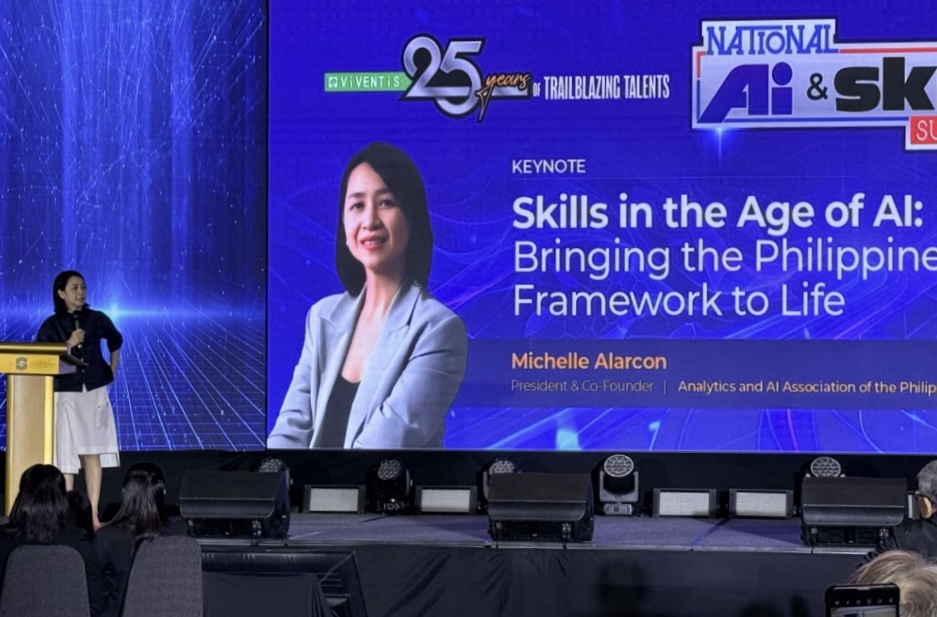 BUILDING THE PIPELINE. Michelle Alarcon maps the framework for preparing enough Filipino talent for an economy shaped by data and analytics.
“We’re calling on everyone to operate from the same playbook. Let’s use the Philippine Skills Framework as a common reference point — for schools designing curricula, employers defining competencies, and workers trying to understand where opportunities are. We can’t do it chaotically,” Alarcon said.
For decision-makers leading the nation toward an AI-driven economy, the Philippine Skills Framework is one place to start.
For DICT Secretary Henry Aguda, preventing an AI divide begins with ensuring that access itself does not become a barrier. He pointed to ongoing government efforts to expand connectivity through infrastructure.
“If we don’t solve it early, [AI fluency] could become the next digital divide. But with connectivity becoming more widespread, access to AI is becoming easier. The real risk is for those who choose not to use these tools,” Aguda said.
But making AI accessible is only part of the equation. DepEd Assistant Secretary Dexter Galban stated that AI fluency starts in the classroom. He cited current initiatives to improve AI literacy, including AI Ready ASEAN Philippines, plans to integrate AI into the basic education curriculum, and AI training programs for teachers.
“As educators and advocates, it is our shared duty to ensure that when AI rewrites the world, our children are holding the pen,” Galban said.
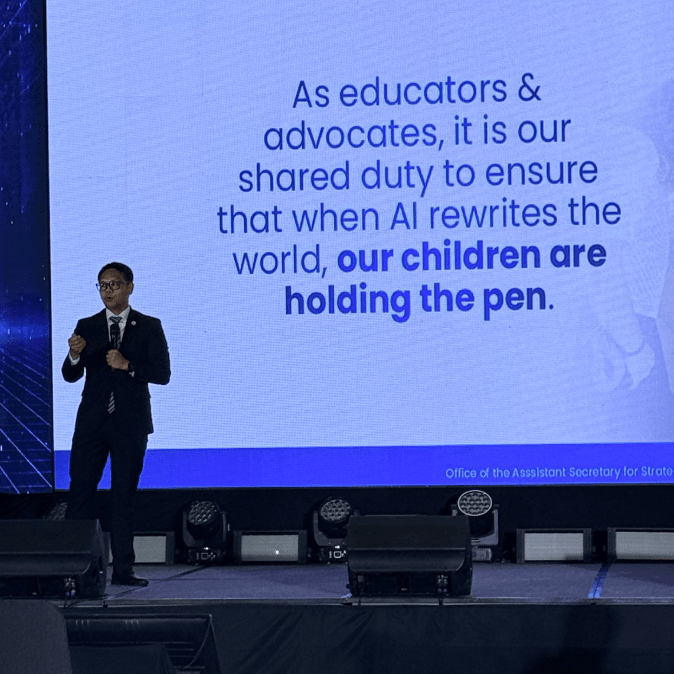 PREPARING THE NEXT GENERATION. Asec. Galban emphasizes the importance of introducing AI literacy early, as schools begin adapting to AI.
For years, the challenge was getting more Filipinos connected to the internet. Today, access still matters, but it is no longer the only consideration. Discussions at the summit showed that the next divide may now be between those who know how to work with AI and those who do not — and so the next challenge for the Philippines is ensuring that Filipinos have the support systems needed to make meaningful use of it. – Rappler.com


추천 콘텐츠

Deaths rise to 37 after 7.8-magnitude Mindanao quake; retrieval ops continue — OCD

Fragmented Ledgers and Connected Value: Interoperability Over Uniformity

Gold Prices Steady Near 11-Week Low as Iran-Israel Ceasefire Takes Hold


인기 뉴스
더보기
