

U.S. Dollar Pulls Back From Two-Month High as Israel-Iran Ceasefire Boosts Risk Sentiment
TLDR
- The U.S. dollar eased slightly from a two-month high after Israel and Iran halted attacks following a Trump appeal.
- Markets now price a 70% chance of a Federal Reserve rate hike by December, after strong jobs data.
- All eyes are on Wednesday’s U.S. consumer price index (CPI) report, which could determine the dollar’s next move.
- The euro edged higher ahead of Thursday’s European Central Bank meeting, where a 25 basis point rate rise is expected.
- Bank Indonesia made a surprise rate hike of 25 basis points, pushing the rupiah to its best single-day gain in over a year.
The U.S. dollar pulled back slightly on Tuesday after hitting its highest level in two months, as a fragile ceasefire between Israel and Iran lifted risk sentiment across global markets.
The U.S. Dollar Index slipped 0.1% to 99.93, just below Monday’s peak of 100.21. The pullback came after U.S. President Donald Trump said the U.S. was close to declaring “total victory” in the conflict with Iran and that oil prices were likely to fall.
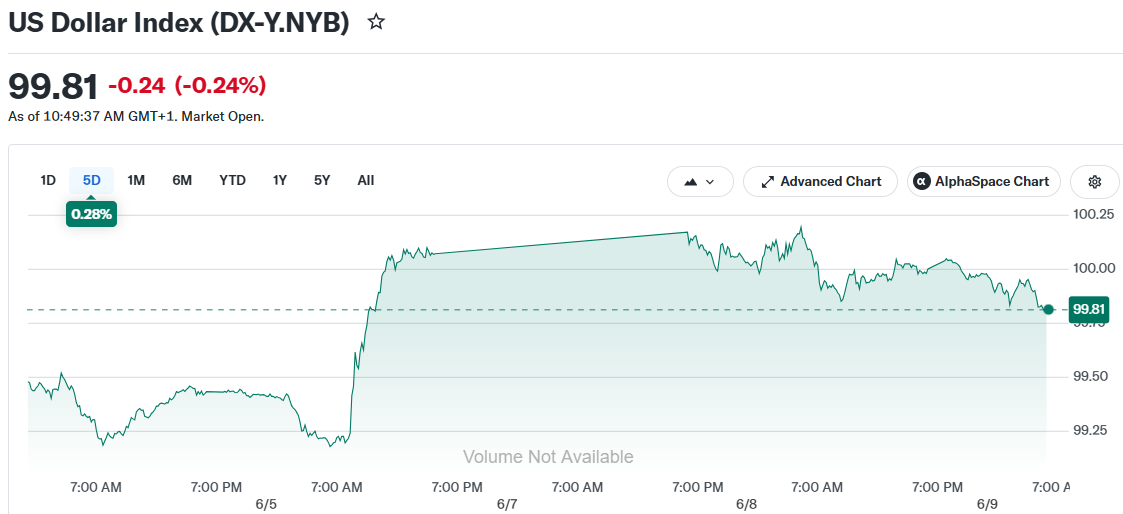 US Dollar Index (DX-Y.NYB)
Despite the easing of immediate tensions, investors stayed cautious. Tehran warned it could resume strikes if Israel continued hitting Iran-backed Hezbollah forces in Lebanon. The status of the Strait of Hormuz, a key route for global oil supplies, also kept traders on edge.
Treasury yields remained elevated after last week’s strong U.S. jobs report. The two-year Treasury note hovered near a 15-month peak, and the benchmark 10-year yield stayed above 4.5%.
Fed Rate Hike Bets Rise
The strong payrolls data pushed markets to price in roughly a 70% chance of a Federal Reserve rate hike by December, according to CME FedWatch. That shift in expectations has been a key driver of dollar strength in recent sessions.
Tony Sycamore, market analyst at IG, said a hotter-than-expected CPI print on Wednesday “would undoubtedly add to mounting fears of a Fed rate hike before year-end.” He added that such a scenario would support the dollar and put pressure on U.S. equities.
Wednesday’s CPI report is now the single most-watched data point for currency traders. Producer price data follows on Thursday.
The Australian dollar fell 0.1% to $0.7039, and the New Zealand dollar traded at $0.5804, both weighed down by the risk-off backdrop and dollar strength.
ECB and Indonesia in Focus
The euro edged up for a second straight session, trading at around $1.1528 to $1.1561. Investors are looking ahead to Thursday’s European Central Bank meeting, where a 25 basis point rate increase is widely expected. Markets will be watching ECB guidance closely for signals on how policymakers plan to handle energy-driven inflation.
A second rate increase in September is also being anticipated, as the ECB tries to balance higher energy costs against a slowing European economy.
In a surprise move, Bank Indonesia raised its benchmark interest rate by 25 basis points on Tuesday, bringing it to 5.50%. The bank acted to support the rupiah, which has been under pressure due to falling foreign exchange reserves and weak investor demand. The rupiah jumped nearly 1% on the news, its best single-day performance in more than a year.
The Japanese yen remained largely unchanged, holding above 160 per dollar. That level is closely watched by currency traders as a potential trigger point for intervention by Japanese authorities.
The post U.S. Dollar Pulls Back From Two-Month High as Israel-Iran Ceasefire Boosts Risk Sentiment appeared first on CoinCentral.


추천 콘텐츠

Phemex Publishes April 2026 Proof of Reserves, Reporting 131% Total Reserve Ratio

Best Crypto Presales to Buy in 2026 as Bitcoin Stabilizes

China Nabs Another Huione Group Core Member in Cambodia Extradition


인기 뉴스
더보기
