

Bessent delivers hard-nosed deficit promise, but math is fuzzy
Washington runs on promises. Most of them are cheap, because the people who make them are rarely still in the room when the bill comes due. The federal budget is the one place where every promise eventually gets graded, because an agency exists whose entire job is to count.
That agency is the Congressional Budget Office (CBO), and its scorekeeping follows a rhythm.
Each month, it publishes a review of what the government actually collected and actually spent. Twice a year, it projects the decade ahead. Officials can argue with the framing. They cannot argue with the arithmetic for long.
Usually, the gap between official optimism and the ledger is a matter of degree. The official says the deficit will shrink briskly. The data say it will shrink slowly. Everyone shrugs and moves on.
Every so often, though, the gap becomes a matter of direction. That is the uncomfortable spot where Treasury Secretary Scott Bessent sits right now, five days after the government's own scorekeeper published a report that quietly dismantled the most repeatable line in his congressional testimony.
A deficit pledge with a three in front of it
Bessent appeared before the Senate Finance Committee on June 3 and the House Ways and Means Committee the same week.
In both rooms, he committed to shrinking the federal deficit to 3% of gross domestic product (GDP) by the end of President Donald Trump's term, telling lawmakers the administration could deliver "something with a three in front of it," according to The Center Square.
MoreEconomy:
- Ernst & Young drops stunning take on economy as oil jumps
- Treasure secretary delivers surprise take on the economy
- Powell sends message on U.S. economy and AI-related job loss fear
He went further in the House hearing, claiming the deficit had already fallen to 5.5% of GDP. Treasury has not explained how that squares with the CBO's 5.8% projection for fiscal 2026.
The 3% figure is not arbitrary. It is roughly the level at which debt stops growing faster than the economy, which is why a bipartisan group in Congress has rallied behind it. It is also a threshold Washington has not actually hit since 2015, The Center Square reported.
The 3% target is the last surviving leg of the "3-3-3" agenda Bessent campaigned on for the Treasury job.
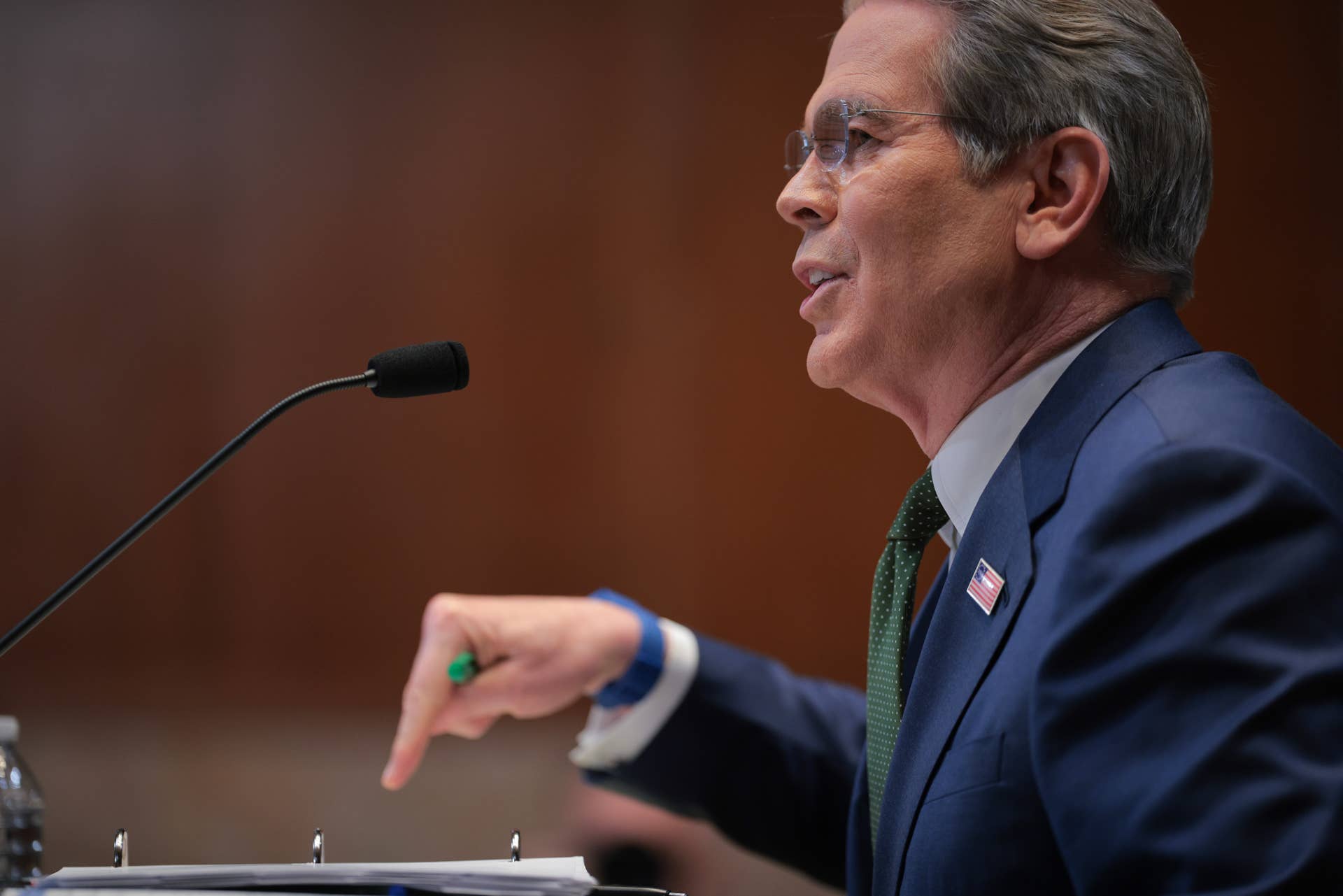 Bessent tells Congress that the “deficit” can fall to 3% of GDP by the end of President Trump's term.
Chip Somodevilla &sol Getty Images
What the new CBO numbers actually show
On June 8, the CBO released its Monthly Budget Review for May, and the headline figure initially looks like vindication for the secretary.
The deficit for the first eight months of fiscal 2026 came in at $1.248 trillion, which is $116 billion less than the same stretch a year earlier, according to the CBO.
I pulled the agency's underlying tables rather than stopping at that summary line, because calendar quirks can manufacture progress that does not exist. This one mostly did.
Related: Treasury issues urgent warning on a growing threat to your bank account
June 1, 2025, fell on a weekend, so billions in federal payments slid into May 2025 and inflated last year's baseline. Strip out that timing shift and the improvement collapses from $116 billion to $19 billion, a 2% change, based on the same CBO report.
May alone was worse than it looked. The month produced a $294 billion deficit, and on a timing-adjusted basis, that is $76 billion deeper than May 2025, the CBO data show.
Here is where the broader deficit math stands:
- The fiscal 2026 deficit is projected at $1.9 trillion, or 5.8% of GDP, according to the Congressional Budget Office's February outlook.
- Deficits never fall below 5.6% of GDP at any point in the next decade under that same baseline, according to the CBO.
- Debt held by the public has reached 101% of GDP, the highest level since World War II, The Center Square noted.
- Reaching a 3% deficit by 2036 would require roughly $10 trillion in deficit reduction over the decade, according to Fortune.
Interest costs are eating the improvement
What struck me when I compared the spending tables was how lopsided the pressure is. One line item is doing most of the damage, and it is the one no Treasury secretary controls.
Net interest on the public debt hit $742 billion through eight months, up $68 billion, or 10%, from a year earlier, according to the CBO. In May alone, interest costs jumped $28 billion, a 32% increase driven by higher long-term rates.
The government is on track to spend more than $1 trillion on interest this fiscal year, which is more than all discretionary defense spending, The Center Square reported.
For readers, that interest bill is not an abstraction. Every dollar spent servicing old debt is a dollar unavailable for tax relief or anything else, and the heavy Treasury issuance behind it helps keep long-term rates, and by extension, mortgage rates, pinned higher than they would otherwise be.
The revenue side is not cooperating, either. Corporate tax receipts fell $88 billion, a 30% decline, because the 2025 reconciliation act let companies take larger deductions on certain investments, the CBO noted.
Tariffs were supposed to plug part of that hole. Customs duties did surge $107 billion through April, a 132% jump from executive action on rates. But net tariff collections "declined sharply" in May as Treasury began paying refunds tied to the Supreme Court's February 20 ruling against certain tariffs, according to the CBO.
So the one revenue source growing fastest is now running in reverse, while the fastest-growing expense compounds daily.
The 3% deficit goal keeps drifting further away
At roughly 6% of GDP, the current deficit is about double what Bessent says he will deliver. The watchdogs who track this full time are not gentle about it.
The fiscal 2026 shortfall is on pace for roughly $2 trillion, and "it's beyond scary that $2 trillion deficits are now the norm," said Maya MacGuineas, president of the Committee for a Responsible Federal Budget, in a May 6 statement.
None of this means the pledge is impossible. It means the pledge requires policy that does not currently exist, and the administration's own fiscal 2027 budget projects deficits above 5% of GDP through 2029.
Bessent has floated creative answers before, including a plan leaning on stablecoins and money-market funds to absorb federal borrowing, as highlighted by TheStreet. Demand for the debt, though, is a different problem than the size of it.
The next grade arrives in mid-July, when Treasury's June statement shows whether tariff refunds keep draining receipts.
The fiscal year closes September 30, and the bond market will mark the final exam. If long-term rates stay elevated, interest costs alone could push the 3% promise from ambitious to arithmetic fiction.
Watch the interest line, not the testimony. That is where this pledge will be kept or broken.
Related: Trump’s top economic adviser issues surprise verdict on latest jobs report


추천 콘텐츠
'Dark day': Elon Musk's milestone draws searing rebuke

Wall Street Closes Higher: Dow Gains 0.70% as Optimism Returns

HolmesAI Partners with TaiJi to Power AI Trading Avatars


인기 뉴스
더보기
