America at 250: why the Constitution was built to restrain government, not celebrate majority rule
Most people, including most Americans, would be surprised to learn that the word democracy does not appear in the Declaration of Independence (1776) or the Constitution of the United States of America (1789). They would also be shocked to learn the reason for the absence of the word democracy in the founding document. Contrary to what the public has been led to believe, America’s Founding Fathers were skeptical and anxious about democracy. They were aware of the evils that accompany a tyranny of the majority. Not surprisingly, the Framers of the Constitution went to great lengths to ensure that the federal government was not based on the will of the majority and therefore was not democratic.
The Constitution divided the federal government into legislative, executive, and judicial branches. Each branch was designed to check the power of the others because the Founders did not want to rely only on the voters to check government power. As a result, citizens were initially given very little power to select federal officials. Neither the President, members of the judiciary nor the Senate were elected by direct popular vote. Only members of the House of Representatives were directly elected.
The Constitution was designed to further the cause of liberty, not democracy. To do that, the Constitution protected individuals’ rights from the government, as well as from their fellow citizens. To that end, the Constitution laid down clear, unequivocal and enforceable rules to protect individuals’ rights. In consequence, the government’s scope and scale were strictly limited. Economic liberty, which is a precondition for growth and prosperity, was strongly favored by the Constitution’s protections for property and contract.
Following the Declaration of Independence, the Constitutional Convention convened in 1787 in Philadelphia. In due course, the Constitution was crafted and ratified in 1789. It is a short, clear, intelligible document. The Constitution’s preamble contains only 52 words. It is followed by seven short articles and ten amendments known as the Bill of Rights (1791). The Bill of Rights establishes the rights of the people against infringements by the State. The only claim citizens have on the state, under the Bill of Rights, is for a trial by jury. The rest of the citizen’s rights are protections from the State.
The original Constitution established the rule of law and limited government. About 20% of the Constitution itemizes things that the federal and state governments may not do. Another 10% of the Constitution is concerned with positive grants of power. The bulk of the Constitution — about 70% — addresses the framers’ conception of their main task: to bring the United States and its government under the rule of law.
The Constitution was not a Cartesian construct or formula aimed at social engineering, but something to protect the people from the government. In short, the Constitution was designed to govern the government.
For roughly a century after the Constitution was ratified, private property, contracts and free internal trade within the United States were respected. The scope and scale of the government remained constrained. All this was consistent with what was understood to be an essential part of liberty.
Until World War I, economic and fiscal affairs were governed in the spirit of the Constitution. On the eve of World War I, government expenditures were less than 2% percent of GNP and 99% of the population paid no income tax. The income tax had just been introduced, with the top rate of 7% applied to incomes exceeding $500,000. The federal government had around 400,000 employees, less than 1 percent of the labor force. About 165,000 troops were on active duty. No federal regulations of capital or labor markets of the modern kind existed. Agricultural production and distribution were also largely free of federal regulation. There was no minimum wage rate and no social security. One area where the government interfered rather aggressively in the economy concerned the rates and tariffs the railroads charged. Antitrust enforcement was also in vogue.
World War I marks a sharp departure from the constitutional limits that had previously constrained Washington. Property rights were suspended on a large scale. There were wide-scale nationalizations of rail, telephone, telegraph and to a lesser degree ocean shipping. Over 100 manufacturing plants were nationalized. Under the Adams Act of 1916, the government became involved in labor-management relations. Conscription was instituted. The Espionage Act was passed in 1917. The Sedition Act of 1918, which subverted the Bill of Rights, imposed penalties for anti-government expression. Upton Sinclair was arrested for reading the Bill of Rights and Roger Baldwin was arrested for reading the Constitution. President Woodrow Wilson presided over this expansion of federal power under emergency powers granted to him by Congress in 1916.
Much of this anti-Constitutional apparatus was scrapped after the war. However, residues remained and eventually resurfaced. All it took was another national emergency – the Great Depression. That emergency was followed by World War II, the Vietnam War, the War on Terror, COVID lockdowns, and so forth and so on. With each emergency, laws were enacted, bureaus created, budgets enlarged, and civil liberties restricted. Indeed, each national emergency has functioned like a ratchet, resetting the baseline size and reach of government ever higher.
To rein in America’s ever-expansive Leviathan, it’s time to amend the U.S. Constitution. Thanks to the Founders’ foresight, it’s possible to do so.
The opinions expressed in Fortune.com commentary pieces are solely the views of their authors and do not necessarily reflect the opinions and beliefs of Fortune.
This story was originally featured on Fortune.com


추천 콘텐츠
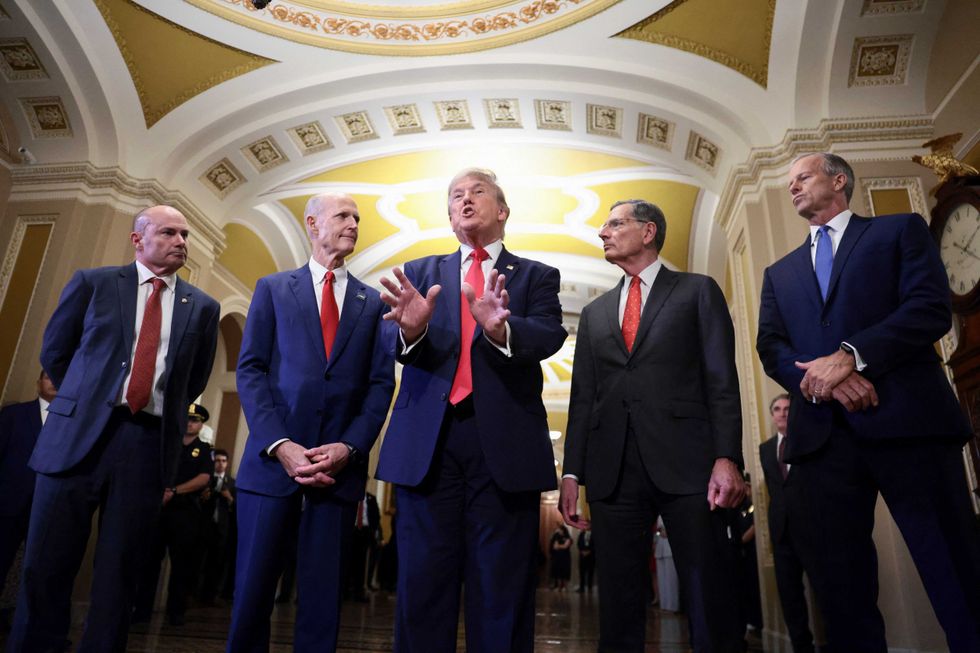
Senate GOP majority in jeopardy as poll finds Dems 'pulled within striking distance'

Alabama Enacts Dual Legislative Breakthrough in Blockchain and Judicial Reform