

Overlooked chip ETF is beating biggest AI names
Semiconductor stocks have dominated every performance leaderboard in 2026, with memory and equipment makers delivering triple-digit gains that dwarf the broader market.
Yet the fund capturing most of that upside is not the industry's largest, and it manages a fraction of the assets held by the sector's biggest ETF.
The Invesco Semiconductors ETF (PSI) has returned about 103.6% year to date through early July, Benzinga reported on July 6.
That figure towers over the roughly 66.2% gain posted by the much larger VanEck Semiconductor ETF (SMH) during the same period.
The roughly 37-point gap between two funds fishing from the same pool of chip stocks traces to a single overlooked variable: how the underlying index weights its holdings.
How Nvidia's weight created a 37-point performance gap
SMH devotes about 18.4% of its total portfolio to Nvidia, while PSI holds just 4.3% in the same chipmaker, according to Benzinga's analysis.
Nvidia has gained about 5% since January, a modest result at a time when the rest of the semiconductor complex has surged well past 100%, Benzinga reported.
When a fund's largest position barely moves and consumes nearly a fifth of total assets, smaller holdings lack the firepower to overcome that drag.
SMH packs about 69.5% of its total assets in its 10 largest holdings, while PSI distributes a more balanced 49.9% across its top 10 holdings, Benzinga noted.
PSI holds larger allocations in memory producers and equipment companies like Micron Technology and Lam Research, names that have each surged past 100% this year.
PSI and SMH track benchmarks built on different selection rules
Both funds hold between 25 and 30 chip companies listed in the United States, but their underlying indexes apply very different criteria for weighting.
SMH tracks the MVIS US Listed Semiconductor 25 Index, a market-capitalization-weighted basket that naturally allows the largest companies to capture the largest share of fund assets.
PSI tracks the Dynamic Semiconductor Intellidex Index, a quantitative model that ranks 30 holdings on price momentum, earnings momentum, quality, management action, and value, according to Invesco's fund documentation.
In a May 7 ETF Trends analysis, Roxanna Islam, head of sector and industry research at VettaFi, wrote that semiconductor ETFs are increasingly useful as the AI trade broadens beyond Nvidia into memory, networking, custom chips, and equipment.
That multi-factor approach pulls weight away from mega-cap names and distributes it toward mid-cap equipment and memory stocks that have led the 2026 rally.
"AI remains the dominant structural driver across the semiconductor value chain," Rene Reyna, head of thematic and specialty product strategy at Invesco, told U.S. News.
Reyna added that data center construction is generating demand for a wide range of chip categories, from processors and networking to memory and manufacturing equipment.
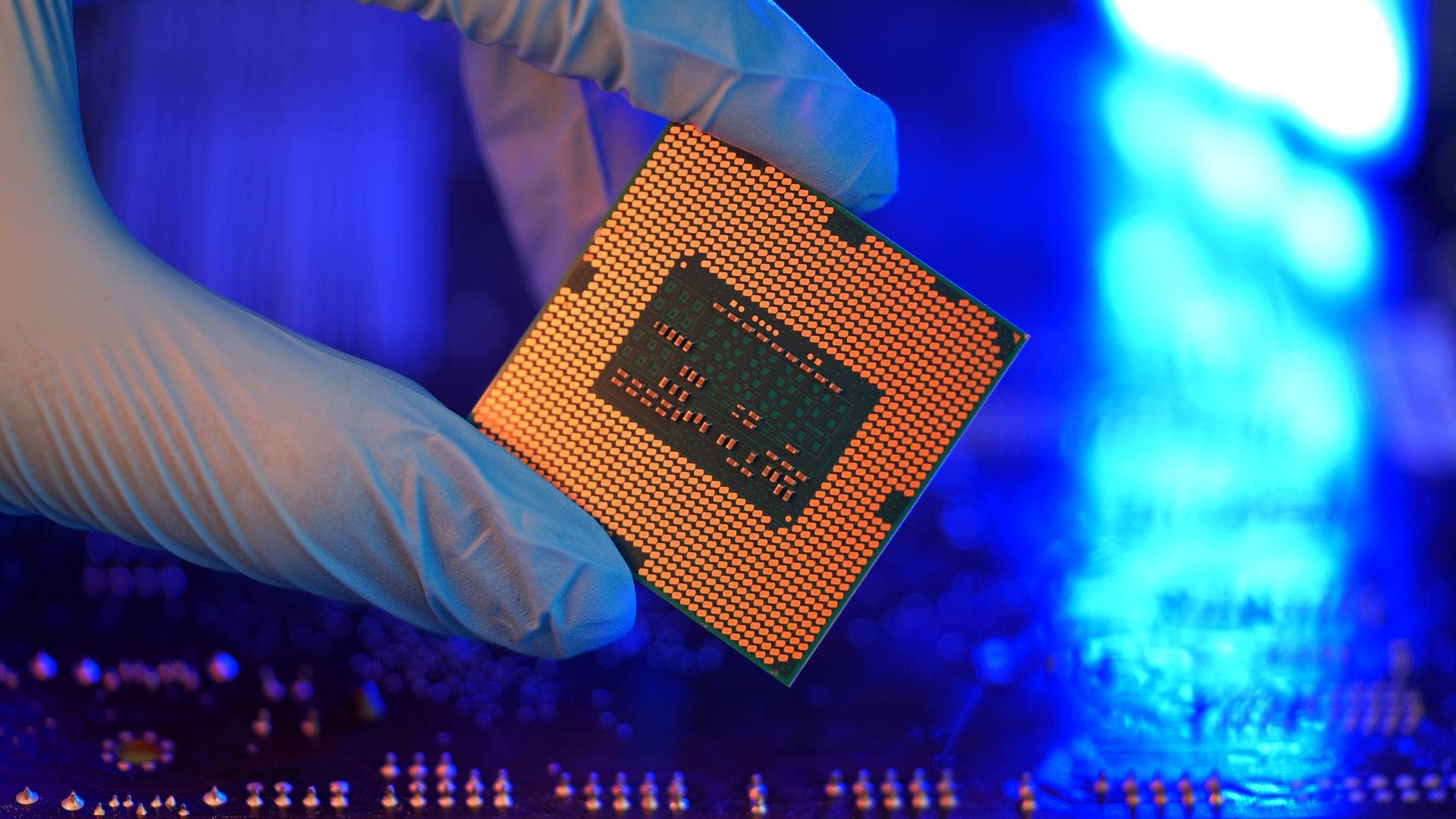 PSI and SMH invest in semiconductors differently. One follows market size, while the other rewards momentum, quality, and value across AI-driven chipmakers.
Wong Yu Liang&solGetty Images
Global chip sales are on pace to reach $1.5 trillion this year
The performance gap between PSI and SMH has opened during one of the strongest stretches the semiconductor industry has recorded.
Global semiconductor sales reached $298.5 billion in the first quarter of 2026, up 25% from the fourth quarter of 2025, the Semiconductor Industry Association reported.
Monthly sales in May reached $120.6 billion, up 104.1% from May 2025, the SIA reported on July 6, calling it the highest-ever recorded monthly sales total.
More Semiconductors:
- Citi sends warning on semiconductor and hyperscaler stocks
- Nvidia stock faces fresh AI roadmap risk, offering rare break to rivals
- Michael Burry doubles down on AI chip bubble with Micron short
“The global semiconductor industry is projected to hit $1.5 trillion in sales in 2026, reaching that milestone earlier than previously expected, fueled by increasing demand for AI infrastructure and accelerated computing platforms," SIA president and CEO John Neuffer said in a June 5, 2026, statement announcing global semiconductor sales for April.
That surge has lifted nearly every chip stock this year, but gains have spread unevenly, and the unequal distribution has exposed how much index construction shapes outcomes.
Index construction can matter more than sector selection for investor returns
SMH returned 66.2% year to date through early July, according to Benzinga, a gain that would outpace most sectors in any calendar year, but trailed PSI's 103.6% return over the same period by roughly 37 percentage points.
Hyperscaler AI spending keeps the chip sector outlook strong, says VanEck Product Manager Nick Frasse, as U.S. News noted.
Broadcom, a top-five holding in SMH, has gained only about 8% this year, offering little offset to Nvidia's flat performance in that fund, Benzinga reported.
A broadening chip rally could keep favoring diversified semiconductor funds
Islam noted in her ETF Trends analysis that the AI investment trade has broadened as investors search for beneficiaries across processors, networking, memory, foundries, and equipment.
"When a theme is strong, but leadership is spread across multiple companies, an ETF can provide diversified exposure to the broader value chain," Islam wrote.
Memory stocks have become central to the AI infrastructure story, and PSI's model rewards this shift by assigning greater weight to companies like Micron Technology.
Micron has surged roughly 253% year to date through July 6, a gain that has a much greater impact within PSI's balanced portfolio than within a concentrated fund, Benzinga reported.
The divergence between the two funds shows how much the benchmark a fund tracks and how it distributes holdings across that benchmark can shape total returns within the same sector.
Related: Fidelity reveals ETF trading traps to avoid


추천 콘텐츠

Pi Coin Price Falls, but the Pi Network Community Says There's a Surprising

Pi Network Unveils Major Pi App Studio Upgrade to Accelerate Web3

Pi Network Under Pressure? 120 Million Pi Coins Set to Unlock in 30 Days


인기 뉴스
더보기
