

Ethereum Foundation to Sell 5,000 ETH via CoWSwap TWAP: Market Impact
Ethereum Foundation to Sell 5,000 ETH via CoWSwap TWAP
Confusion around the Ethereum Foundation’s latest treasury activity comes from two separate events being merged into one narrative: a completed OTC disposal and an earlier CoWSwap TWAP plan.
The Foundation said it finalized a 5,000 ETH sale on March 14, 2026 at an average $2,042.96 via OTC, and it named @BitMNR (BitMine) as the counterparty.
According to unconfirmed reports, the same transfer was framed as a CoWSwap TWAP sale, but that mechanism is not in the issuer disclosure and should be treated as unverified.
What the Ethereum Foundation’s 5,000 ETH CoWSwap TWAP sale means
A report dated October 3, 2025 said the Foundation planned to convert 1,000 ETH through CoWSwap TWAP, which is distinct from the OTC event in the issuer update.
In practice, TWAP means splitting one large order into time-sliced executions, while OTC routes inventory directly to one counterparty; for this story, that method difference is the core reason the headline and the confirmed filing diverge.
The Foundation’s treasury policy says ETH sales are typically handled through fiat off-ramps or on-chain swaps into fiat-denominated assets, which fits the OTC structure in the March disclosure.
That routing choice mirrors how large holders try to reduce visible book impact, similar to the execution setup described in coinlineup’s report on BlackRock ETF wallets moving $49M in BTC and ETH to Coinbase Prime.
Potential ETH price and liquidity impact from a structured treasury sale
At the market snapshot in this brief, ETH traded near $2,204.24, was up about 5.1369% over the prior 24 hours, and carried a capitalization around $266.03 billion, which points to broader risk sentiment as a larger driver than forced spot liquidation.
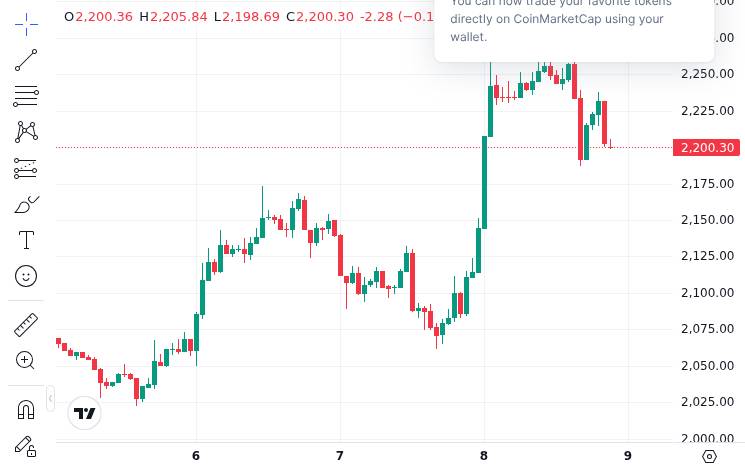 CoinMarketCap market data view included to frame the latest move in ethereum.
The comparison between the issuer-reported average execution level of $2,042.96 and the cited market level of $2,204.24 indicates the disclosed block was not equivalent to a panic sell into weak bids.
Macro tone still looked defensive, with the Fear & Greed Index at 17 (Extreme Fear), which helps explain why treasury headlines can trigger outsized interpretation even when mechanics are pre-arranged.
That reflexive behavior has been visible during other stress windows, including coinlineup’s coverage of the $285M Drift hack risk narrative and a separate report on speculative rotation in meme-coin positioning.
What traders should monitor after the Ethereum Foundation TWAP announcement
The practical next step is to track confirmed wallet-flow evidence and issuer statements first, then map that data to execution method instead of trading the headline phrasing alone.
A concise monitoring checklist is spot depth, bid-ask spread behavior, perpetual funding direction, open interest changes, and CoWSwap settlement cadence if a new on-chain program is formally announced.
Orderly absorption usually shows stable spreads and balanced derivatives positioning, while stress is more likely when deteriorating liquidity conditions align with risk-off sentiment such as the Extreme Fear reading in this brief.
For now, the strongest evidence remains the issuer-confirmed OTC structure, the named counterparty, and the earlier separate TWAP report, so risk decisions should be anchored to those verified datapoints rather than reposted claim chains.
Disclaimer: This content is for informational purposes only and is not investment advice.
Disclaimer: This article is for informational purposes only and does not constitute financial or investment advice. Cryptocurrency and digital asset markets carry significant risk. Always do your own research before making decisions.


You May Also Like

Nasdaq Wants to Give New ETFs a Smoother Launch Day

US Treasury Rolls Out Draft Rule To Implement GENIUS Act Compliance Program




