

Zcash (ZEC) Plunges 40% as Critical Orchard Pool Vulnerability Comes to Light After 4 Years
Key Takeaways
- Zcash (ZEC) experienced a roughly 40% price decline following the revelation of a critical security vulnerability within its Orchard shielded pool
- The flaw involved a “soundness” issue in the zero-knowledge proof circuit, possibly existing undetected since 2022
- Taylor Hornby, a security expert, identified the vulnerability using Anthropic’s Claude Opus 4.8 AI technology
- Network analysis found no evidence of exploitation, with turnstile safeguards preventing unauthorized coin creation
- The Zcash team implemented an emergency soft fork followed by a permanent hard fork (NU6.2) to resolve the security issue within days
In early June 2026, Zcash (ZEC) witnessed a devastating price collapse of approximately 40% after developers publicly disclosed and remediated a significant security vulnerability affecting its Orchard shielded pool. The dramatic selloff wiped out over $3 billion in market value and sent ZEC trading below the $350 threshold.
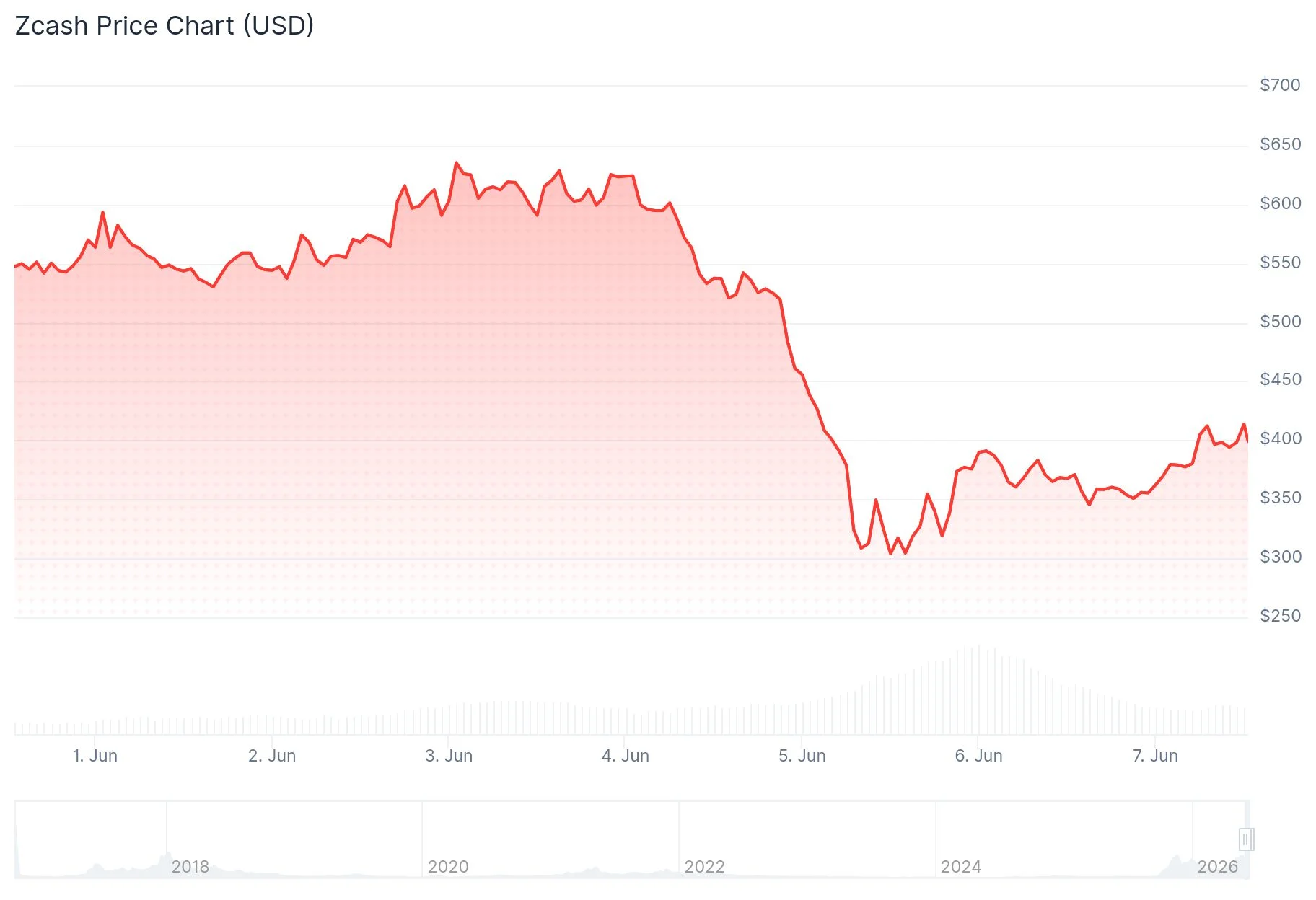 Zcash (ZEC) Price
The security issue was characterized as a “soundness” vulnerability within Zcash’s zero-knowledge proof circuit infrastructure. Evidence suggests the flaw could have been present since the Orchard pool’s initial deployment in May 2022, remaining hidden despite numerous professional security reviews.
The vulnerability was uncovered on May 29, 2026, by security expert Taylor Hornby during research funded by Shielded Labs. The breakthrough came through the innovative use of Anthropic’s Claude Opus 4.8 artificial intelligence system combined with specialized analytical tools.
Hornby, working in tandem with the AI system, successfully created a proof-of-concept demonstration capable of producing fraudulent ZEC tokens within a controlled testing environment. Crucially, however, the network’s built-in turnstile security mechanisms would have prevented any large-scale unauthorized supply inflation in real-world conditions.
Emergency Response and Network Upgrade
The Zcash development community responded with remarkable speed. On June 2, an emergency soft fork was rolled out through Zebra 4.5.3, which temporarily disabled Orchard transactions to eliminate the vulnerability vector.
A comprehensive resolution arrived on June 3 via the NU6.2 hard fork, which activated at block height 3,364,600. This upgrade implemented a corrected circuit design along with an updated verifying key. Normal Orchard operations resumed shortly after.
On June 4, Zcash co-founder Zooko Wilcox joined forces with Jason McGee and Taylor Hornby to publish a comprehensive public disclosure of the security incident. The team emphasized that no actual exploitation had been detected and confirmed that the overall ZEC supply remained accurate and uncompromised.
Cryptocurrency analyst Ardi (@ArdiNSC) offered his technical perspective on the price movement following the crash. He observed that ZEC surrendered nearly all gains from a multi-month rally that had delivered close to 250% returns—erasing those profits in mere days. His analysis anticipates a temporary recovery bounce toward the $430–$480 zone, but warns of further downside if that area fails to provide solid support. He indicated his bearish outlook would only shift with consecutive daily closes surpassing $520.
Investor Response and Transparency Concerns
ZEC had reached peaks above $600 before market sentiment deteriorated rapidly once vulnerability specifics became public knowledge. The decline through $350 intensified after news emerged that prominent investor Arthur Hayes had exited his entire ZEC holdings.
A significant source of trader anxiety centered on the fact that Zcash’s privacy-focused architecture makes comprehensive verification of potential exploitation nearly impossible. Unlike transparent blockchains like Bitcoin, transactions within the shielded pool remain cryptographically hidden from public scrutiny.
Shielded Labs announced future initiatives including expanded AI-powered security auditing, a formal verification initiative for the Orchard circuit architecture, and potential development of an enhanced shielded pool with superior supply transparency features.
Cameron Winklevoss characterized the incident positively, framing it as evidence of the project’s robustness, noting that top-tier security researchers continuously probe and strengthen the network’s defenses.
According to the most recent updates, no exploitation has been verified, the NU6.2 upgrade is successfully operating across the network, and ZEC continues trading under the $400 level.
The post Zcash (ZEC) Plunges 40% as Critical Orchard Pool Vulnerability Comes to Light After 4 Years appeared first on Blockonomi.


You May Also Like

Alex Eala ends winless run vs Czech foes to capture Birmingham Open crown

Putin Says Moscow Will Continue Building Iran’s Nuclear Infrastructure

Moody’s Assigns First-Ever Rating to Bitcoin-Backed Municipal Bond in Historic Crypto Finance Move



