

Could Disease Outbreaks Accelerate Stablecoin Adoption In Frontier Markets

The idea sounds dramatic at first, linking an Ebola outbreak in Africa to a crypto boom, but markets don’t move on headlines alone. They move on to behavior, liquidity, fear, access to banking, and how people react when normal systems feel strained. Tension is building up in several places in Central and East Africa.
June set in with an active Ebola epidemic in DRC and Uganda. The World Health Organization (WHO) estimates 340 cases and 60 deaths. So the real question isn’t theoretical anymore. It’s whether disruptions like this can spill over into financial behavior, including crypto usage.
The current outbreak is more focused on a challenging setting. The absence of contact tracking, inadequate funds, and insecurity have made it impossible for health personnel and civilians to travel and communicate.
This matters for financial systems because outbreaks like this don’t happen in isolation. They intersect with daily life, markets, transport, remittances, and informal trade.
Why crises sometimes push people toward crypto
During major disruptions, people don’t suddenly “adopt crypto” in a philosophical sense. They use whatever tools still function.
In past global shocks, especially in 2020 when COVID-19 struck, charts show that digital financial activity increased in several regions as people adapted to restricted movement and strained banking access. The Bank for International Settlements has noted that adoption patterns can accelerate in environments where traditional financial systems are under pressure.
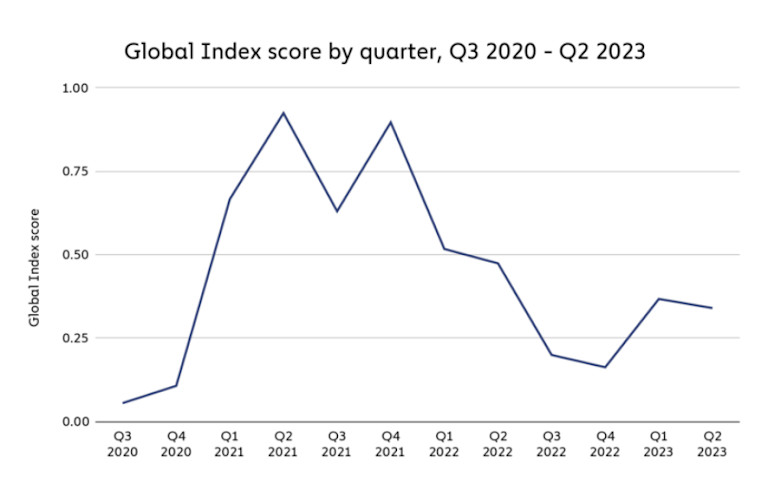
Source: Chainalysis
In simpler terms, when it becomes harder to move money through normal channels, people look for alternatives that are accessible on mobile devices, not dependent on physical branches, and fast for cross-border transfers. That’s where crypto and stablecoins enter the conversation.
Africa’s unique payment reality
To see how an Ebola-driven lockdown may affect crypto, it’s important to know how payments are done in many African economies.
In many parts, mobile money systems are the primary means of everyday transactions, and cross-border payments continue to be a challenge. Informal trade routes are prevalent in border areas between DRC and Uganda, and many people use non-traditional financial systems when formal ones are slow or costly.
That’s why, during times of instability, stablecoins are more likely to be the focus of attention than investments, as they are known for their liquidity.
Over the years, the usage of stablecoins has been directly linked to times of financial chaos and currency pressure in emerging markets. Stablecoin use has been correlated with times of financial chaos and currency pressure in emerging markets over the years, consistently, according to Chainalysis research.
What an Ebola lockdown could realistically change
But if restrictions worsen, like movement restrictions, localized lockdowns, or tightening of borders, the most significant thing that would be affected in the short term wouldn’t be speculative trading. It would be remittances and payments.
People in affected regions often rely on cross-border flows for family support transfers, small business trade settlements, emergency funding, and informal import/export activity.
If banks are harder to access or transport routes become restricted, digital alternatives naturally gain attention. But that doesn’t automatically translate into a “crypto boom.” It usually shows up first in stablecoin usage, not Bitcoin speculation.
The speculation narrative vs real usage
Outside the region, especially in global trading communities, crises often trigger a different reaction: speculation.
Traders may interpret uncertainty as a liquidity event and position themselves in risk assets, including crypto. That’s where the “boom narrative” usually comes from, not from local adoption but from global capital flows reacting to macro fear.
However, institutional behavior tends to move in the opposite direction during early crisis phases. Risk assets are often sold off first, not bought.
So you end up with two different realities. Local users will potentially increase practical digital payment use, and global markets may react with volatility, not necessarily sustained growth
Stablecoins are the real pressure point
If any part of crypto benefits directly from crisis-driven behavior, it is stablecoins.
They function as digital dollar substitutes in many emerging markets and are often used for remittances, savings protection, and cross-border trade settlement
In a scenario where banking access is disrupted even temporarily, stablecoins would likely see increased transaction activity long before speculative tokens do. But even then, this is usually a utility spike, not a long-term adoption wave.
The urge to link crises with market narratives of explosions is strong, but historically, it is not. For instance, the COVID-era crypto rally was more about the global liquidity expansion and the inflows from institutions rather than COVID. While crises can speed up the awareness, they do not necessarily create bull markets.
In the same way. An Ebola-related lockdown might lead to more visibility of digital finance products, stimulate usage of stablecoins in the distressed region, and lead to temporary price fluctuations on global crypto markets.
But interest rates, liquidity, regulation, and technology adoption would still be crucial elements to maintaining a boom, even more basic ones.
Final view
So, could another crypto boom be triggered by an Ebola lockdown? Not in the ‘easily done’ sense that people usually think of.
What it can actually accomplish is emphasise the effectiveness of borderless financial measures in specific circumstances when borders are problematic. That will lead to greater stability of the cryptocurrency market, greater experimentation in border payments, and greater attention paid to digital infrastructure in stressed areas.
However, a crisis trigger is not enough to create a full market boom. It needs long-term trust in the ecosystem, policy clarity, and sustained capital flows. Crises change behavior temporarily. When those behaviors stick, markets change.
The post Could Disease Outbreaks Accelerate Stablecoin Adoption In Frontier Markets appeared first on Metaverse Post.


You May Also Like

Why Businesses Need Professional Machine Design and Development Services

Quantum-Powered Crypto Mining Is Here—But It Won’t Help You Mine Bitcoin

Lenovo Stock Drops 10% As Price Hike Reports Hit — Is the 140% Rally at Risk?



