

Goldman Sachs Sees $60 Oil as a Real Possibility — Here’s What Changed
TLDR
- Goldman Sachs cut its Q4 2026 Brent forecast to $80 from $90 after a U.S.-Iran interim deal
- The bank lowered its 2027 Brent average forecast to $75 from $80
- President Trump announced a deal to lift the U.S. blockade and reopen the Strait of Hormuz
- Goldman now expects Persian Gulf exports to normalize by end of July, a month earlier than previously expected
- Brent fell 3.4% to $87.33 and WTI dropped 3.2% to $84.88 on peace deal news
Goldman Sachs has cut its oil price forecasts after President Trump announced an interim deal to lift the U.S. blockade and reopen the Strait of Hormuz.
The bank now expects the strait to be fully operational by end of July 2026, one month earlier than its previous estimate of end-August.
Goldman cut its Q4 2026 Brent crude forecast to $80 a barrel, down from $90. Its 2027 average Brent forecast was lowered to $75, down from $80. WTI is now expected to average $75 in Q4 2026 and $70 in 2027.
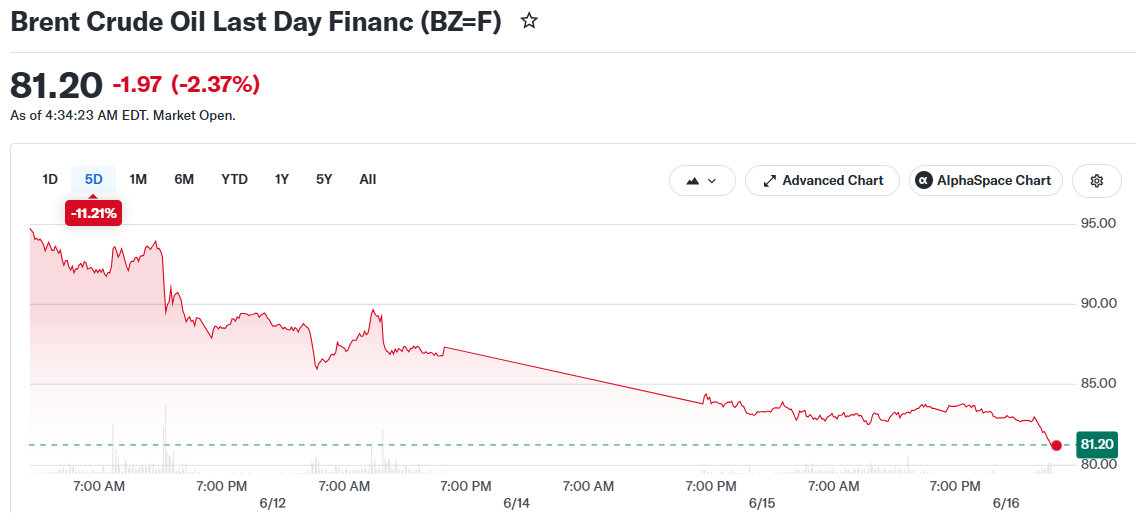 Brent Crude Oil Last Day Financ (BZ=F)
The bank said moving the supply normalization timeline forward by a month reduces the fair value of crude by around $10 and $5 a barrel for those periods.
Oil markets reacted quickly to the peace deal news. Brent settled down 3.4% at $87.33, while WTI fell 3.2% to $84.88.
Why the Strait of Hormuz Matters
The Strait of Hormuz handles roughly one-fifth of global oil and LNG supply. When traders believed it could reopen, the war premium in prices faded fast.
Gulf flows have already risen to an estimated 11 million barrels per day. Goldman said reaching pre-war export levels would require just a 12 million barrel-per-day increase in Hormuz flows to 70% of pre-war volumes.
Earlier in the conflict, traders feared losses of 12 to 15 million barrels per day of Gulf exports. Current estimates have narrowed to around 5 to 6 million barrels per day.
U.S. crude inventories dropped by 7.2 million barrels to 426.5 million, sitting nearly 5% below the five-year average. Distillates were 13% below normal.
Supply Growth and Demand Weakness
Goldman pointed to stronger supply coming from the U.S., Brazil, Guyana, Venezuela, and the UAE as reasons for the softer long-term outlook.
Weaker demand, partly driven by China’s shift toward electric vehicles, is also weighing on the longer-term picture. The bank said it assumes just over 10% of demand weakness will persist.
Despite a forecast 3.2 million barrel-per-day surplus in 2027, Goldman still expects prices to hold near long-term fair values. Strategic stockpiling above 1 million barrels per day is expected to limit how much inventories build.
Goldman said risks remain tilted to the upside. If Hormuz stays disrupted through 2027, Brent could top $130 in late 2026 and average $105 next year.
In a downside case involving faster export recovery and weaker demand, Brent could fall below $60 in 2027.
Exxon CEO Darren Woods warned that if the strait stays closed, supply sources will run out. The bank kept some security premium in its forecast, citing ongoing disruption risk.
The formal deal signing is scheduled for Friday.
The post Goldman Sachs Sees $60 Oil as a Real Possibility — Here’s What Changed appeared first on CoinCentral.


You May Also Like
Synopsys (SNPS) Stock Climbs on Murata Simulation Model Partnership

Hyperscale Data (GPUS) Stock Retreats After 77% Rally on Massive AI Data Center Agreement

Franklin Templeton CEO Dismisses 50bps Rate Cut Ahead FOMC



