

Oil Slides as Iran Says Peace Talks Are Working — But Analysts Urge Caution
TLDR
- Brent crude fell to around $79 a barrel after Iran reported “major progress” in peace talks with the US in Switzerland
- Both Brent and WTI had already dropped nearly 10% last week on optimism over an interim peace deal
- The US and Iran agreed on a 60-day roadmap, with technical talks continuing through the week at Bürgenstock resort
- Iran briefly closed the Strait of Hormuz again over the weekend, blaming Israeli military operations in Lebanon
- Analysts warn markets may be too optimistic, with 80 million barrels of crude potentially hitting the market if Hormuz fully reopens
Oil prices dropped Monday after Iran said peace talks with the United States in Switzerland had made “major progress.” Brent crude fell around 2% to roughly $79 a barrel, while West Texas Intermediate slipped to near $75.
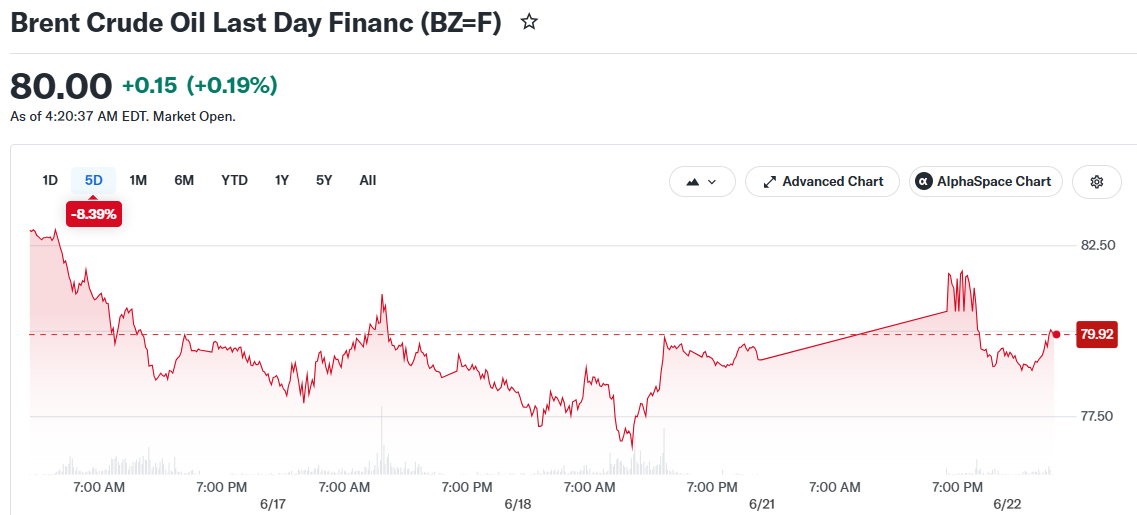 Brent Crude Oil Last Day Financ (BZ=F)
Both contracts had already fallen close to 10% last week when an interim peace deal was announced. Monday’s drop continued that trend as traders factored in the possibility of more Iranian oil reaching global markets.
Iranian Foreign Minister Abbas Araghchi confirmed progress had been made in the quadrilateral talks. The discussions are being mediated by Qatar and Pakistan and are taking place at the Bürgenstock resort in Switzerland.
The two sides have agreed on a 60-day roadmap toward a final deal. Technical talks are set to continue through the rest of the week.
What the Talks Covered
Negotiators discussed sanctions relief, maritime security, and a framework for future talks on Iran’s nuclear program. They also created a communications mechanism to help keep commercial shipping lanes through the Strait of Hormuz open.
US Vice President JD Vance took part in the discussions alongside senior Iranian officials. The meeting follows a memorandum of understanding signed by both sides last week.
Despite the progress, the process hit a rough patch over the weekend. Iran claimed it had again closed the Strait of Hormuz, citing ongoing Israeli military operations in Lebanon and alleged failures by the US to meet commitments in the interim agreement.
Millions of barrels of oil continued to flow through the strait over the weekend, however. Chubb CEO Evan Greenberg told Fox News that security in the region remains volatile.
Risk of a Flare-Up Remains
Traders responded to Trump’s comments by rebuilding a geopolitical risk premium into oil prices. ING analysts warned that “moving towards a more permanent deal will be challenging, with very real risks of a flare-up in hostilities during the 60-day ceasefire.”
Vivek Dhar, an analyst at Commonwealth Bank of Australia, said markets may be too optimistic about a quick return to normal oil flows from the region.
Persian Gulf producers are already preparing for higher output. Kuwait canceled earlier force majeure notices, and Abu Dhabi National Oil Company told customers to resume loading supply from inside the Persian Gulf.
If Hormuz fully reopens, analysts estimate around 80 million barrels of crude could hit the market quickly. That volume could overwhelm refiners, especially with demand from China, the world’s top oil importer, currently running soft.
Oil prices remain higher than pre-war levels, but the direction of travel depends on whether diplomats can hold the peace process together in the days ahead.
The post Oil Slides as Iran Says Peace Talks Are Working — But Analysts Urge Caution appeared first on CoinCentral.


You May Also Like

Bitcoin Liquidations Dethroned? A Tokenized Bet Just Posted Crypto’s Biggest Loss

Polymarket Paid Creators To Film Fake Trades In Covert Social Media Campaign, Investigation Finds

Current price of oil as of June 22, 2026



