

Aave Captures More Than 80% of DeFi Lending Revenue as Rivals Struggle to Keep Up
Key highlights:
- Aave generated more than $930,000 in revenue over the last seven days, accounting for over 80% of the DeFi lending sector's earnings.
- The protocol manages $22.79 billion in supplied assets, more than double the amount deposited into second-ranked Morpho.
- Aave's revenue dominance comes as lending activity across DeFi continues to recover amid growing institutional participation.
Aave is taking home the vast majority of DeFi lending profits
Aave has cemented its position as the undisputed leader of decentralized lending.
According to DeFiLlama, Aave generated approximately $930,606 in revenue during the last seven days, accounting for more than 80% of the total revenue generated by all tracked DeFi lending protocols in that time period.
The figure dwarfs competing protocols such as Maple ($311,393), Kamino ($90,270), SparkLend ($85,858), and Compound ($29,751).
While competitors continue attracting deposits and expanding across multiple chains, Aave remains the only lending protocol consistently converting scale into meaningful earnings.
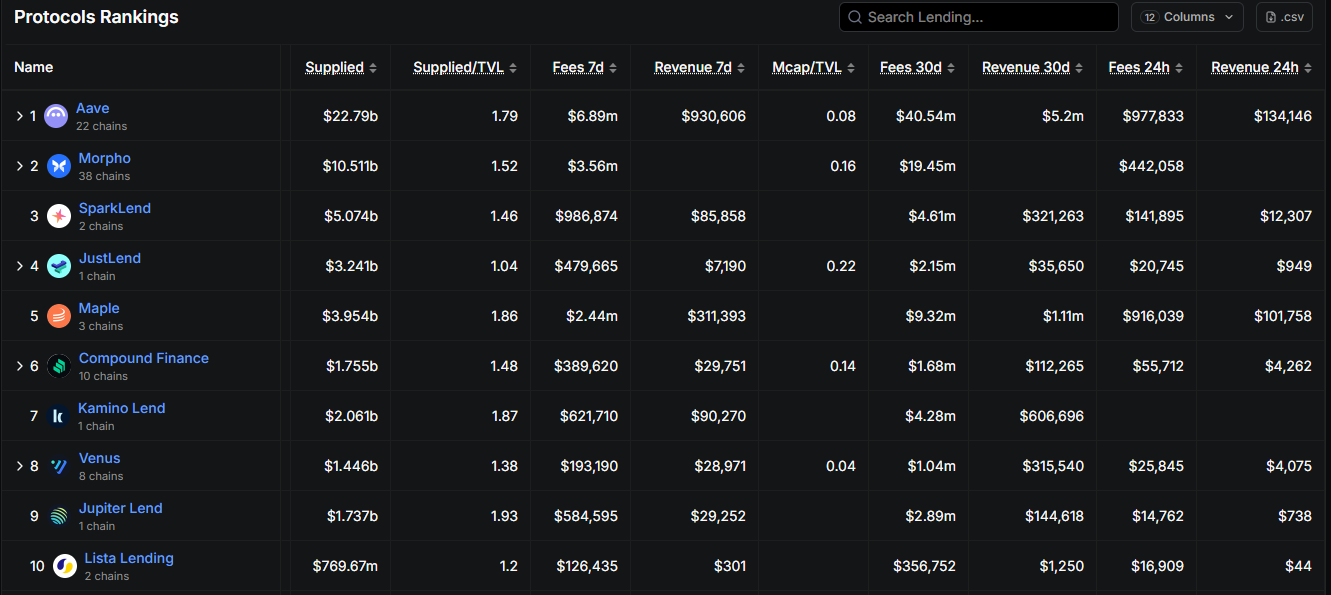
DeFi protocol rankings by amount supplied. Source: DeFi Llama
Scale is becoming Aave's biggest advantage
The protocol's revenue lead mirrors its dominance in total capital supplied.
Data shows users have deposited approximately $22.79 billion into Aave, giving it the largest lending market in decentralized finance. By comparison, second-ranked Morpho holds roughly $10.5 billion, while SparkLend manages approximately $5 billion.
That scale creates a powerful competitive advantage.
More deposits allow Aave to facilitate larger borrowing markets, generate higher fee volumes, and attract additional institutional participants seeking deep liquidity.
The protocol's $40.5 million in fees over the past 30 days further illustrates how effectively it monetizes activity compared to rivals. The positive metrics aligns with AAVE price predictions to hit $ 91.13 by the end of 2026.
Competitors are growing, but profits remain concentrated
Interestingly, the data suggests market share and profitability are not necessarily moving together.
Morpho has emerged as one of the fastest-growing lending protocols, accumulating more than $10 billion in supplied assets. Yet despite managing nearly half of Aave's deposits, the protocol generated less than half the fees and significantly lower revenue.
Other competitors face similar challenges.
Kamino, Jupiter Lend, Venus, and Compound continue expanding their ecosystems, but none have demonstrated Aave's ability to convert activity into protocol earnings at scale.
The disparity suggests that Aave mostly extends beyond liquidity alone. Brand recognition, risk management, governance infrastructure, and institutional integrations may be helping the protocol maintain its lead.
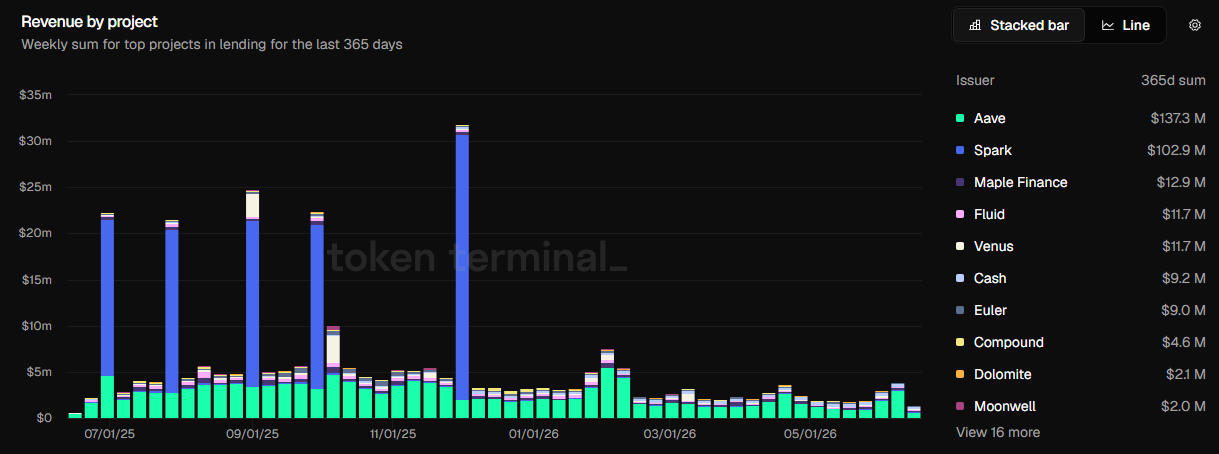
DeFi lending protocols ranked by yearly revenue. Source: Token Terminal
Why investors are paying attention
The figures arrive at a time when investors are increasingly evaluating crypto projects based on revenue generation rather than speculative narratives.
As the digital asset market matures, protocols capable of producing sustainable cash flows are attracting greater attention from both retail and institutional investors.
Aave appears to be one of the clearest examples of that trend.
With nearly $23 billion in supplied capital, tens of millions in monthly fees, and the overwhelming majority of sector revenue flowing through its ecosystem, the protocol is beginning to resemble a mature financial platform rather than a traditional crypto startup.
For AAVE holders, the numbers reinforce the protocol's dominant position within decentralized finance.
For competitors, they highlight a growing challenge: gaining market share is one thing, but matching Aave's profitability is proving far more difficult.


You May Also Like

LIST: Bayanihan initiatives amid soaring oil prices
ASICID Launches Plug-and-Play Crypto Miners With Up to $25,590 Monthly Revenue

Report reveals what started Trump's feud with Italian pal: 'She doesn't see this as petty'


Trending News
More24/7 Live News
MoreQuick Reads
More
