

Daya raises $2.4 million to simplify cross-border payments for African businesses
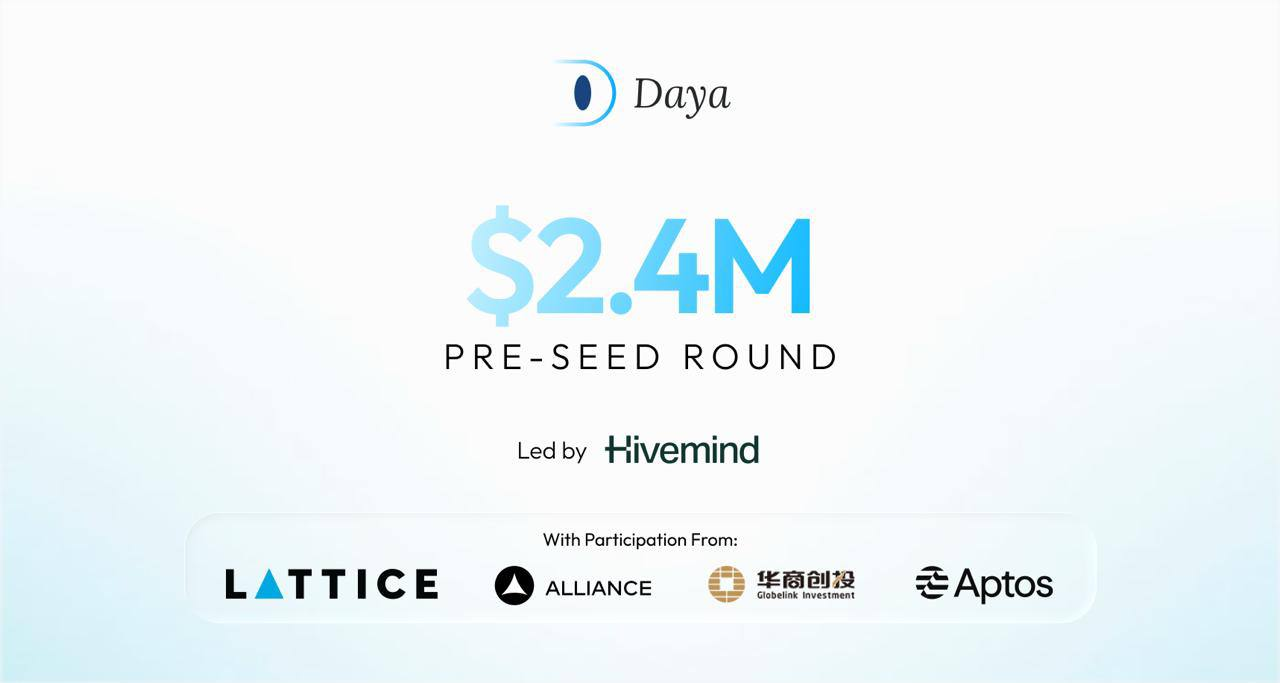
Daya, a Nairobi-based fintech building payment and treasury infrastructure for African businesses, has raised $2.4 million in a pre-seed round to expand its platform across the continent.
The round was led by Hivemind Capital, with participation from Lattice Fund, Alliance, and Aptos. The funding will support Daya’s efforts to reduce the cost and complexity of cross-border money transfers for African businesses, freelancers, and global teams.
The startup was founded by Tomiwa “Aleph” Lasebikan and Paul Joe in October 2025. Lasebikan’s path to building Daya ran through Helicarrier, the Y Combinator-backed crypto startup he co-founded after leaving Microsoft in 2018.
As head of product there, he kept noticing that customers were not really showing up for crypto; they were showing up because they needed a faster, cheaper way to receive dollars and pay suppliers abroad. That recurring frustration became the thesis behind Daya.
 Daya
Daya
Daya describes itself as a financial engine for African businesses, offering unified payment infrastructure, real-time foreign exchange, stablecoin rails, and modern treasury management from a single platform. In practical terms, a business can collect payments, convert currencies, manage multi-currency accounts, and send international transfers without juggling several separate providers, a problem that has long defined cross-border commerce in Africa.
What Daya actually solves for African businesses
For African businesses, freelancers, and companies managing global teams, moving money across borders has long meant dealing with high fees, slow settlement times, and fragmented systems that rarely talk to each other.
A business in Lagos paying a supplier in another country might need a bank for local transfers, a separate FX provider for currency conversion, and yet another platform for international payouts, each adding cost and delay.
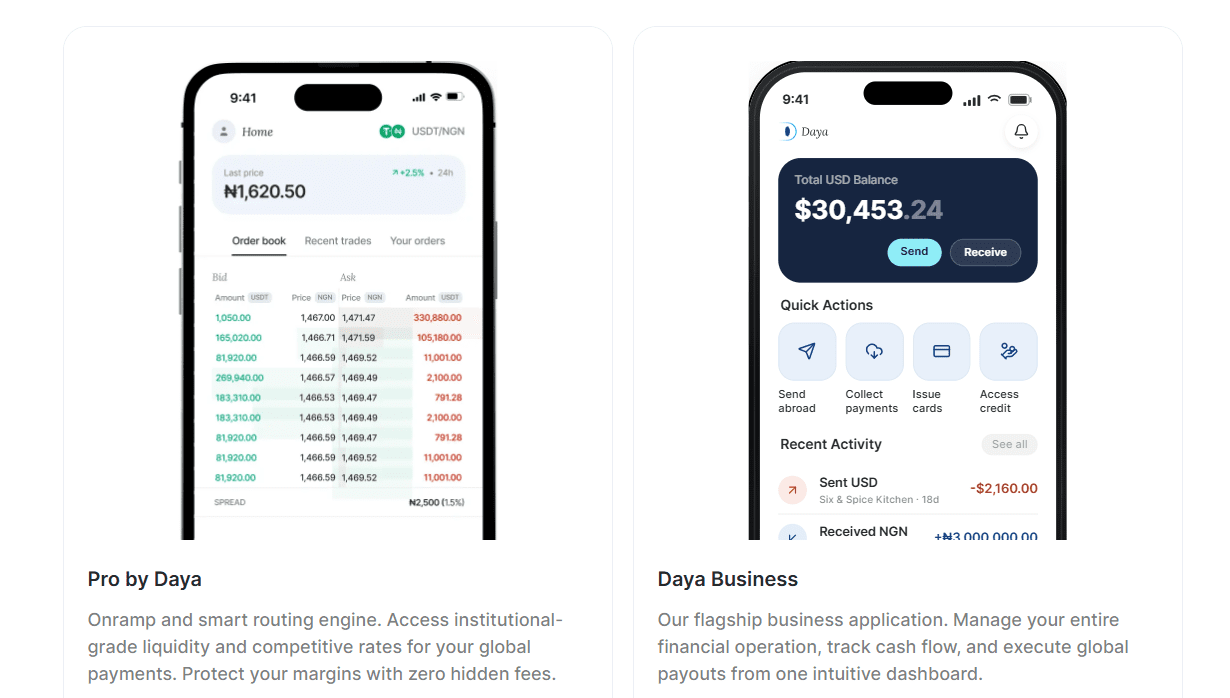
Daya consolidates financial operations into a single system. Its flagship product, Daya Business, enables companies to manage their entire financial workflow, including cash flow tracking and global payouts, from one dashboard. The companion product, Pro by Daya, serves as an onramp and smart routing engine, providing access to institutional-grade liquidity and competitive exchange rates while safeguarding margins from hidden fees.
The platform provides developers with a straightforward API to integrate payment and FX capabilities directly into their products. Live currency quoting and payout execution can be implemented with minimal code, which is valuable for fintechs and platforms seeking to embed cross-border payment functionality without developing it independently.
The opportunity Daya is chasing is significant. The global B2B cross-border payments market was worth $31.7 trillion in 2024 and is projected to reach $47.8 trillion by 2032, according to research firm FXC Intelligence, dwarfing consumer remittances, which totalled $905 billion globally in 2024 according to the World Bank.
Also read: Tapnob rolls out Nigeria’s first crypto-to-Naira gateway and lightning addresses to bridge the utility gap
Businesses simply move far more money than individuals do, yet much of that activity still runs on ageing correspondent banking infrastructure that was never built for speed.
Daya is also not alone in betting on stablecoins to fix this. Bridge, the stablecoin company Stripe acquired in 2025, has built similar banking-linked settlement rails, with Stripe reporting that Bridge’s transaction volume grew more than fourfold in its 2025 annual letter.
 Stablecoins
Visa and Mastercard have both expanded stablecoin settlement pilots, and Mastercard has agreed to acquire BVNK, a UK-based stablecoin neobank. Within Africa specifically, companies including Yellow Card, Juicyway, and Conduit are building comparable infrastructure focused on cross-border payments and treasury flows for businesses.
The new $2.4 million investment gives the company more resources to develop this infrastructure and grow its presence across Africa.


You May Also Like
Web3 Marketing Isn’t Broken -Most Projects Are Using It Wrong

U.S. Manufacturing Activity Surges to 49-Month High, Signaling Strong Economic

Custom Silicon and Scalable Ledgers



