Why You Need a High-Yield Savings Account for Short-Term Goals and Cash Reserves, from a Personal Finance Expert
The post Why You Need a High-Yield Savings Account for Short-Term Goals and Cash Reserves, from a Personal Finance Expert appeared first on 24/7 Wall St..
A high-yield savings account (HYSA) is an FDIC-insured deposit account that pays significantly more interest than a traditional savings account while keeping your cash accessible and risk-free up to insurance limits. If you have an emergency fund, cash you aren’t planning to invest, or you’re saving for a down payment, a strong HYSA is one of the easiest ways to upgrade your personal finances. My career is built on analyzing consumer banking products like HYSAs, credit cards, and mortgages to help people maximize their money. When I want to increase my savings and don’t want it to be eaten alive by inflation, I put my money in a HYSA. Here’s why you should, too.
What Makes a Savings Account High-Yield?
There is no specific legal definition for what constitutes “high-yield.” In practice, a HYSA is any savings account with an annual percentage yield (APY) that is substantially higher than the national bank average. For my money, I want to see a HYSA yield at least 0.5%–2% above inflation.
The FDIC reported that the national average yield on a 12-month certificate of deposit (CD) was 1.65% as of June 2026, and traditional savings averages are well below that. However, competitive online HYSAs regularly offer rates that are double that or more, depending on the current federal funds rate. Since online institutions lack the overhead costs of physical branches but must compete nationally, they pass these savings on to customers by offering higher interest rates.
How HYSA Rates Are Determined
HYSA yields are primarily driven by benchmark interest rates set by the Federal Reserve, with a lag of a few weeks to a few months. When the Fed raises rates, online banks generally pass that increase on to customers. When rates are cut, yields decrease. The Federal Funds Rate target upper bound sits at 3.75% as of June 2026, down 0.75 percentage points from a year ago, after the Fed eased policy to the 3.50%-3.75% target range on December 10, 2025. Lowering that benchmark rate is exactly why HYSA rates today are lower than they were this time last year.
For context on real returns, the Consumer Price Index (CPI), which measures the change in prices paid by consumers for everyday goods and services, has climbed steadily over the past year. The CPI reading was 333.979 in May 2026, up from 332.407 in April 2026. The Fed’s preferred gauge for measuring inflation, the Core Personal Consumption Expenditures (PCE) index, is also showing consistent month-over-month increases through April 2026. Currently, a strong HYSA generally outpaces headline inflation, but a mediocre one does not, so rate shopping is crucial.
Who Should Open a HYSA?
A HYSA is the right place for your money if you want it to be safe, liquid, and earning. Consider a HYSA if you have:
- Emergency funds. Most financial planners recommend that people save 3-6 months of expenses. The FINRA Foundation’s 2024 National Financial Capability Study found that 46% of U.S. adults have rainy day funds covering three months of expenses, down from 53% in 2021. No matter how much you have, don’t let it stagnate in a traditional savings account when you could be earning considerably more.
- Short and medium-term goals. If you’re saving for a wedding, a down payment on a house, next year’s tax bill, or a planned car purchase, put your nest egg in a HYSA. If you need to access your savings within a few years, it does not belong in the stock market.
- Cash drag in a broader investment portfolio. Even committed investors keep liquid cash reserves. However, there is no reason to let those reserves sit idle when you can deposit the cash into a HYSA.
A HYSA is the wrong choice for long-term retirement savings. Over decades, equities and bonds have historically outpaced cash by a wide margin. It is also the wrong option if you want to make daily transactions. Most banks still throttle outbound transfers, and many do not issue debit cards on savings accounts.
How to Choose a Strong HYSA
When it comes to choosing a strong HYSA, here are the five things I tell my family, friends, and our readers to look for:
- Yield and how it is delivered. A great rate on the entire balance beats a teaser rate that applies only to the first few thousand dollars, or that only lasts for the first few months. Find out whether the APY is tiered, capped, or promotional.
- Minimums and fees. The best online HYSAs charge no monthly maintenance fees and require no minimum balances. If an account demands a high opening deposit, charges for paper statements, or penalizes balances below a certain threshold, the yield is effectively lower than advertised.
- Access. Check transfer limits, ACH speed, mobile app quality, and whether the account offers an ATM card. For an emergency fund, a two-day delay during a real emergency is a serious problem.
- Insurance and ownership. Bank deposits are protected by the FDIC or the NCUA for credit unions. Accounts are insured up to $250,000 per depositor, per institution, per ownership category. Confirm FDIC or NCUA coverage and determine how it scales if your balance approaches the per-institution cap. Joint accounts, trust titling, and multiple banks all extend your coverage.
- Sign-up bonuses. Some banks offer a one-time cash bonus for new deposits that meet funding and time requirements. Read the terms so you’re not locked into an account that could cost you a better long-term yield elsewhere.
The Tradeoffs and Fine Print
As I mentioned earlier, yields are variable and will drop when the Fed cuts rates, which it has been doing. The yield curve, measured by the 10-year minus 2-year Treasury spread, has flattened sharply, sitting at 0.27% as of June 18, 2026, down from 0.54% in mid-May. Markets are pricing in further easing, which generally drags savings yields down with it.
Interest is taxed as ordinary income at the federal level and in most states. A HYSA paying a strong rate in a high tax bracket is still attractive, but the after-tax return is what matters. Conversely, U.S. Treasury bills are exempt from state income tax, and the 10-year Treasury note currently yields around 4.49%, which is worth considering when comparing alternatives.
Common Mistakes to Avoid
The biggest mistake is doing nothing. Leaving cash in a traditional savings account at a megabank is the most expensive non-decision in personal finance. The second mistake is chasing a headline rate without reading the conditions, including caps, promotional windows, and minimum balance penalties. The third is overfunding a HYSA at the expense of retirement contributions, especially when employer matching is available. Financial advisor Suze Orman urges savers to favor strong institutions paying genuinely competitive rates, bluntly telling her listeners,
HYSAs Versus the Alternatives
Even if you feel like a HYSA is a good fit for you, there are a few alternatives to consider if you need to park your cash. In addition to the Treasury bills mentioned above, one alternative is a money market account (MMA). MMAs frequently offer check writing and debit card access, making them an attractive option if you need more flexibility. MMA yields are also competitive with HYSAs. The right choice depends on how often you need to write checks against the balance.
CDs are another possibility. Funds are locked for a defined term in exchange for a fixed yield. CDs make sense when you have a set timeline and want to lock in a high APY before further Fed cuts. They can often provide a slightly higher yield, but they come with liquidity limitations, including interest penalties for early withdrawals, that HYSAs generally don’t have.
The third and most common option is a checking account. Most people choose a checking account because it is the easiest way for most households to manage their cash flow for bills, groceries, and other expenses. Unfortunately, the yields are practically non-existent. Instead, I recommend that all of my friends and readers consider a checking account and a HYSA. You can move money between the two as needed, keeping the checking account relatively low with the cash you’ll need for the next few weeks, drawing on the HYSA if needed. This is easy to manage with ACH between the two accounts, especially if both are with the same bank.
Putting Your HYSA to Work
When you open your account, automate a recurring transfer for the day after payday, and revisit the yield once or twice a year. With personal savings rates falling from 6.2% in Q1 2024 to 3.7% in Q1 2026, every dollar you save needs to work harder. A HYSA is the easiest and most cost-effective way to make that happen.
Additional Resources:
Finding the Best High-Yield Savings Account Rate for Your Money
How High-Yield Savings Accounts and Money Markets Compare for Savers
How Do High-Yield Savings Account Sign-Up Bonuses Work, and Are They Worth It?
Bask Bank Offers FDIC-Insured Accounts with Cash Interest or AAdvantage Miles
The post Why You Need a High-Yield Savings Account for Short-Term Goals and Cash Reserves, from a Personal Finance Expert appeared first on 24/7 Wall St..
You May Also Like
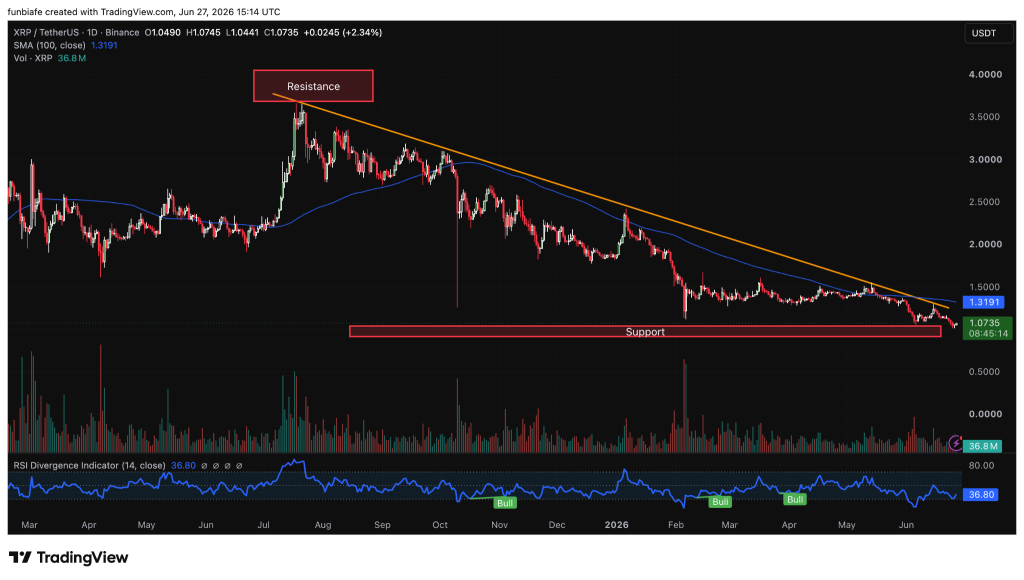
What Happens to the XRP Price if the Crypto Bear Market Gets Worse?

Solana SOL Reclaims $72, But Fading On-Chain Metrics Signal Weakening DEX Momentum

Bitcoin Price Prediction: Analysts Believe BTC Bottom Window Is Open