

Morgan Stanley Slashes Brent Crude Outlook After Hormuz Shipping Rebounds
Key Highlights
- Morgan Stanley reduced its Q3 2026 Brent crude projection by $15 to $75 per barrel
- Tanker movements through the Strait of Hormuz have rebounded to typical levels of 30-40 vessels daily
- The investment bank forecasts a worldwide oil glut of 4.8 million barrels daily in 2027
- Brent prices have surrendered April’s rally, declining from over $126 to below $74
- Crude is heading toward three consecutive months of losses and its weakest quarter since early 2020
Morgan Stanley has revised its oil price projections downward following a quicker-than-anticipated rebound in vessel movements through the Strait of Hormuz. The financial institution slashed its third-quarter 2026 Dated Brent projection by $15, adjusting it to $75 per barrel.
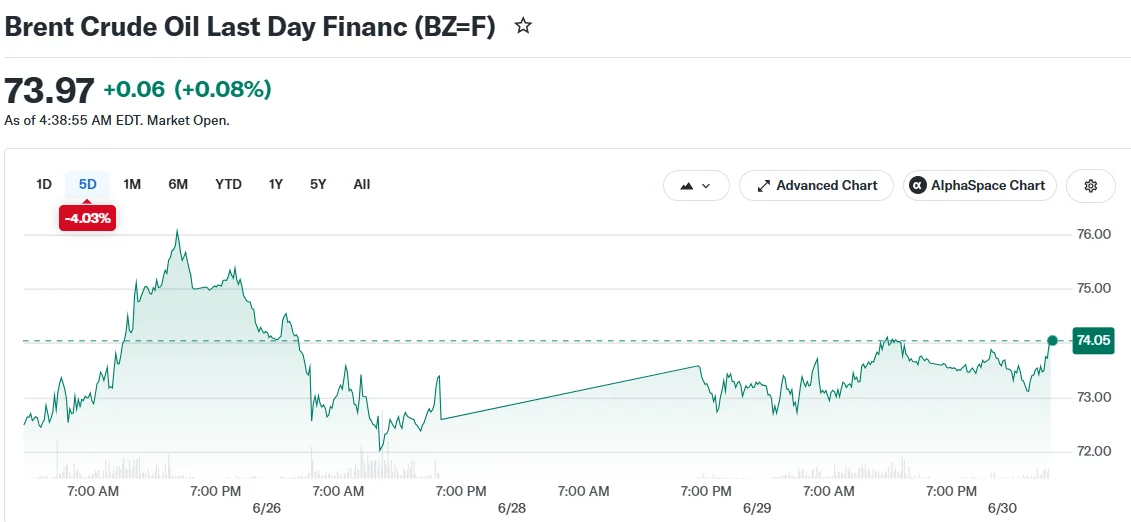 Brent Crude Oil Last Day Financ (BZ=F)
The revision follows a four-month disruption that hampered petroleum shipments through the strategically vital waterway. This strait serves as a crucial conduit for energy exports originating from Middle Eastern nations.
Shipping Activity Returns to Typical Ranges
Morgan Stanley analysts observed 35 petroleum and natural gas tankers departing the Persian Gulf via the strait on Thursday. This figure aligns with the 30 to 40 vessel range documented prior to February’s onset of hostilities.
This represented the initial instance of traffic returning to normal parameters since the conflict’s commencement. Shipping operators and maritime personnel now demonstrate renewed confidence in transiting the waterway, according to the bank’s assessment.
Traffic experienced a temporary slowdown following a weekend incident where two vessels sustained damage during renewed tensions. However, the broader trajectory indicates continued normalization.
For the petroleum market to achieve equilibrium in 2027, Hormuz throughput needs only to reach approximately 65% of pre-conflict volumes. This translates to around 11 to 12 million barrels daily, per Morgan Stanley’s calculations.
Oversupply Projections Replace Deficit Scenarios
The financial institution currently anticipates a worldwide petroleum surplus of 4.8 million barrels daily throughout 2027. Prior to the conflict’s eruption, Morgan Stanley had estimated a more modest surplus between 2 million and 3 million barrels daily for that year.
The strait’s temporary closure had momentarily transformed that projected surplus into a substantial deficit. With export volumes now accelerating, market conditions are reverting toward oversupply territory.
Robust American petroleum production and sluggish Chinese consumption are amplifying surplus concerns. Morgan Stanley identified these dual factors as persistent downward pressures on valuations.
The bank additionally lowered its fourth-quarter 2026 outlook to $75 per barrel, down from a previous $80 estimate. For 2027’s first half, it now projects Brent at $75 per barrel, declining to $70 during the latter six months.
This represents Morgan Stanley’s second forecast adjustment since the United States and Iran declared an accord to suspend hostilities and reopen the strait earlier this month.
Brent futures had surged beyond $126 per barrel during April amid peak conflict intensity. Those advances have since completely evaporated.
The most-active September Brent contract settled at $73.91 per barrel on Monday. Valuations weakened further on Tuesday, with August Brent futures declining 0.9% to $72.47 per barrel.
American West Texas Intermediate crude for August delivery dropped 0.5% to $70.24 per barrel. Petroleum is currently tracking toward its third straight monthly retreat.
This trajectory would represent crude’s poorest quarterly showing since the beginning of 2020. Iranian and American negotiation delegations were anticipated to convene in Doha this week, though Iran announced Monday that no session had been arranged.
Weekend rocket exchanges between opposing forces challenged the provisional truce that concluded the four-month confrontation.
The post Morgan Stanley Slashes Brent Crude Outlook After Hormuz Shipping Rebounds appeared first on Blockonomi.


You May Also Like

Pepe Price Prediction 2027: Breakdown vs Recovery Path

COIN Stock Price Falls to Key Support Despite ARK’s $43.5M Purchase: What’s Next?


