Anchorage Digital says it has integrated its off-exchange settlement system with Binance, enabling select institutional clients to trade on Binance without depositingAnchorage Digital says it has integrated its off-exchange settlement system with Binance, enabling select institutional clients to trade on Binance without depositing

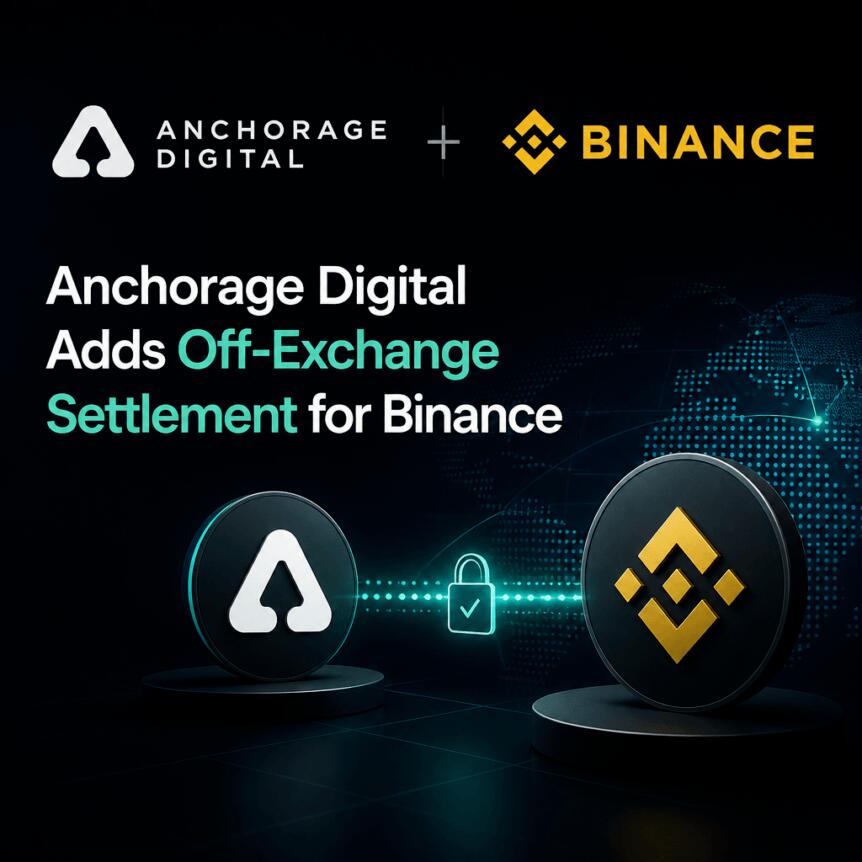
Anchorage Digital Adds Off-Exchange Settlement for Binance
For feedback or concerns regarding this content, please contact us at crypto.news@mexc.com
Anchorage Digital Adds Off-Exchange Settlement For Binance

Anchorage Digital says it has integrated its off-exchange settlement system with Binance, enabling select institutional clients to trade on Binance without depositing their crypto or cash directly onto the exchange. Instead, clients’ assets and funds can remain in qualified custody at Anchorage—a federally chartered US crypto bank—until settlement.

The arrangement is built around margin and collateral mechanics: institutions can use crypto assets or US dollar deposits held with Anchorage to satisfy Binance’s margin requirements, without moving those holdings to Binance first. Anchorage and Binance framed the workflow as a separation of custody from trade execution, aiming to reduce the operational friction—and counterparty exposure—that can come with pre-funding trades on exchanges.

Key takeaways

  • Anchorage integrated its off-exchange settlement platform with Binance to support institutional trading while keeping custody at Anchorage.
  • Clients can use Anchorage-held crypto or US dollar deposits as collateral for Binance margin without transferring assets to the exchange.
  • The model is positioned as a response to exchange counterparty risk and aims to improve capital efficiency by avoiding pre-funding.
  • Anchorage’s Atlas platform is cited as the infrastructure behind this first off-exchange settlement implementation.
  • Financial terms of the partnership were not disclosed.

How the Anchorage–Binance model changes custody and collateral

In traditional exchange-based workflows, institutions typically pre-fund trading accounts—transferring assets to the venue where trades are executed. Anchorage’s stated objective with this integration is to shift that balance. Under the collaboration, institutional clients can maintain crypto and cash in qualified custody with Anchorage while accessing trade execution through Binance.

Practically, the integration focuses on margin: Binance’s margin requirements are met using collateral held with Anchorage. The companies say this keeps assets in an independent custodian until settlement, rather than routing custody into the exchange account itself. By design, it also reduces the need for institutions to move holdings between custody providers and the trading venue ahead of every trade.

Anchorage said the rollout is available initially to select institutional clients, marking the first off-exchange settlement deployment for its Atlas platform—an infrastructure Anchorage describes as supporting institutional trading, settlement, lending, and collateral management using custody-based building blocks.

Why “off-exchange settlement” is drawing institutional attention

Exchange counterparty risk has long been one of the main frictions for institutions considering larger allocations to crypto trading. When assets must be deposited to an exchange to enable trading, risk is concentrated at the execution venue. Off-exchange settlement attempts to address that by keeping custody separate from the trading leg, with settlement handled via a different mechanism.

Anchorage and Binance framed their setup as moving closer to the custody-and-execution structure common in traditional financial markets, where institutions can separate where assets are held from where trades are executed and settled. The proposed benefit is twofold: it reduces exposure tied to pre-funding and may also improve capital efficiency by relying on custody-based collateral rather than tying funds to exchange balances.

While the companies did not disclose financial terms, they emphasized the core operational change: trades can be executed on Binance while crypto and cash remain with Anchorage through settlement—an approach intended to make institutional participation smoother without requiring full custody migration to the exchange.

Off-exchange settlement expands across major venues

This Anchorage–Binance integration sits within a broader industry pattern. Off-exchange settlement has been gaining traction among institutional crypto trading platforms throughout 2026, with multiple firms announcing similar custody-and-trade separation approaches.

According to earlier coverage from Cointelegraph, in April BitMEX partnered with Zodia Custody to allow institutional clients to trade derivatives while keeping collateral in segregated custody rather than depositing it onto the exchange. Under that structure, traders could access perpetual swaps and futures while collateral remained with Zodia and was mirrored for trading. BitMEX said the design eliminated the need to prefund exchange accounts and improved capital efficiency, while also reducing operational risks tied to moving assets between custody and trading venues.

In June, Bitget adopted a comparable model by integrating Fireblocks Off Exchange. Bitget said that its integration enables clients to execute trades from MPC-based wallets while keeping assets in trader-controlled collateral vaults rather than transferring them to the exchange. The company also claimed the platform can verify trading accounts are fully collateralized in real time without taking custody of client assets.

Separately, KuCoin Institutional expanded its custody offering earlier in the year by integrating Ceffu’s MirrorX platform in January. That system, according to the linked Ceffu and KuCoin Institutional material, is designed for institutional trading while digital assets remain in third-party custody, with funds mirrored for trading and settled off-chain every four hours.

Taken together, these deployments show a recurring theme: institutions increasingly want the flexibility of exchange liquidity and execution alongside custody structures that better match their risk controls. Off-exchange settlement is becoming a practical pathway to combine those priorities—at least for use cases offered through specific integrations between exchanges, custodians, and settlement platforms.

What investors should monitor next

For institutions, the most important questions now are likely operational and risk-related: which collateral types are supported end-to-end for margin, how settlement timing works in practice for different product categories, and how widely Anchorage’s off-exchange service will be rolled out beyond the initial select client group. Readers should also watch whether more major venues add similar custody-separated settlement layers, as that trend would further define how institutional crypto trading infrastructure evolves.

This article was originally published as Anchorage Digital Adds Off-Exchange Settlement for Binance on Crypto Breaking News – your trusted source for crypto news, Bitcoin news, and blockchain updates.


Market Opportunity
Polytrade Logo
Polytrade Price(TRADE)
$0.03573
$0.03573$0.03573
+0.53%
USD
Polytrade (TRADE) Live Price Chart

World Cup Combo: Aim for 200x

World Cup Combo: Aim for 200xWorld Cup Combo: Aim for 200x

Combine up to 20 World Cup matches in one order

Disclaimer: The articles reposted on this site are sourced from public platforms and are provided for informational purposes only. They do not necessarily reflect the views of MEXC. All rights remain with the original authors. If you believe any content infringes on third-party rights, please contact crypto.news@mexc.com for removal. MEXC makes no guarantees regarding the accuracy, completeness, or timeliness of the content and is not responsible for any actions taken based on the information provided. The content does not constitute financial, legal, or other professional advice, nor should it be considered a recommendation or endorsement by MEXC.

You May Also Like

Bitcoin, Ethereum, XRP and Solana show monthly buy signals on TD Sequential

Bitcoin, Ethereum, XRP and Solana show monthly buy signals on TD Sequential

🚨 TD Sequential shows monthly buy signals in $BTC, ETH, XRP, and SOL. 📊 Recent turbulence gives way to cautious optimism as indicators align. 🪙 ETF flows and futures
Share
COINTURK EN2026/07/02 06:51
Amanah says political rivals stoking racial hatred ahead of Johor polls

Amanah says political rivals stoking racial hatred ahead of Johor polls

Amanah deputy president Mujahid Yusof Rawa says such narratives, especially involving DAP, are being used to create divisions between the Malays and Chinese.
Share
Free Malaysia Today2026/07/02 07:18
Revolutionary: CME SOL XRP Futures Options Set to Transform Crypto Trading

Revolutionary: CME SOL XRP Futures Options Set to Transform Crypto Trading

BitcoinWorld Revolutionary: CME SOL XRP Futures Options Set to Transform Crypto Trading Exciting news is rippling through the cryptocurrency world! The U.S. Chicago Mercantile Exchange (CME), a titan in traditional finance, is reportedly planning to launch CME SOL XRP futures options. This significant development, initially reported by Walter Bloomberg, marks a pivotal moment for institutional involvement in the altcoin market. It signals a new era for how Solana (SOL) and Ripple (XRP) might be traded, potentially opening doors to broader adoption and increased market maturity. What Does the Launch of CME SOL XRP Futures Mean for Crypto? When an institution like CME, known for its rigorous standards and vast trading volume, enters a new market, it brings a wave of legitimacy. The introduction of CME SOL XRP futures options indicates a growing acceptance of these digital assets within mainstream finance. This move could fundamentally change how investors perceive and interact with SOL and XRP. Futures options are financial derivatives that give traders the right, but not the obligation, to buy or sell an underlying asset at a specific price on or before a certain date. For SOL and XRP, this means: Enhanced Price Discovery: More participants and trading volume can lead to more efficient and accurate pricing. Institutional Access: It provides regulated avenues for large institutional investors to gain exposure to SOL and XRP without directly owning the underlying assets. Risk Management: Traders can use these options to hedge against potential price fluctuations in their existing SOL and XRP holdings. Why Are SOL and XRP Chosen for CME SOL XRP Futures? The selection of Solana (SOL) and Ripple (XRP) for these new futures options is not arbitrary. Both cryptocurrencies hold significant positions in the market and offer distinct value propositions: Solana (SOL): Known for its high-performance blockchain, offering fast transaction speeds and low costs. Its robust ecosystem supports numerous decentralized applications (dApps), NFTs, and DeFi projects, attracting considerable developer and user interest. Ripple (XRP): Primarily focused on facilitating fast, low-cost international payments for financial institutions. Despite ongoing regulatory discussions, XRP maintains a strong market presence and a dedicated community, highlighting its potential for cross-border transactions. Their substantial market capitalization and existing liquidity make them attractive candidates for institutional-grade derivative products. This choice reflects a strategic assessment by CME of assets that can sustain significant trading interest and volume. Navigating the Landscape: Opportunities and Considerations for CME SOL XRP Futures The introduction of CME SOL XRP futures options presents a wealth of opportunities, yet it also comes with important considerations. On the opportunity front, we can expect increased liquidity, which benefits all market participants by making it easier to buy and sell without significant price impact. Moreover, it could attract new capital from traditional financial players who prefer regulated products. However, traders and investors should also consider the implications: Market Volatility: While derivatives can offer hedging, they can also amplify market movements. Regulatory Clarity: The regulatory landscape for cryptocurrencies, particularly for XRP, continues to evolve. CME’s move might encourage further clarity but also means ongoing scrutiny. Learning Curve: Understanding futures options requires a certain level of financial literacy, which new entrants to the crypto market may need to develop. These products offer sophisticated tools for managing exposure and speculating on price movements, but they demand a careful approach. What’s Next for the Crypto Market with CME SOL XRP Futures? The reported launch of CME SOL XRP futures options is more than just a new product offering; it represents a significant milestone in the ongoing convergence of traditional finance and the digital asset space. It underscores the growing maturity of the cryptocurrency market and its increasing integration into global financial systems. As institutional interest continues to surge, we can anticipate further innovation and a broader range of regulated products for other altcoins. This development is poised to offer sophisticated tools for investors and traders, potentially stabilizing market dynamics while simultaneously introducing new avenues for growth and investment. The crypto market is evolving rapidly, and CME’s latest initiative is a clear indicator of this exciting trajectory. To learn more about the latest crypto market trends, explore our article on key developments shaping the cryptocurrency market institutional adoption. Frequently Asked Questions (FAQs) What is the Chicago Mercantile Exchange (CME)? The CME is one of the world’s largest and most diverse derivatives marketplaces, offering a wide range of futures and options products across various asset classes, including equities, commodities, and now, expanding into specific cryptocurrencies. What are futures options in the context of SOL and XRP? Futures options for SOL and XRP are financial contracts that give the holder the right, but not the obligation, to buy or sell SOL or XRP futures contracts at a predetermined price on or before a specific date. They allow for hedging and speculation on price movements. Why are Solana (SOL) and Ripple (XRP) chosen for these new options? SOL and XRP were likely chosen due to their significant market capitalization, established liquidity, and distinct use cases within the crypto ecosystem, making them attractive for institutional-grade derivative products. How might CME SOL XRP futures options affect the prices of SOL and XRP? The introduction of these options could lead to increased liquidity and institutional participation, potentially influencing price discovery and stability. However, like all derivatives, they can also contribute to market volatility. When are these CME SOL XRP futures options expected to launch? While Walter Bloomberg reported CME’s plans, an official launch date has not yet been publicly announced by CME. Market participants should monitor official CME channels for updates. If you found this article insightful, please consider sharing it with your network! Help us spread the word about the exciting developments in the crypto space by sharing this article on your social media platforms. This post Revolutionary: CME SOL XRP Futures Options Set to Transform Crypto Trading first appeared on BitcoinWorld.
Share
Coinstats2025/09/18 00:45