Bitcoin surged past $125K to a new all-time high (ATH) as Polymarket traders eye $130K in ”Uptober.” BTC pumped over 2% in the last 24 [...]Bitcoin surged past $125K to a new all-time high (ATH) as Polymarket traders eye $130K in ”Uptober.” BTC pumped over 2% in the last 24 [...]

Stablecoins Will Push ‘Consumer Hostile’ Banks To Raise Yields, Stripe CEO Says


3 min read

Banks will be forced to offer customers better yields in order to stay competitive as stablecoins begin to boom, according to Stripe CEO Patrick Collison.

Replying to a post on X about the rise of yield-bearing stablecoins, Collison noted that the average interest rate for savings accounts is 0.40% in the US and 0.25% in the EU.

“Depositors are going to, and should, earn something closer to a market return on their capital,” Collison said. “The business imperative here is clear — cheap deposits are great, but being so consumer-hostile feels to me like a losing position.” 

His remarks follow Stripe’s launch of “Open Issuance” on Sept. 30, a new product by Bridge that enables companies to launch and manage their own stablecoins with minimal friction.

GENIUS Act Prohibits Direct Stablecoin Yields, But Banking Groups See Loopholes

The stablecoin market has blossomed in recent months, with the capitalization for the sector recently soaring to a new record high above $300 billion. This is as more institutions begin to explore offering their own tokenized offerings to clients.

The stablecoin market’s growth accelerated after crypto-friendly US President Donald Trump signed the Guiding and Establishing National Innovation for US Stablecoins (GENIUS) Act into law in July, creating a federal framework for stablecoins in the US.

Following the bill’s signing, the capitalization of the stablecoin market has soared from around $253 billion to approximately $302.89 billion, data from DefiLlama shows. 
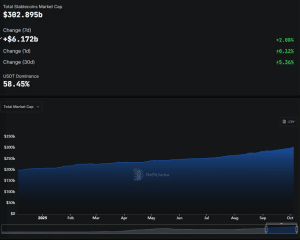
stablecoin market cap

Stablecoin market cap (Source: DefiLlama)

The GENIUS Act currently prohibits stablecoin issuers from offering users yields directly. However, banking groups have pointed out that there are loopholes that don’t explicitly restrict stablecoin issuers from offering yields through third party providers. 

“Some lobbies are currently pushing, post-GENIUS, to further restrict any kinds of rewards associated with stablecoin deposits,” according to Collison. 

Coinbase CEO Brian Armstrong posted a video on X on Sept. 29 after meeting with various lawmakers and industry executives, noting that banks are trying to push back on stablecoins, particularly potential yields that they could offer.

“Banks want to ban rewards to maintain their monopoly, and we’re making sure the Senate knows bailing out the big banks at the expense of the American consumer is not ok,” he wrote on X.

“All Currency” Will Become Stablecoins By 2030

Despite the pushback from banks, crypto executives see stablecoins as the next big thing, and have even gone as far as to predict that stablecoins will consume legacy fiat payments. 

Among those executives is Tether co-founder Reeve Collins, who said during the Token2049 conference in Singapore that “all currency will be a stablecoin.” 

“A stablecoin simply is a dollar, euro, yen, or, you know, a traditional currency running on a blockchain rail by 2030,” he added. 

“Every large institution, every bank, everyone wants to create their own stablecoin, because it’s lucrative and it’s just a better way to transact,” Collins said.

Disclaimer: The articles reposted on this site are sourced from public platforms and are provided for informational purposes only. They do not necessarily reflect the views of MEXC. All rights remain with the original authors. If you believe any content infringes on third-party rights, please contact service@support.mexc.com for removal. MEXC makes no guarantees regarding the accuracy, completeness, or timeliness of the content and is not responsible for any actions taken based on the information provided. The content does not constitute financial, legal, or other professional advice, nor should it be considered a recommendation or endorsement by MEXC.

You May Also Like

Water150 Unveils Historical Satra Brunn Well: The Original Source of 150 Years of Premium Quality Spring Water Hydration

Water150 Unveils Historical Satra Brunn Well: The Original Source of 150 Years of Premium Quality Spring Water Hydration

The post Water150 Unveils Historical Satra Brunn Well: The Original Source of 150 Years of Premium Quality Spring Water Hydration appeared on BitcoinEthereumNews.com. Water150, the project developed by the Longhouse Foundation to reserve access to premium spring water through a transparent, blockchain-based ecosystem of natural water springs, is excited to introduce its first natural water well, Satra Brunn.  The Sätra Brunn well is one of Sweden’s oldest and best-preserved natural spring water wells, located in a 324-year-old Swedish village. Every water source added to the network will be measured according to the pedigree and based on the foundations of the historically reliable Satra Brunn natural spring, a well that has endured since the 18th century.   The Satra Brunn well secures the first 66 million liters of the annually replenished mineral water supply, starting in January 2027, for the next 150 years. Each liter of water secured in the Satra Brunn well is fully backed by a corresponding Water150 token, issued on the Ethereum blockchain by the Longhouse Water S.A., a Luxembourg public limited liability company.  Hence, the first batch of 66 million Water150 tokens to enter circulation will fully back the annual supply from the Satra Brunn well.  The project uses blockchain technology as a barrierless and transparent ecosystem to connect users to naturally filtered, high-quality, and sustainably managed drinking water per year for at least 150 years, starting in 2027. The amount of Water150 tokens in circulation is a verifiable measure of the volume of annual water flow available within the ecosystem, audited by independent third parties. The W150 token is one of the first real-world asset (RWA) utility tokens to get the full approval of the European Securities and Markets Authority (ESMA), the body responsible for the Markets in Crypto-Assets Regulation (MiCAR), a cryptocurrency regulatory standard recognized and adopted throughout Europe. Water150 is building a global network of 1,000 premium mineral water sources like Satra Brunn, managed according to the high…
Share
BitcoinEthereumNews2025/09/19 19:41
Amazon signs AI and cloud partnership to accelerate growth

Amazon signs AI and cloud partnership to accelerate growth

Prosus and Amazon have signed a multi-year deal with AWS to consolidate cloud and AI contracts and save costs.
Share
Cryptopolitan2026/02/04 18:05
Senate Democrats Forge Ahead with U.S. Crypto Regulation Efforts

Senate Democrats Forge Ahead with U.S. Crypto Regulation Efforts

The long-stalled CLARITY Act, designed to regulate the U.S. cryptocurrency market, is back in the spotlight as Senate Democrats quietly resume discussions.Continue
Share
Coinstats2026/02/04 18:08