

Here’s How High Stellar (XLM) Could Climb as DTCC’s Tokenization Rollout Nears
Stellar is back in the spotlight after a major development that could change how institutional assets move across blockchain networks. The latest catalyst is the Depository Trust & Clearing Corporation’s tokenization rollout, which has already entered its first live phase.
That timeline has prompted fresh discussion about XLM price potential. YouTube analyst BE CRYPTO SMART examined how Stellar could benefit as the rollout expands over the next 12 months.
The discussion focuses on whether one of the world’s largest financial market infrastructure providers could eventually create meaningful demand for XLM as tokenized securities begin settling through the Stellar network.
DTCC’s Rollout Gives Stellar a Multi-Phase Institutional Timeline
BE CRYPTO SMART begins by pointing out that the DTCC tokenization project is no longer a distant idea. The rollout has already started.
The first major milestone arrived on May 27, 2026, when DTCC announced that its tokenization service would connect to the Stellar network. XLM was identified as the settlement token after an SEC no action letter granted regulatory approval for DTC to tokenize selected assets. Those assets include Russell 1000 stocks, major ETFs, and U.S. Treasury securities.
July 2026 marks the first limited production phase. This is no longer a proof of concept. Real assets and real settlements are now taking place within a regulated environment, although participation remains controlled.
Another important milestone is scheduled for October 2026, when DTCC plans to expand the service to more participants and larger trading volumes. The final stage is expected during the first half of 2027, when tokenized assets become available directly on the Stellar network. That phase could make XLM’s settlement role much more visible than it is today.
Stellar’s Network Could Benefit Even If XLM Does Not Immediately Follow
One of the strongest parts of BE CRYPTO SMART’s analysis is the discussion about value flowing through the Stellar network versus flowing directly into the XLM price.
DTCC reportedly safeguards roughly $114 trillion in assets. Even tokenizing a tiny fraction of that amount would represent activity far beyond Stellar’s current network size.
According to the video, Crypto.News has also noted that the relationship between settlement activity and XLM price is not perfectly direct. Every transaction on Stellar requires a small XLM fee, which creates genuine demand for the token. XLM may also serve as a bridge asset during certain cross-border settlements.
That does not automatically mean every increase in settlement volume produces an equal increase in XLM’s market value. Institutions may only need relatively small XLM balances to pay network fees. Much will depend on how the settlement process develops once more activity begins appearing on chain.
BE CRYPTO SMART argues that understanding this difference creates a more balanced investment thesis because infrastructure growth and token price do not always move together immediately.
XLM Price Scenarios Depend On How The DTCC Rollout Progresses
After discussing the fundamentals, BE CRYPTO SMART outlined several price scenarios based on historical levels and analyst forecasts instead of relying on optimistic assumptions.
The first scenario simply returns XLM to about $0.52, which was reached during 2025. Since Stellar has already traded there before, the analyst views this as a realistic historical benchmark instead of an aggressive projection.
The second scenario examines XLM reaching $1. BE CRYPTO SMART notes that this target has support from recent Crypto.News forecasts, which projected bullish end of 2026 estimates between $1.20 and $2.50 if institutional adoption continues expanding and broader crypto market conditions remain favorable.
The most optimistic scenario looks at XLM reaching $2.50. That outlook assumes a sustained crypto bull market alongside successful execution of DTCC’s wider rollout in October 2026 and the full Stellar integration expected during the first half of 2027.
The analysis also includes a bearish possibility. If institutional usage grows slowly, broader crypto markets remain weak, or token demand develops more gradually than expected, XLM could remain close to its current price near $0.18 through much of 2026 despite the infrastructure rollout.
The discussion from BE CRYPTO SMART can be summarized into 4 broad outcomes:
- Historical recovery: XLM revisits about $0.52 if it returns to its previous cycle high.
- Bullish institutional case: XLM reaches around $1 if adoption accelerates and market conditions improve.
- Strong bull market case: XLM climbs toward $2.50 if the DTCC rollout succeeds and institutional demand expands through 2027.
- Conservative case: XLM remains near current levels if settlement activity produces only modest token demand during the early rollout phases.
XLM Price Holds Above Long Term Support Despite Recent Weakness
Recent price action paints a more cautious picture in the short term.
XLM has fallen almost 18% from its late June peak near $0.23 and currently trades close to the important $0.18 support area. A look at the XLM chart shows buyers continue defending that zone, although the token still trades below several short and medium term moving averages.
Momentum indicators remain mixed. The daily RSI sits around 46, which points to balanced market conditions instead of an overbought or oversold market. MACD has started improving slightly, although confirmation of a stronger recovery has not appeared.
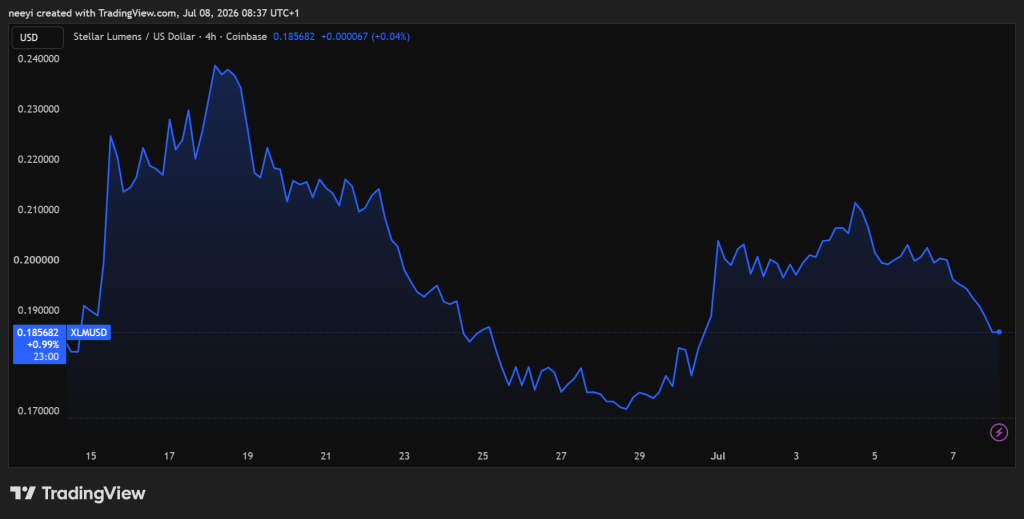 XLM Price Chart / TradingView.com
Technical analysis currently points to 3 possible paths over the coming month.
The most likely outcome keeps Stellar trading between roughly $0.17 and $0.22 if Bitcoin remains stable and XLM continues holding long term support.
A stronger recovery would require XLM to reclaim $0.20 and eventually challenge resistance around $0.23. Continued strength across the wider crypto market could then open the door toward the psychological $0.30 level.
Read Also: $5,000 in XRP Today: Here’s What It Could Be Worth by the End of September
The bearish case begins if XLM closes decisively below $0.17. That breakdown could expose the token to the $0.14 to $0.16 region, while $0.10 remains the next major psychological level if selling pressure becomes much stronger.
Current technical signals point toward these possible outcomes:
- Base case: XLM trades between $0.17 and $0.22 during the next several weeks.
- Bullish case: A move above $0.20 could allow another test of $0.23 before attention turns toward $0.30.
- Bearish case: Losing $0.17 support may increase the possibility of a decline toward $0.14 to $0.16, with $0.10 remaining the deeper downside level.
FAQs
Subscribe to our YouTube channel for daily crypto updates, market insights, and expert analysis.
The post Here’s How High Stellar (XLM) Could Climb as DTCC’s Tokenization Rollout Nears appeared first on CaptainAltcoin.


You May Also Like

Rogers backs Kane to outshine Haaland in World Cup showdown

6 Crypto Sportsbooks Ranked on On-Chain Transparency

Russia bans diesel exports as Ukrainian strikes intensify fuel crisis



