The post Umbra’s ICO and MetaDAO’s ‘Unruggable’ futarchy take center stage appeared on BitcoinEthereumNews.com. This is a segment from the Lightspeed newsletter. To read full editions, subscribe. A little-known privacy project, Umbra, launched its initial coin offering (ICO) on Solana yesterday. As I write this, Umbra is already 1169% oversubscribed over its $750 million raise target. Source: MetaDAO The real story here isn’t Umbra — it’s the infrastructure that’s powering its sale: MetaDAO’s “Unruggable ICO” futarchy launchpad. A lot has already been written on the intersection of crypto and futarchy by people smarter than me, but here’s the gist: Futarchy is the simple idea that governance should be decided by markets, rather than “one man, one vote” democratic rules, or DAO token voting. If you believe Donald Trump will spur economic growth more than Joe Biden, buying “Pass Trump” shares will get him elected if enough traders buy it past a set threshold. Or if you believe Facebook spending $50 billion on investments in the metaverse will not improve Meta’s stock price, then do the opposite and buy “Fail” shares. Futarchy markets work similarly to prediction markets: They channel the wisdom of markets by requiring participants put their money where their mouth is. The key difference is that with futarchy, actual outcomes are influenced by how markets “vote.” This radical idea was popularized by the libertarian economist Robin Hanson and has existed for years as a topic of nerdy fascination in technolibertarian circles.  (Hanson, incidentally, was also responsible for advancing many of crypto’s major innovations, like automated market makers and prediction markets.) For some time, DAOs like Drift, Sanctum and Marinade have experimented with piecemeal futarchy governance using MetaDAO’s core protocol. The ongoing Umbra ICO is taking place on a relatively newer MetaDAO product, its futarchy-powered ICO launchpad. Source: Blockworks Research By launching on MetaDAO’s ICO launchpad, teams like Umbra in effect bind its… The post Umbra’s ICO and MetaDAO’s ‘Unruggable’ futarchy take center stage appeared on BitcoinEthereumNews.com. This is a segment from the Lightspeed newsletter. To read full editions, subscribe. A little-known privacy project, Umbra, launched its initial coin offering (ICO) on Solana yesterday. As I write this, Umbra is already 1169% oversubscribed over its $750 million raise target. Source: MetaDAO The real story here isn’t Umbra — it’s the infrastructure that’s powering its sale: MetaDAO’s “Unruggable ICO” futarchy launchpad. A lot has already been written on the intersection of crypto and futarchy by people smarter than me, but here’s the gist: Futarchy is the simple idea that governance should be decided by markets, rather than “one man, one vote” democratic rules, or DAO token voting. If you believe Donald Trump will spur economic growth more than Joe Biden, buying “Pass Trump” shares will get him elected if enough traders buy it past a set threshold. Or if you believe Facebook spending $50 billion on investments in the metaverse will not improve Meta’s stock price, then do the opposite and buy “Fail” shares. Futarchy markets work similarly to prediction markets: They channel the wisdom of markets by requiring participants put their money where their mouth is. The key difference is that with futarchy, actual outcomes are influenced by how markets “vote.” This radical idea was popularized by the libertarian economist Robin Hanson and has existed for years as a topic of nerdy fascination in technolibertarian circles.  (Hanson, incidentally, was also responsible for advancing many of crypto’s major innovations, like automated market makers and prediction markets.) For some time, DAOs like Drift, Sanctum and Marinade have experimented with piecemeal futarchy governance using MetaDAO’s core protocol. The ongoing Umbra ICO is taking place on a relatively newer MetaDAO product, its futarchy-powered ICO launchpad. Source: Blockworks Research By launching on MetaDAO’s ICO launchpad, teams like Umbra in effect bind its…

Umbra’s ICO and MetaDAO’s ‘Unruggable’ futarchy take center stage

4 min read

This is a segment from the Lightspeed newsletter. To read full editions, subscribe.


A little-known privacy project, Umbra, launched its initial coin offering (ICO) on Solana yesterday.

As I write this, Umbra is already 1169% oversubscribed over its $750 million raise target.

Source: MetaDAO

The real story here isn’t Umbra — it’s the infrastructure that’s powering its sale: MetaDAO’s “Unruggable ICO” futarchy launchpad.

A lot has already been written on the intersection of crypto and futarchy by people smarter than me, but here’s the gist: Futarchy is the simple idea that governance should be decided by markets, rather than “one man, one vote” democratic rules, or DAO token voting.

If you believe Donald Trump will spur economic growth more than Joe Biden, buying “Pass Trump” shares will get him elected if enough traders buy it past a set threshold.

Or if you believe Facebook spending $50 billion on investments in the metaverse will not improve Meta’s stock price, then do the opposite and buy “Fail” shares.

Futarchy markets work similarly to prediction markets: They channel the wisdom of markets by requiring participants put their money where their mouth is. The key difference is that with futarchy, actual outcomes are influenced by how markets “vote.”

This radical idea was popularized by the libertarian economist Robin Hanson and has existed for years as a topic of nerdy fascination in technolibertarian circles. 

(Hanson, incidentally, was also responsible for advancing many of crypto’s major innovations, like automated market makers and prediction markets.)

For some time, DAOs like Drift, Sanctum and Marinade have experimented with piecemeal futarchy governance using MetaDAO’s core protocol.

The ongoing Umbra ICO is taking place on a relatively newer MetaDAO product, its futarchy-powered ICO launchpad.

Source: Blockworks Research

By launching on MetaDAO’s ICO launchpad, teams like Umbra in effect bind its entire governance to a futarchy model from day one.

The incentive for existing DAOs to adopt futarchy isn’t strong, which is why MetaDAO is now targeting founders from day one, MetaDAO’s pseudonymous co-founder Proph3t tells me.

This entails limiting the founding team’s powers in ways that would be considered abnormal in the real world.

For one, teams have to commit to a set budget allowance. Umbra, for instance, is agreeing to lock in to a $34K monthly budget. This can change, but only if markets vote on it to pass.

Secondly, the team agrees to subject its treasury and all intellectual property — domain names, Discord and Twitter accounts, brand names — to ownership under a DAO LLC legal entity headquartered in the Marshall Islands, executed by MetaDAO themselves. This ensures that whatever happens onchain is legally binding in the real world.

The first criterion primarily serves to align long-term incentives between founders and tokenholders, avoiding situations where founding teams have quietly abandoned projects with huge controlled allocations.

The second avoids crypto’s notorious token equity mismatch problem, where revenues are directed to equity holders rather than tokens.

“I’m not in love with governance. I see it as a tool to solve a specific problem. Most founders want control for obvious reasons and I would like to give them as much control as possible while still maintaining the properties that make tokens unruggable,” Proph3t tells me.

In return for binding their hands to a futarchy-based governance model, founding teams can signal legitimacy by advertising their tokens as protected by traditional “shareholder protections”.

But whether or not you believe these protections are robust depends on whether you believe market forces can make the right governance decisions.

Are they? Take the example of the mtnCapital investment fund.

In April, mtnCapital ran the first ICO on MetaDAO’s futarchy launchpad, raising ~$5.7 million USDC. The fund’s performance eventually underperformed, so DAO members took it upon themselves to vote on a proposal to unwind the fund and return monies to MTN tokenholders in September.

Source: MetaDAO

That decision was made by tokenholders, as opposed to the mtnCapital investment team that could have quietly abandoned the project, or conjure an endless string of amorphous reasons for why their strategy “needed more time”.

Futarchy isn’t a guarantee that the business will succeed; it serves as a safeguard against the kinds of plutocratic rent-seeking that DAOs have been plagued with for years.

The META token, which has seen a speculative pump of 191% in the last month, currently receives no value accrual.

That is set to change in the near future with MetaDAO taking a 25 bps take-rate on its futarchy AMM.

This will work similarly to how memecoins launch from launchpads to a DEX, Proph3t tells me.


Get the news in your inbox. Explore Blockworks newsletters:

Source: https://blockworks.co/news/umbra-metadao-futarchy

Market Opportunity
Overtake Logo
Overtake Price(TAKE)
$0.01948
$0.01948$0.01948
-10.39%
USD
Overtake (TAKE) Live Price Chart
Disclaimer: The articles reposted on this site are sourced from public platforms and are provided for informational purposes only. They do not necessarily reflect the views of MEXC. All rights remain with the original authors. If you believe any content infringes on third-party rights, please contact service@support.mexc.com for removal. MEXC makes no guarantees regarding the accuracy, completeness, or timeliness of the content and is not responsible for any actions taken based on the information provided. The content does not constitute financial, legal, or other professional advice, nor should it be considered a recommendation or endorsement by MEXC.

You May Also Like

Once Upon a Farm Announces Pricing of Initial Public Offering

Once Upon a Farm Announces Pricing of Initial Public Offering

BERKELEY, Calif.–(BUSINESS WIRE)–Once Upon a Farm today announced the pricing of its initial public offering of 10,997,209 shares of its common stock, 7,631,537
Share
AI Journal2026/02/06 08:15
Forward Industries Bets Big on Solana With $4B Capital Plan

Forward Industries Bets Big on Solana With $4B Capital Plan

The firm has filed with the U.S. Securities and Exchange Commission to launch a $4 billion at-the-market (ATM) equity program, […] The post Forward Industries Bets Big on Solana With $4B Capital Plan appeared first on Coindoo.
Share
Coindoo2025/09/18 04:15
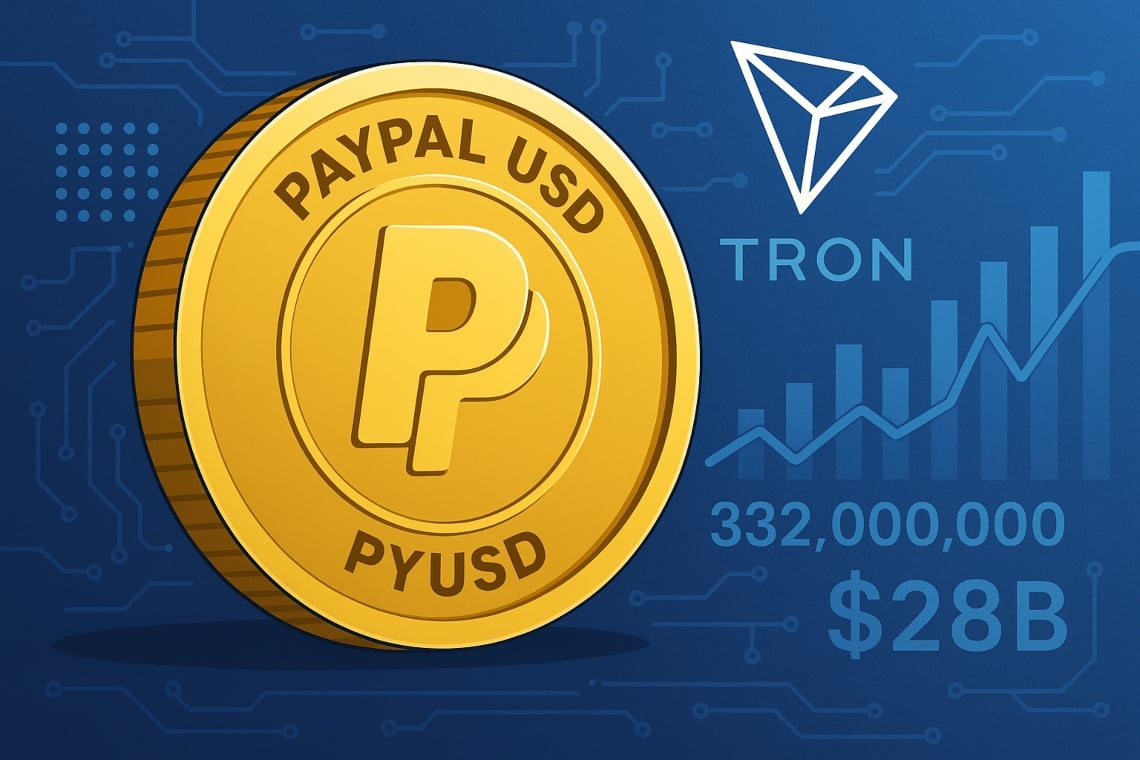
332M accounts and $28B TVL,

332M accounts and $28B TVL,

The post 332M accounts and $28B TVL, appeared on BitcoinEthereumNews.com. PayPal USD debuts on TRON as a permissionless token PYUSD0, enabled by LayerZero’s OFT standard and the Stargate Hydra extension. The announcement on September 18, 2025 (Geneva) introduces native interoperability between chains and transfers without manual steps for users; the news echoes elements already communicated by PayPal at the launch of PYUSD PayPal Newsroom. The move concerns an ecosystem that includes 332 million accounts and over $28 billion in TVL. In this context, the fungibility of a stablecoin regulated across multiple networks and the use of TRON as a settlement layer for payments and remittances is at stake. According to the data collected by TRONSCAN updated as of September 18, 2025, the network metrics confirm the cited volumes and highlighted traffic patterns. Our editorial team has verified the transaction logs and monitored the public chain metrics to corroborate the reported figures; the observations on daily flows and TVL are consistent with the network dashboards. Industry analysts observe that the entry of a regulated issuer like PayPal tends to increase institutional interest, provided there is transparency on reserves and compliance checks. What is PYUSD0 on TRON and why is it relevant PYUSD0 is the representation of PayPal USD on TRON. It is pegged one-to-one to PYUSD through the OFT standard: the two tokens remain a single stablecoin, fungible and reconciled across chains. The integration is made possible by Stargate Hydra, now operational through LayerZero. According to the founder of TRON, Justin Sun, the extension on TRON expands access and trust for users and institutions. For Bryan Pellegrino (CEO of LayerZero Labs), stablecoins represent a pillar of global payments and remittances, as the native compatibility between chains enables their operational scalability. It must be said that the alignment between issuer, cross-chain infrastructure, and settlement network is a key element. Key Numbers: TRON…
Share
BitcoinEthereumNews2025/09/19 08:18