South Korea’s tax authorities are intensifying efforts to crack down on crypto tax evasion, with new measures targeting the concealment of digital assets—even those stored in cold wallets disconnected from the internet. The National Tax Service (NTS) has announced plans to conduct home searches and confiscate hardware wallets and cold storage devices if suspicious activity [...]South Korea’s tax authorities are intensifying efforts to crack down on crypto tax evasion, with new measures targeting the concealment of digital assets—even those stored in cold wallets disconnected from the internet. The National Tax Service (NTS) has announced plans to conduct home searches and confiscate hardware wallets and cold storage devices if suspicious activity [...]

South Korea Tax Agency Cracks Down on Cold Wallets in Crypto Seizures
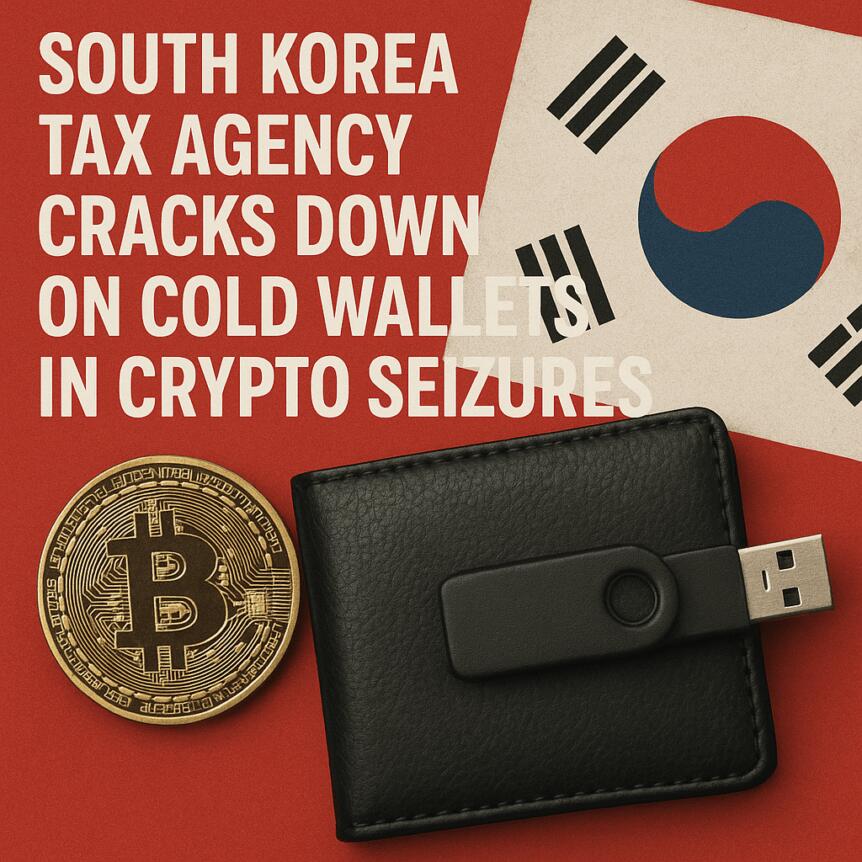
South Korea Tax Agency Cracks Down On Cold Wallets In Crypto Seizures

South Korea’s tax authorities are intensifying efforts to crack down on crypto tax evasion, with new measures targeting the concealment of digital assets—even those stored in cold wallets disconnected from the internet. The National Tax Service (NTS) has announced plans to conduct home searches and confiscate hardware wallets and cold storage devices if suspicious activity is detected, signaling a more aggressive stance on crypto compliance amid surging adoption across the country.

  • The NTS warns that crypto assets stored in cold wallets are subject to seizure if linked to tax evasion.
  • Over the past four years, South Korea has confiscated and liquidated more than $108 million worth of cryptocurrency from thousands of individuals.
  • Crypto trading volume in South Korea has surged to nearly $4.7 billion, fueling increased scrutiny on tax compliance.
  • Suspicious crypto transactions reported by virtual asset service providers peaked in 2025, surpassing previous years’ totals.

South Korea’s National Tax Service is ramping up its crackdown on crypto tax evasion as the nation experiences a dramatic rise in cryptocurrency trading and ownership. An official from the NTS indicated that the agency is prepared to conduct home searches and seize physical devices such as hardware wallets and cold storage units if they suspect individuals are hiding assets offline. These measures come amid growing concerns around the use of cold wallets, which are favored for their enhanced security and disconnected nature, typically making them harder to track and tax.

The NTS employs sophisticated crypto-tracking programs to analyze transaction histories. If any suspicion of concealment arises, authorities will pursue home searches, seizure of devices, and asset liquidation. Under South Korea’s National Tax Collection Act, the government can also request account data from local exchanges, freeze accounts for tax delinquents, and liquidate assets at market value to satisfy unpaid taxes.

Crypto Enforcement Actions Already Substantial

In the past four years, South Korea has confiscated and liquidated over $108 million worth of crypto from more than 14,000 individuals. The country’s crackdown was initially prompted by the rapid boom in crypto trading, with the number of crypto investors soaring from 1.2 million in 2020 to nearly 11 million in June 2025. During this period, trading volumes skyrocketed from 1 trillion won ($730 million) to $4.7 billion, greatly expanding the scope for potential tax evasion.

The increase in crypto adoption has been mirrored by the government’s intensified efforts to combat tax evasion through digital assets. Since 2021, authorities have targeted crypto-related tax violations, collecting approximately $50 million from over 5,700 suspects before escalating their enforcement tactics.

Rising Suspicion and Crypto Transaction Monitoring

The focus on cold wallets coincides with a notable rise in suspicious transaction reports (STRs). Data from the Financial Intelligence Unit (FIU) revealed nearly 37,000 STRs filed by virtual asset service providers (VASPs) as of August 2025, already exceeding the combined total for 2023 and 2024. These reports are pivotal in South Korea’s anti-money laundering (AML) efforts and are now being generated at record levels, reflecting increased monitoring of crypto movements.

This intensified oversight underscores the government’s broader aim to regulate the fast-growing crypto markets within the country, ensuring transparency and compliance amid a landscape of expanding digital asset use and complex tax challenges.

This article was originally published as South Korea Tax Agency Cracks Down on Cold Wallets in Crypto Seizures on Crypto Breaking News – your trusted source for crypto news, Bitcoin news, and blockchain updates.

Disclaimer: The articles reposted on this site are sourced from public platforms and are provided for informational purposes only. They do not necessarily reflect the views of MEXC. All rights remain with the original authors. If you believe any content infringes on third-party rights, please contact service@support.mexc.com for removal. MEXC makes no guarantees regarding the accuracy, completeness, or timeliness of the content and is not responsible for any actions taken based on the information provided. The content does not constitute financial, legal, or other professional advice, nor should it be considered a recommendation or endorsement by MEXC.

You May Also Like

Anchorage Digital applies for a Fed master account; what is it?

Anchorage Digital applies for a Fed master account; what is it?

The post Anchorage Digital applies for a Fed master account; what is it? appeared on BitcoinEthereumNews.com. Anchorage Digital Bank has formally applied for a Federal Reserve master account, according to a database update published Friday. The filing confirms months of speculation after Anchorage co-founder and CEO Nathan McCauley declined to comment on the matter in June.  According to the Crypto In America podcast host Eleanor Terrett, the crypto bank for institutions submitted an application to federal regulators on August 28.  Another semi-interesting thing in this latest update: the Fed has rejected a request from a Tier 1 institution. Notable because under the Fed’s 2022 guidelines applications from Tier 1 institutions are “generally … subject to a less intensive and more streamlined review” pic.twitter.com/vn8uYkycui — Bank Reg Blog (@bank_reg) September 19, 2025 Anchorage is the only digital asset company that holds a national trust bank charter, a designation it received from the US Office of the Comptroller of the Currency (OCC) in 2021. That charter authorizes Anchorage to operate as a federally regulated trust bank but does not grant the same payment access that comes with a Fed master account.  What is a Fed master account? A master account is the operational foundation that allows banks to settle transactions directly with the central bank and hold balances with the Federal Reserve. Depository institutions use these accounts to hold reserves and access the Fed’s payment services, including settlement of wire transfers, check clearing, and other interbank transactions. Without such access, banks must use third-party intermediaries to route payments. If Anchorage Digital acquired the account, it could become the first and only crypto bank that could hold assets outside digital currencies, just like traditional financial institutions.  Anchorage became one of the first federally chartered digital-asset banks when the OCC conditionally approved its national trust bank charter in January 2021. However, a little over a year later, the OCC issued…
Share
BitcoinEthereumNews2025/09/20 15:49
Could Ripple’s XRP Replace SWIFT? New Signals Hint at Potential Financial Power Shift

Could Ripple’s XRP Replace SWIFT? New Signals Hint at Potential Financial Power Shift

Global payments rarely face direct challenges to long-established infrastructure. The debate around Ripple and XRP now questions whether cross-border finance could
Share
Captainaltcoin2026/02/07 22:00
EY warns firms they must own the wallet to keep their customers

EY warns firms they must own the wallet to keep their customers

The post EY warns firms they must own the wallet to keep their customers appeared on BitcoinEthereumNews.com. In the evolving landscape of digital finance, Big
Share
BitcoinEthereumNews2026/02/07 22:10