Nvidia’s fiscal Q3 numbers didn’t just beat expectations, they detonated them. Revenue came in at $57.01 billion, almost $2B above what Wall Street was pricing in, with a jaw-dropping $51.2 billion from data-center alone. AI spending isn’t easing off the accelerator; it’s compounding like a tech-market feedback loop on steroids. And yes, that matters for […]Nvidia’s fiscal Q3 numbers didn’t just beat expectations, they detonated them. Revenue came in at $57.01 billion, almost $2B above what Wall Street was pricing in, with a jaw-dropping $51.2 billion from data-center alone. AI spending isn’t easing off the accelerator; it’s compounding like a tech-market feedback loop on steroids. And yes, that matters for […]

Nvidia’s $57B Quarter, Bitcoin’s Rebound, And 3 Tokens Aligned With The Next Risk Cycle

Nvidia’s fiscal Q3 numbers didn’t just beat expectations, they detonated them.

Revenue came in at $57.01 billion, almost $2B above what Wall Street was pricing in, with a jaw-dropping $51.2 billion from data-center alone. AI spending isn’t easing off the accelerator; it’s compounding like a tech-market feedback loop on steroids.

And yes, that matters for crypto.

Bitcoin had slipped under $89,000 after a 27% drawdown from its $126K+ peak six weeks ago. But the moment Nvidia’s earnings hit, BTC snapped back above $91,000, and risk appetite started seeping back into the broader market.
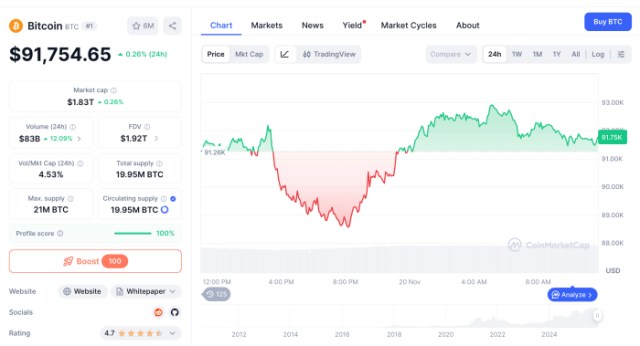
Bitcoin Price Today November 2025

Traders suddenly remembered that the so-called “AI bubble” looks a lot more like a structural capital cycle than a blow-off top.

The pattern is getting hard to ignore:

When AI infrastructure beats, digital assets catch a bid.

Through 2024 and 2025, the correlation between high-growth tech and Bitcoin has only tightened as both assets increasingly express the same macro trade, long compute, long scarce digital assets, short fiat dilution.

So the question isn’t just where Bitcoin goes next, it’s which parts of the crypto stack actually benefit from this returning liquidity. Capital is rotating into assets with real throughput, real user demand, and tangible cash-flow potential, not just shiny narratives.

That’s where programmable Bitcoin layers, multi-chain wallet ecosystems, and even high-octane meme assets start to separate.

Below, we look at three projects across that spectrum. One aims to fix Bitcoin’s structural limitations. One is positioning itself as the next major wallet-distribution and order-flow engine. And one is pure speculative beta packaged in meme culture, the kind that historically thrives when risk cycles flip from cautious to greedy.

Together, they outline how this next phase of the market could unfold across infrastructure, utility, and culture.

1. Bitcoin Hyper ($HYPER) – An SVM Execution Layer Built for Bitcoin’s Next Cycle

Bitcoin Hyper ($HYPER) positions itself as the first Bitcoin Layer 2 to integrate the Solana Virtual Machine (SVM), effectively grafting Solana-grade parallel execution onto Bitcoin’s settlement layer.

The pitch is simple but powerful: let Bitcoin handle security and finality, while an SVM-powered L2 processes everything that requires speed, throughput, and programmability.

That architecture directly targets Bitcoin’s three long-running frictions: slow block times, high fees during congestion, and limited support for complex applications.

Because the SVM stack has already proven itself at high throughput and ultra-low latency, Bitcoin Hyper aims to deliver sub-second performance to wrapped BTC payments, DeFi protocols, NFT platforms, and even gaming environments, without dragging interactions through 10-minute blocks.

A decentralized Canonical Bridge manages BTC flow between layers, while SPL-style token support and Rust tooling make it easier for Solana-native developers to deploy dApps that tap into Bitcoin’s liquidity without learning an entirely new stack.

Momentum on the fundraising side has been strong. The presale has now raised more than $28.1M, placing it among the larger early-stage Bitcoin L2 launches, with tokens currently priced at $0.013305.

Recent on-chain activity shows four whale wallets accumulating roughly $532K, including a $53K single purchase, a sign of early conviction from size-on-chain buyers.

Staking is set to open immediately after TGE, with a seven-day vesting period for presale allocations and a confirmed 41% APY, adding an income angle for early supporters.

Those looking to position early can explore how to buy $HYPER, while long-term analysts may want to revisit the latest Bitcoin Hyper price prediction to understand where the project could sit if demand for scalable BTC layers continues to build.

Join the $HYPER presale now.

2. Best Wallet Token ($BEST) – Wallet Distribution as a Leverage Point

If Bitcoin Hyper is a bet on Bitcoin becoming a high-performance settlement engine, Best Wallet is a bet on controlling the front door that users walk through to access that ecosystem.

Its pitch is bold: capture a massive share of the wallet market by the end of 2026 by merging security, presale access, liquidity routing, and a smoother user experience into a single interface.

The stack behind it is surprisingly serious. Best Wallet integrates Fireblocks’ MPC-CMP architecture at the wallet layer, the same institutional-grade key management used by major exchanges, then layers on portfolio analytics, presale discovery, and Rubic-powered DEX aggregation.

In a market where users hop between Bitcoin L2s, Ethereum rollups, Solana, and Base within the same session, routing matters. If a wallet controls where swaps, bridges, and presale entries originate, its native token can effectively tax that flow via fee rebates, yield boosts, or future governance over routing paths.

Traction has also been strong. The Best Wallet presale has raised $17.22M+ so far, with tokens currently priced around $0.025975.

Staking utilizes a dynamic APY model (currently 76%), adjusting rewards based on demand, lock durations, and liquidity conditions. This mechanism is designed to prevent runaway emissions and keep incentives responsive as volumes shift.

For traders, $BEST is less about chasing speculative spikes and more about owning optionality on order-flow capture.

If the next cycle brings another wave of retail onboarding as Bitcoin pushes toward or past its highs, the wallets that sit closest to user intent become some of the most leveraged positions in the ecosystem, and Best Wallet is aiming directly at that layer.

For traders mapping out the potential upside, our Best Wallet token price prediction offers useful context on how its market share ambitions could translate into value.

Explore Best Wallet’s roadmap and presale details.

3. SPX6900 ($SPX) – Meme Liquidity as a Sentiment Gauge

SPX6900 ($SPX) lives on the far end of the spectrum: a meme-driven ERC-20 that blends parody, market cynicism, and pure speculative energy into a single ticker.

It primarily runs on Ethereum but extends across Solana and Base via Wormhole, providing multichain liquidity and cross-community reach. Circulating supply sits near 930M SPX, supported by deflationary burn mechanics that lean into the “engineered scarcity” meme.

The token’s breakout moment came in early 2024 when it briefly crossed the $1.5B market-cap milestone before cooling toward the mid-hundreds of millions, still enough to hover near the top-100 bracket and sit shoulder-to-shoulder with established meme heavyweights.]

Its culture centers on satire, speed, and collective in-jokes rather than utility, but that’s precisely why traders watch it.

In risk-on windows, especially when AI stocks rip or Bitcoin reclaims momentum, SPX tends to act as a volatility amplifier. Liquidity often rotates from majors into meme assets with cross-chain presence, and SPX’s ties to Project AEON NFTs give it extra surface area for speculative flows.

Track SPX6900 across major exchanges and analytics dashboards.

Recap: Nvidia’s blowout $57.01B quarter has flipped the switch back to risk-on, and Bitcoin’s rebound above $91,000 is already pulling liquidity toward higher-beta opportunities. In that environment, the market isn’t just chasing momentum; it’s reallocating toward projects aligned with where this cycle is actually heading. Bitcoin Hyper, Best Wallet, and SPX6900 sit on three different branches of that tree: programmable Bitcoin infrastructure, wallet-layer distribution, and pure meme-driven beta. But it’s Bitcoin Hyper’s SVM-powered execution layer that stands out, bringing smart contracts and high-speed throughput directly into Bitcoin’s orbit just as demand for scalable BTC-aligned platforms accelerates.

Explore Bitcoin Hyper now.

This article is informational only and does not constitute financial, investment, or trading advice of any kind.

Authored by Bogdan Patru, Bitcoinist – https://bitcoinist.com/nvidia-bitcoin-rebound-best-crypto-to-buy-now-bitcoin-hyper

Market Opportunity
Threshold Logo
Threshold Price(T)
$0.0094
$0.0094$0.0094
-0.52%
USD
Threshold (T) Live Price Chart
Disclaimer: The articles reposted on this site are sourced from public platforms and are provided for informational purposes only. They do not necessarily reflect the views of MEXC. All rights remain with the original authors. If you believe any content infringes on third-party rights, please contact service@support.mexc.com for removal. MEXC makes no guarantees regarding the accuracy, completeness, or timeliness of the content and is not responsible for any actions taken based on the information provided. The content does not constitute financial, legal, or other professional advice, nor should it be considered a recommendation or endorsement by MEXC.

You May Also Like

South Korea Launches Innovative Stablecoin Initiative

South Korea Launches Innovative Stablecoin Initiative

The post South Korea Launches Innovative Stablecoin Initiative appeared on BitcoinEthereumNews.com. South Korea has witnessed a pivotal development in its cryptocurrency landscape with BDACS introducing the nation’s first won-backed stablecoin, KRW1, built on the Avalanche network. This stablecoin is anchored by won assets stored at Woori Bank in a 1:1 ratio, ensuring high security. Continue Reading:South Korea Launches Innovative Stablecoin Initiative Source: https://en.bitcoinhaber.net/south-korea-launches-innovative-stablecoin-initiative
Share
BitcoinEthereumNews2025/09/18 17:54
Trump Cancels Tech, AI Trade Negotiations With The UK

Trump Cancels Tech, AI Trade Negotiations With The UK

The US pauses a $41B UK tech and AI deal as trade talks stall, with disputes over food standards, market access, and rules abroad.   The US has frozen a major tech
Share
LiveBitcoinNews2025/12/17 01:00
Summarize Any Stock’s Earnings Call in Seconds Using FMP API

Summarize Any Stock’s Earnings Call in Seconds Using FMP API

Turn lengthy earnings call transcripts into one-page insights using the Financial Modeling Prep APIPhoto by Bich Tran Earnings calls are packed with insights. They tell you how a company performed, what management expects in the future, and what analysts are worried about. The challenge is that these transcripts often stretch across dozens of pages, making it tough to separate the key takeaways from the noise. With the right tools, you don’t need to spend hours reading every line. By combining the Financial Modeling Prep (FMP) API with Groq’s lightning-fast LLMs, you can transform any earnings call into a concise summary in seconds. The FMP API provides reliable access to complete transcripts, while Groq handles the heavy lifting of distilling them into clear, actionable highlights. In this article, we’ll build a Python workflow that brings these two together. You’ll see how to fetch transcripts for any stock, prepare the text, and instantly generate a one-page summary. Whether you’re tracking Apple, NVIDIA, or your favorite growth stock, the process works the same — fast, accurate, and ready whenever you are. Fetching Earnings Transcripts with FMP API The first step is to pull the raw transcript data. FMP makes this simple with dedicated endpoints for earnings calls. If you want the latest transcripts across the market, you can use the stable endpoint /stable/earning-call-transcript-latest. For a specific stock, the v3 endpoint lets you request transcripts by symbol, quarter, and year using the pattern: https://financialmodelingprep.com/api/v3/earning_call_transcript/{symbol}?quarter={q}&year={y}&apikey=YOUR_API_KEY here’s how you can fetch NVIDIA’s transcript for a given quarter: import requestsAPI_KEY = "your_api_key"symbol = "NVDA"quarter = 2year = 2024url = f"https://financialmodelingprep.com/api/v3/earning_call_transcript/{symbol}?quarter={quarter}&year={year}&apikey={API_KEY}"response = requests.get(url)data = response.json()# Inspect the keysprint(data.keys())# Access transcript contentif "content" in data[0]: transcript_text = data[0]["content"] print(transcript_text[:500]) # preview first 500 characters The response typically includes details like the company symbol, quarter, year, and the full transcript text. If you aren’t sure which quarter to query, the “latest transcripts” endpoint is the quickest way to always stay up to date. Cleaning and Preparing Transcript Data Raw transcripts from the API often include long paragraphs, speaker tags, and formatting artifacts. Before sending them to an LLM, it helps to organize the text into a cleaner structure. Most transcripts follow a pattern: prepared remarks from executives first, followed by a Q&A session with analysts. Separating these sections gives better control when prompting the model. In Python, you can parse the transcript and strip out unnecessary characters. A simple way is to split by markers such as “Operator” or “Question-and-Answer.” Once separated, you can create two blocks — Prepared Remarks and Q&A — that will later be summarized independently. This ensures the model handles each section within context and avoids missing important details. Here’s a small example of how you might start preparing the data: import re# Example: using the transcript_text we fetched earliertext = transcript_text# Remove extra spaces and line breaksclean_text = re.sub(r'\s+', ' ', text).strip()# Split sections (this is a heuristic; real-world transcripts vary slightly)if "Question-and-Answer" in clean_text: prepared, qna = clean_text.split("Question-and-Answer", 1)else: prepared, qna = clean_text, ""print("Prepared Remarks Preview:\n", prepared[:500])print("\nQ&A Preview:\n", qna[:500]) With the transcript cleaned and divided, you’re ready to feed it into Groq’s LLM. Chunking may be necessary if the text is very long. A good approach is to break it into segments of a few thousand tokens, summarize each part, and then merge the summaries in a final pass. Summarizing with Groq LLM Now that the transcript is clean and split into Prepared Remarks and Q&A, we’ll use Groq to generate a crisp one-pager. The idea is simple: summarize each section separately (for focus and accuracy), then synthesize a final brief. Prompt design (concise and factual) Use a short, repeatable template that pushes for neutral, investor-ready language: You are an equity research analyst. Summarize the following earnings call sectionfor {symbol} ({quarter} {year}). Be factual and concise.Return:1) TL;DR (3–5 bullets)2) Results vs. guidance (what improved/worsened)3) Forward outlook (specific statements)4) Risks / watch-outs5) Q&A takeaways (if present)Text:<<<{section_text}>>> Python: calling Groq and getting a clean summary Groq provides an OpenAI-compatible API. Set your GROQ_API_KEY and pick a fast, high-quality model (e.g., a Llama-3.1 70B variant). We’ll write a helper to summarize any text block, then run it for both sections and merge. import osimport textwrapimport requestsGROQ_API_KEY = os.environ.get("GROQ_API_KEY") or "your_groq_api_key"GROQ_BASE_URL = "https://api.groq.com/openai/v1" # OpenAI-compatibleMODEL = "llama-3.1-70b" # choose your preferred Groq modeldef call_groq(prompt, temperature=0.2, max_tokens=1200): url = f"{GROQ_BASE_URL}/chat/completions" headers = { "Authorization": f"Bearer {GROQ_API_KEY}", "Content-Type": "application/json", } payload = { "model": MODEL, "messages": [ {"role": "system", "content": "You are a precise, neutral equity research analyst."}, {"role": "user", "content": prompt}, ], "temperature": temperature, "max_tokens": max_tokens, } r = requests.post(url, headers=headers, json=payload, timeout=60) r.raise_for_status() return r.json()["choices"][0]["message"]["content"].strip()def build_prompt(section_text, symbol, quarter, year): template = """ You are an equity research analyst. Summarize the following earnings call section for {symbol} ({quarter} {year}). Be factual and concise. Return: 1) TL;DR (3–5 bullets) 2) Results vs. guidance (what improved/worsened) 3) Forward outlook (specific statements) 4) Risks / watch-outs 5) Q&A takeaways (if present) Text: <<< {section_text} >>> """ return textwrap.dedent(template).format( symbol=symbol, quarter=quarter, year=year, section_text=section_text )def summarize_section(section_text, symbol="NVDA", quarter="Q2", year="2024"): if not section_text or section_text.strip() == "": return "(No content found for this section.)" prompt = build_prompt(section_text, symbol, quarter, year) return call_groq(prompt)# Example usage with the cleaned splits from Section 3prepared_summary = summarize_section(prepared, symbol="NVDA", quarter="Q2", year="2024")qna_summary = summarize_section(qna, symbol="NVDA", quarter="Q2", year="2024")final_one_pager = f"""# {symbol} Earnings One-Pager — {quarter} {year}## Prepared Remarks — Key Points{prepared_summary}## Q&A Highlights{qna_summary}""".strip()print(final_one_pager[:1200]) # preview Tips that keep quality high: Keep temperature low (≈0.2) for factual tone. If a section is extremely long, chunk at ~5–8k tokens, summarize each chunk with the same prompt, then ask the model to merge chunk summaries into one section summary before producing the final one-pager. If you also fetched headline numbers (EPS/revenue, guidance) earlier, prepend them to the prompt as brief context to help the model anchor on the right outcomes. Building the End-to-End Pipeline At this point, we have all the building blocks: the FMP API to fetch transcripts, a cleaning step to structure the data, and Groq LLM to generate concise summaries. The final step is to connect everything into a single workflow that can take any ticker and return a one-page earnings call summary. The flow looks like this: Input a stock ticker (for example, NVDA). Use FMP to fetch the latest transcript. Clean and split the text into Prepared Remarks and Q&A. Send each section to Groq for summarization. Merge the outputs into a neatly formatted earnings one-pager. Here’s how it comes together in Python: def summarize_earnings_call(symbol, quarter, year, api_key, groq_key): # Step 1: Fetch transcript from FMP url = f"https://financialmodelingprep.com/api/v3/earning_call_transcript/{symbol}?quarter={quarter}&year={year}&apikey={api_key}" resp = requests.get(url) resp.raise_for_status() data = resp.json() if not data or "content" not in data[0]: return f"No transcript found for {symbol} {quarter} {year}" text = data[0]["content"] # Step 2: Clean and split clean_text = re.sub(r'\s+', ' ', text).strip() if "Question-and-Answer" in clean_text: prepared, qna = clean_text.split("Question-and-Answer", 1) else: prepared, qna = clean_text, "" # Step 3: Summarize with Groq prepared_summary = summarize_section(prepared, symbol, quarter, year) qna_summary = summarize_section(qna, symbol, quarter, year) # Step 4: Merge into final one-pager return f"""# {symbol} Earnings One-Pager — {quarter} {year}## Prepared Remarks{prepared_summary}## Q&A Highlights{qna_summary}""".strip()# Example runprint(summarize_earnings_call("NVDA", 2, 2024, API_KEY, GROQ_API_KEY)) With this setup, generating a summary becomes as simple as calling one function with a ticker and date. You can run it inside a notebook, integrate it into a research workflow, or even schedule it to trigger after each new earnings release. Free Stock Market API and Financial Statements API... Conclusion Earnings calls no longer need to feel overwhelming. With the Financial Modeling Prep API, you can instantly access any company’s transcript, and with Groq LLM, you can turn that raw text into a sharp, actionable summary in seconds. This pipeline saves hours of reading and ensures you never miss the key results, guidance, or risks hidden in lengthy remarks. Whether you track tech giants like NVIDIA or smaller growth stocks, the process is the same — fast, reliable, and powered by the flexibility of FMP’s data. Summarize Any Stock’s Earnings Call in Seconds Using FMP API was originally published in Coinmonks on Medium, where people are continuing the conversation by highlighting and responding to this story
Share
Medium2025/09/18 14:40
