

Mubarak set off the BNB Chain Middle East MEME trend, CZ and He Yi came on stage to help the chain sentiment
Author: Nancy, PANews
Last weekend (March 15-16), MEME coins led by Mubarak helped revive the sentiment on the BNB Chain. The long-inactive P players switched to the Middle East time zone and followed the rhythm to participate in the carnival. In this MEME hype, Binance founders CZ and He Yi became the promoters of the craze, personally participating in the memes and creating memes. Various MEME hype materials pushed the craze to a new height.
With the investment enthusiasm of MGX increasing, CZ’s entry ignites the MEME narrative in the Middle East
Not long ago, Binance announced that it had received an investment of up to US$2 billion from the UAE sovereign fund MGX. This blockbuster news not only attracted widespread attention from both inside and outside the industry, but also became the strongest hype narrative on BNB Chain.
On March 13, the day when Binance officially announced its investment in MGX, the official posted a tweet on X with a picture of a "rich editor" wearing a Middle Eastern headscarf. This teasing tweet attracted interaction between CZ and He Yi.
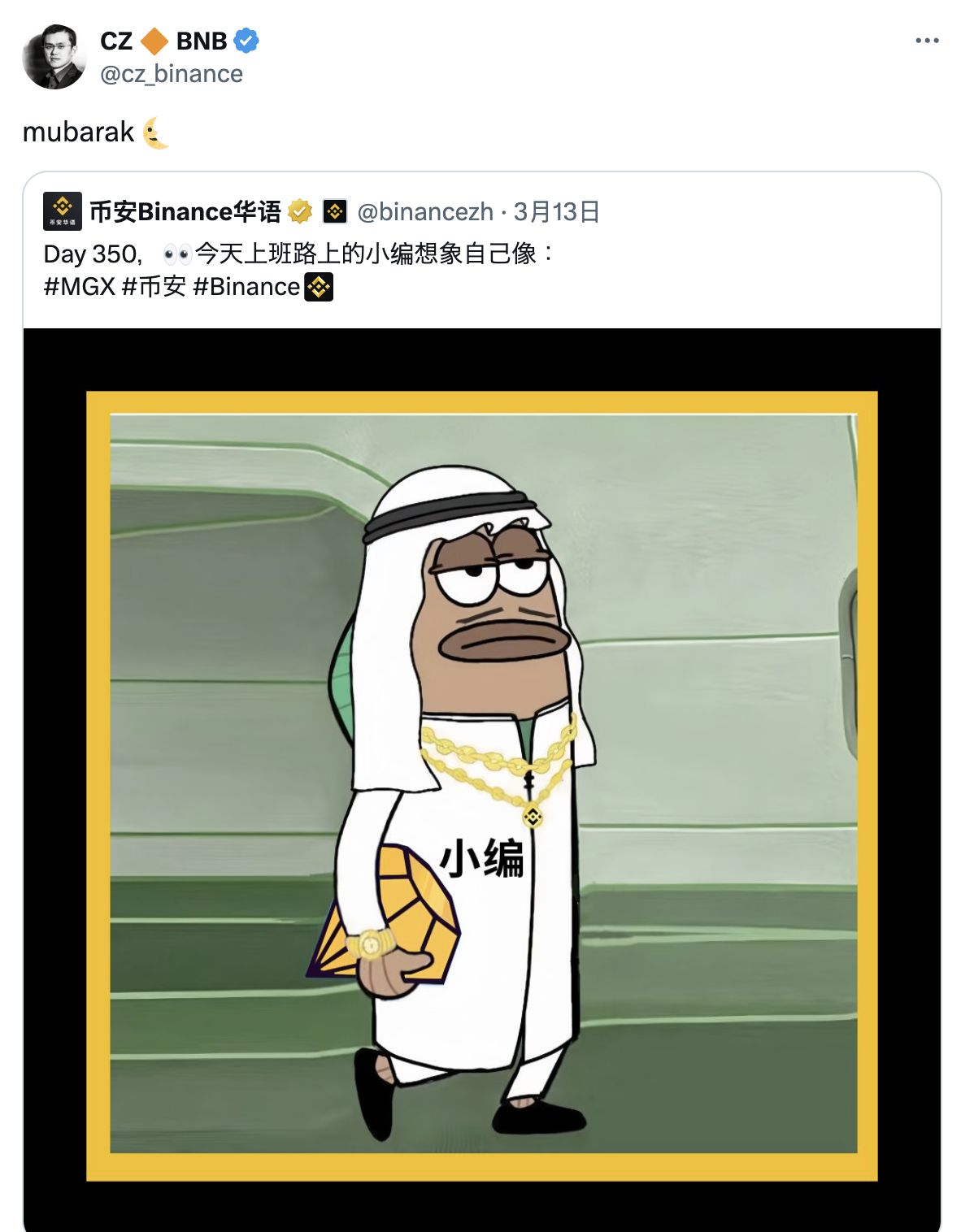
When CZ retweeted the tweet, he added the word "Mubarak", which is an Arabic word meaning "blessing" or "giving grace". This term with Middle Eastern cultural connotations was immediately captured by the market, and a large number of MEME coins named Mubarak began to appear in the community. But among all the MEME tokens, CZ then retweeted a related tweet from a community member named "0x5c...46f6". This move was like "selection", which quickly led to a consensus in the market, and the attention to Mubarak also soared.
The heat has not subsided, and CZ dropped another depth bomb on Binance Square - he posted a message saying "I'm going to meet a friend on the weekend" and attached a funny Mubarak-themed MEME picture, which began to spread rapidly in the community.
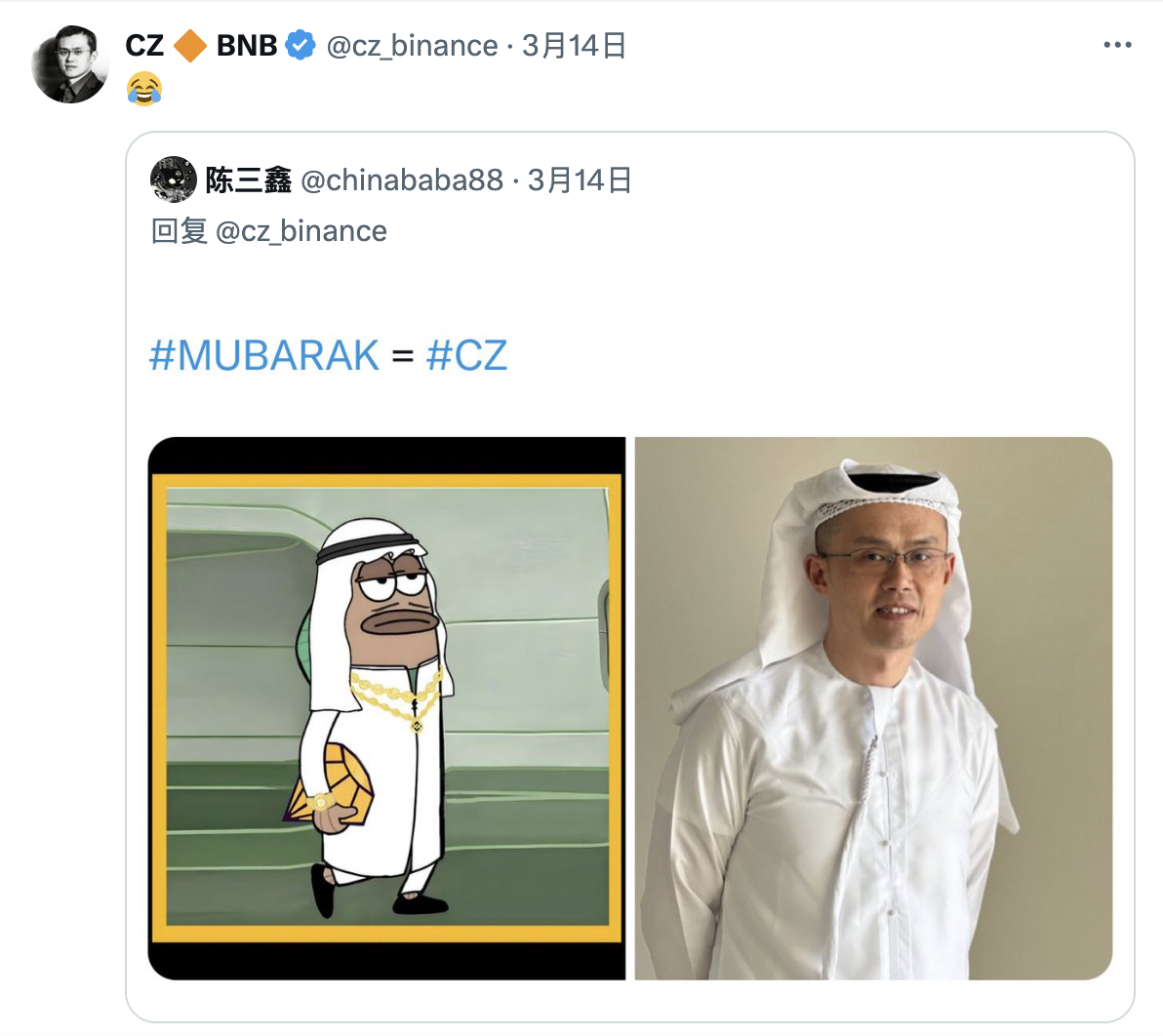
On March 15, Binance Alpha quickly launched Mubarak. At the same time, CZ spent 1 BNB each to buy 9,161 TST and 20,155 mubarak the next day, and posted a message on Binance Square that seemed to respond, "Do some testing on the weekend." This series of operations pushed the hype of Mubarak to a climax. On March 16, CZ tweeted again that he was "considering changing the new avatar and soliciting interesting suggestions from the community," and mentioned that the current avatar has been used for 11 years. Combined with his recent frequent mention of Mubarak, this statement undoubtedly adds more imagination to the MEME coin, and some people even speculate that the new avatar may be related to Mubarak's image as a local tyrant. In addition, with the support of the community, Mubarak also won the $4.4 million permanent liquidity pool support provided by Binance.
Compared with the on-chain PVP melee triggered by CZ's announcement of the name of his pet dog "Broccoli", Mubarak's operation was smooth and flowing. "With a piece of cloth on my head, I am the richest in the Middle East", from the cultural label of Mashallah to the ridicule of the Middle Eastern version of CZ, to the launch of Binance Alpha and CZ's personal purchase, every step of interaction helped Mubarak achieve viral spread. It can be said that Mubarak's popularity is a combination of celebrity effect, cultural narrative and MEME attributes, accurately seizing the window of popularity of Binance's layout in the Middle East.
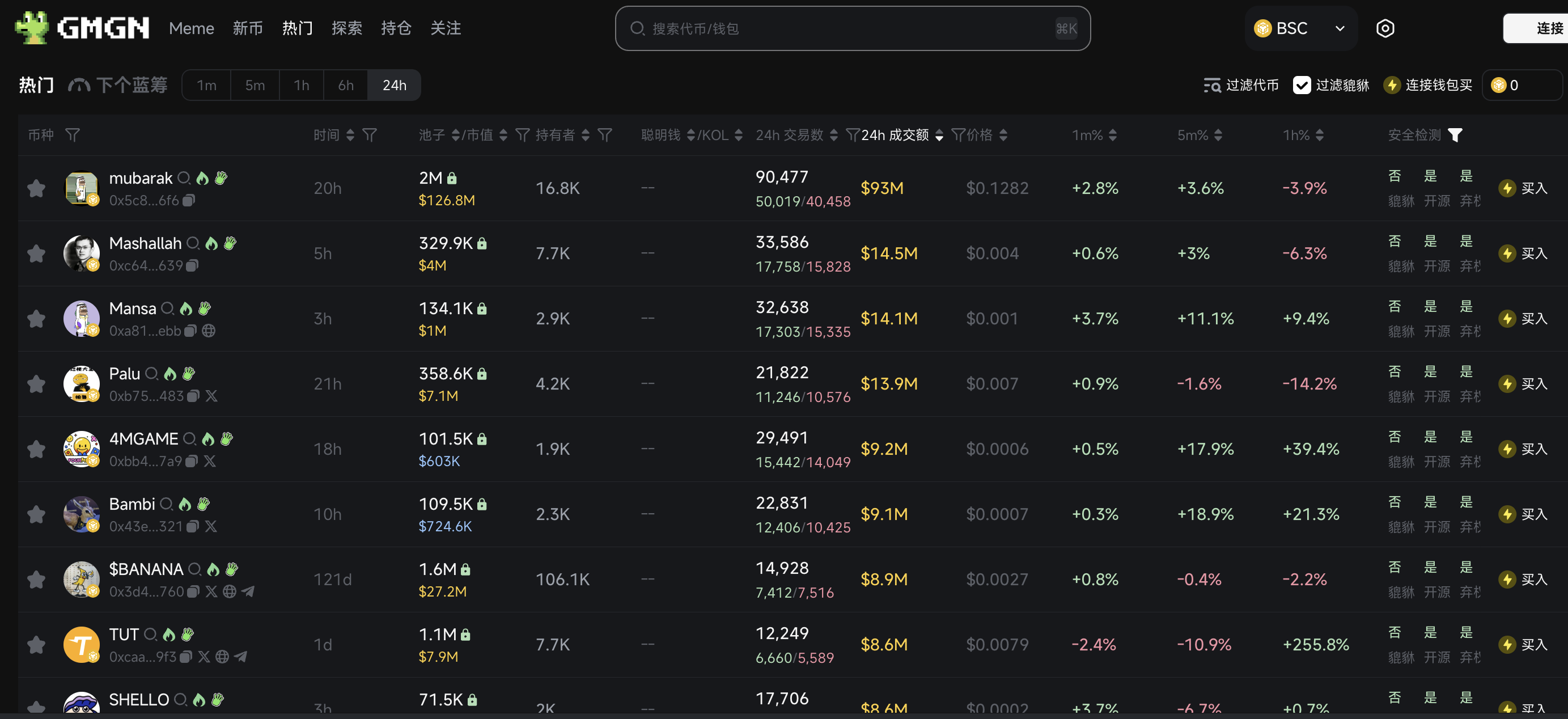
GMGN data shows that Mubarak's market value is close to $150 million at its highest. However, according to Aunt Ai's analysis, Mubarak currently has a problem of insufficient liquidity depth, which may make it difficult for large holders to sell their positions without significantly affecting the price. Mubarak's current market value is approximately $134 million, and its 24-hour trading volume is $88.1 million, but the liquidity pool depth is only $4.48 million, accounting for only 5% of the daily trading volume. Taking the number one address as an example, the 13 million tokens currently held by this address are worth approximately $1.618 million. If you try to sell them all at the market price, you will face slippage losses of more than $500,000, because the current BNB depth of the liquidity pool cannot support transactions of such a scale.
In addition to Mubarak, there are many other Middle Eastern narrative MEME coins that are being hyped in the market. For example, a few days ago, CZ retweeted a tweet from many years ago called "Inshallah" and posted a photo with MGX Chairman Tahnoon with the caption "Mashallah", which once made the MEME coin of the same name popular, but then it fell sharply after the tweet was unpinned.
Interactive marketing ignites community sentiment, but MEME hype has limited room
Mubarak’s hype ignited the sentiment on the BNB Chain, and Binance’s movements also became a source of market hype. Its interactive marketing has set off wave after wave of community enthusiasm.
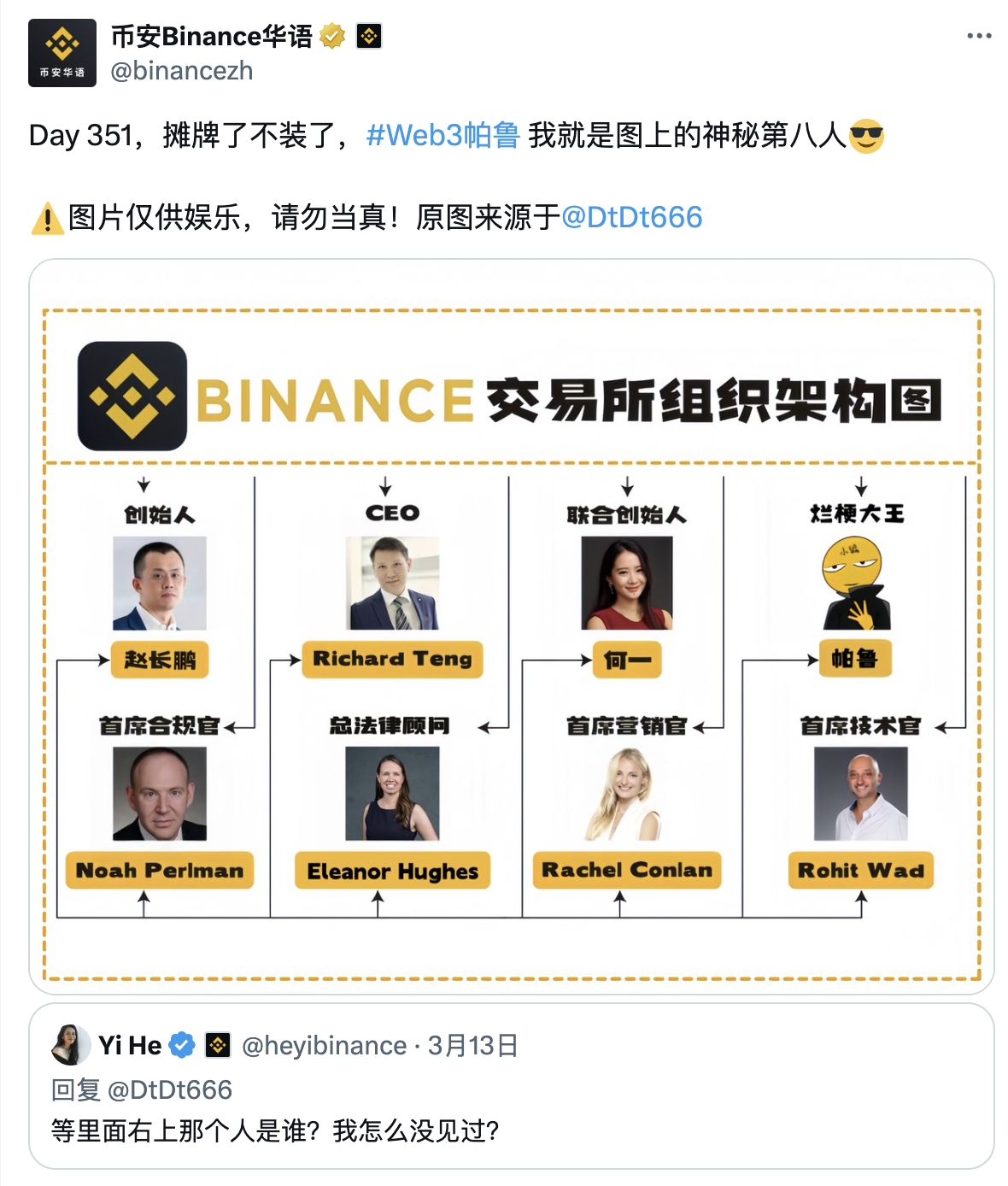
For example, on March 13, He Yi left a message on X in response to a tweet about the organizational chart of Binance Exchange: "Who is that person in the upper right corner? Why haven't I seen him before?" This remark instantly ignited the enthusiasm of the community. Many members quickly followed up and played with the meme, inserting their own avatars into the organizational chart, setting off a wave of spoofs. Binance's official X account also joined in. In addition to replacing the person in the picture with "BNB Holder", it also self-deprecatingly changed it to "Palu" - the name "Palu" comes from the popular game "Phantom Beast Palu", and the Chinese community often uses it to jokingly refer to "cow and horse workers". This self-deprecating brand marketing and community interaction spread like a virus in the crypto circle, not only giving rise to the "bad" label "Web3 Palu", but also evolving into the MEME coin of the same name Palu, further driving the market's continued heat.
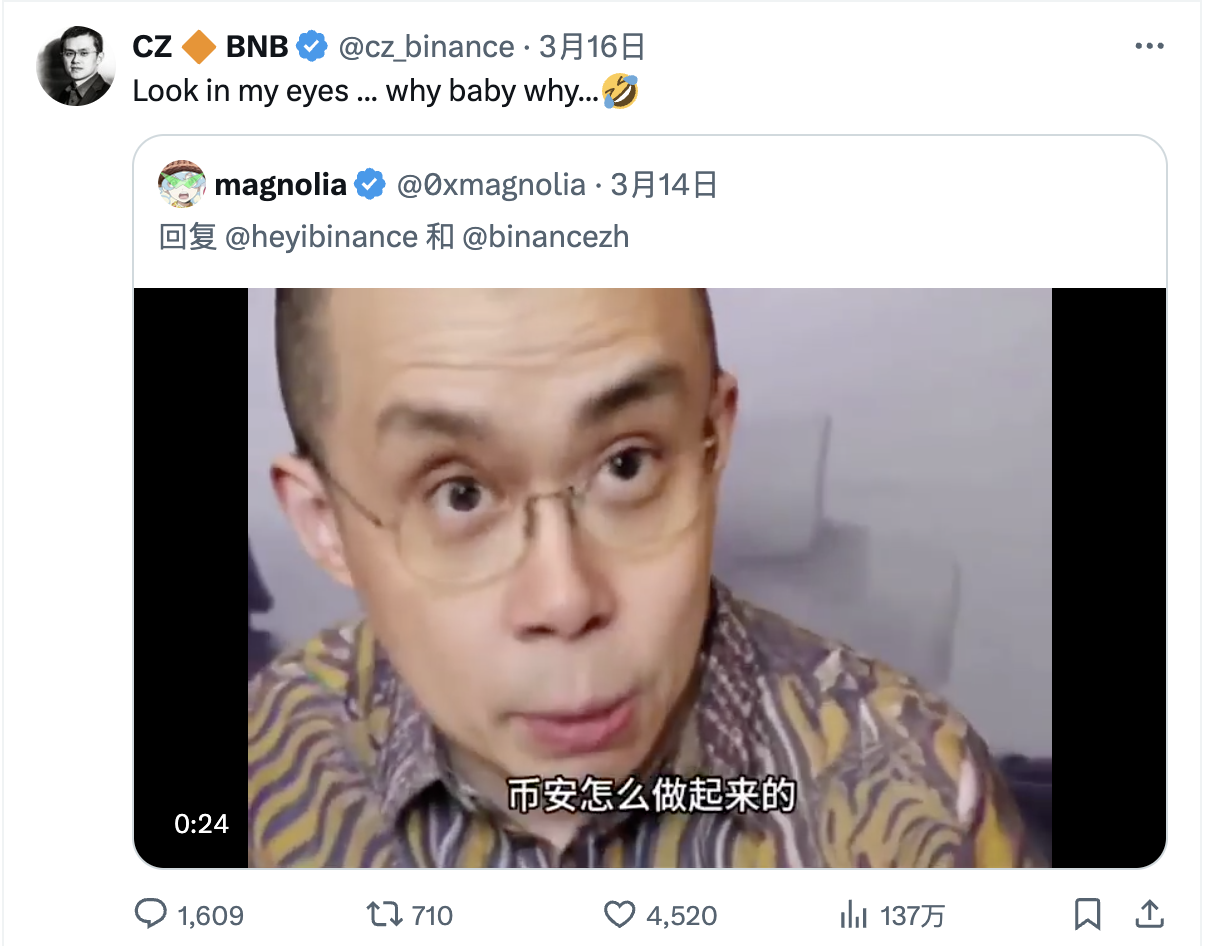
For example, the popular "answer me" and "look in my eyes" video memes on the TikTok platform have also been played out in new ways by the crypto community. There are many videos featuring CZ and He Yi. These funny videos have not only gone viral in the community, but have even been forwarded and liked by CZ and He Yi themselves. The official Binance account has also joined in the interaction, further amplifying the impact. The derived MEME coin $Answer of the same name has become another market hotspot.
However, overall, the hype space for most MEME coins on BNB Chain at this stage shows certain limitations. According to GMGN data, in the past 24 hours, the MEME coin with the highest transaction volume on BNB Chain was Mubarak, which was close to 100 million US dollars, while there were only three projects with transaction volumes of tens of millions of US dollars, and most of the others were hovering below one million or even hundreds of thousands of US dollars, showing the concentration of market enthusiasm and the lack of long-tail effect.
In order to attract more users, Binance Wallet also launched a six-month zero-fee trading event. On March 17, Binance announced that it will launch a zero-fee trading event from 16:00 on March 17, 2025, applicable to all trading pairs in Binance Wallet. The event will last until 16:00 on September 17, 2025. During the event, all transactions completed through the exchange and cross-chain bridge functions in Binance Wallet or the quick purchase function of Binance Alpha will be exempted from transaction fees, but users still need to pay network Gas fees. In addition, transactions conducted through third-party dApps are not included in the event.
In general, in the BNB Chain ecosystem construction, the "two-way rush" between Binance and the community has become the highlight of its marketing strategy. It not only narrows the distance with users, but also injects more vitality and topicality into the ecosystem through the light-hearted and humorous way of MEME.
You May Also Like

The Role of Blockchain in Building Safer Web3 Gaming Ecosystems
- Immutable Ownership of Assets Blockchain records can be manipulated by anyone. If a player owns a sword, skin, or plot of land as an NFT, it is verifiably in their ownership, and it cannot be altered or deleted by the developer or even hacked. This has created a proven track record of ownership, providing control back to the players, unlike any centralised gaming platform where assets can be revoked.
- Decentralized Infrastructure Blockchain networks also have a distributed architecture where game data is stored in a worldwide network of nodes, making them much less susceptible to centralised points of failure and attacks. This decentralised approach makes it exponentially more difficult to hijack systems or even shut off the game’s economy.
- Secure Transactions with Cryptography Whether a player buys an NFT or trades their in-game tokens for other items or tokens, the transactions are enforced by cryptographic algorithms, ensuring secure, verifiable, and irreversible transactions and eliminating the risks of double-spending or fraudulent trades.
- Smart Contract Automation Smart contracts automate the enforcement of game rules and players’ economic exchanges for the developer, eliminating the need for intermediaries or middlemen, and trust for the developer. For example, if a player completes a quest that promises a reward, the smart contract will execute and distribute what was promised.
- Anti-Cheating and Fair Gameplay The naturally transparent nature of blockchain makes it extremely simple for anyone to examine a specific instance of gameplay and verify the economic outcomes from that play. Furthermore, multi-player games that enforce smart contracts on things like loot sharing or win sharing can automate and measure trustlessness and avoid cheating, manipulations, and fraud by developers.
- Cross-Platform Security Many Web3 games feature asset interoperability across platforms. This interoperability is made viable by blockchain, which guarantees ownership is maintained whenever assets transition from one game or marketplace to another, thereby offering protection to players who rely on transfers for security against fraud. Key Security Dangers in Web3 Gaming Although blockchain provides sound first principles of security, the Web3 gaming ecosystem is susceptible to threats. Some of the most serious threats include:
Vitalik Buterin Challenges Ethereum’s Layer 2 Paradigm
