The European Central Bank has confirmed that it will begin allowing blockchain-based transactions to settle in central bank money in 2026, as political attentionThe European Central Bank has confirmed that it will begin allowing blockchain-based transactions to settle in central bank money in 2026, as political attention

ECB Confirms DLT Transactions Coming in 2026 as Digital Euro Privacy Debate Heats Up

The European Central Bank has confirmed that it will begin allowing blockchain-based transactions to settle in central bank money in 2026, as political attention increasingly shifts to the unresolved privacy questions surrounding the proposed digital euro.

In a statement released Friday, ECB executive board member Piero Cipollone said the institution is preparing to make distributed ledger technology settlements possible within its existing monetary infrastructure next year.

At the same time, he said the ECB is continuing technical work on the digital euro, a central bank digital currency that would function as a digital form of cash across the euro area.

The move marks a concrete step toward integrating blockchain-based systems into Europe’s financial plumbing.

ECB Readies Digital Euro System, Puts Decision in Lawmakers’ Hands

Under the plan, transactions executed on DLT platforms would be able to settle directly in central bank money rather than relying on private intermediaries.

The ECB has argued that this is necessary to prevent fragmentation in tokenized markets and to ensure that new digital asset ecosystems continue to rely on a risk-free public settlement asset.

Cipollone said the digital euro infrastructure would also be designed to interact with other central bank digital currencies, allowing institutions to use it for cross-border payments.

He added that safeguards such as holding limits and the absence of interest payments would be built in to prevent large-scale shifts of deposits away from commercial banks, preserving their role in credit creation and monetary transmission.

The ECB’s technical preparations are largely complete, following a two-year preparation phase that ended in October 2025.
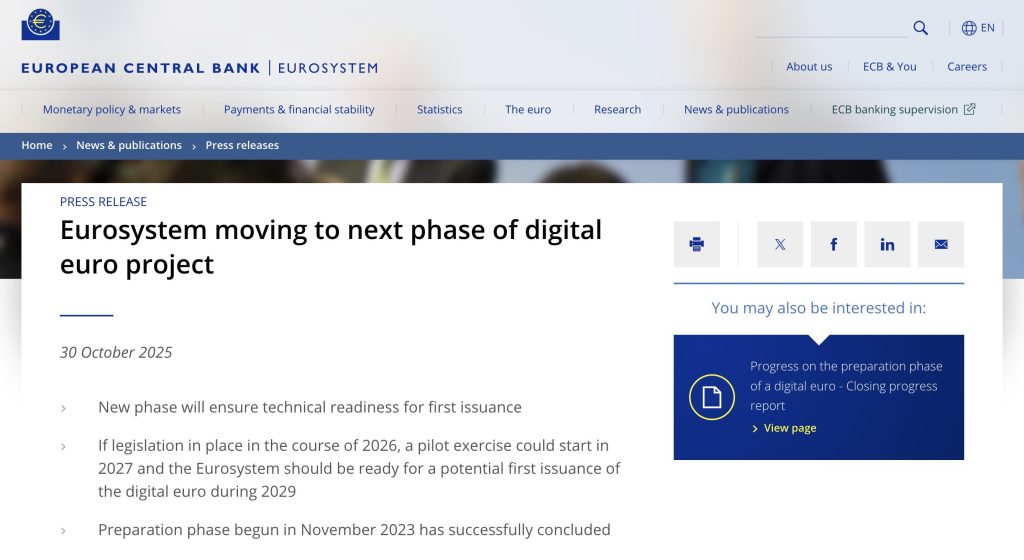
Source: ECB

The project has now moved into a readiness phase, with the central bank selecting potential system providers and testing settlement mechanisms.

However, officials have stressed that the ECB cannot proceed without a legal framework approved by EU lawmakers.

ECB President Christine Lagarde stated this week that the central bank’s design work is finished and that responsibility now lies with political institutions.

If the legislation is adopted in 2026, pilot transactions using the digital euro could begin in mid-2027, with the ECB aiming to be ready for a first issuance in 2029.

ECB Promises Privacy, but EU Rules Complicate the Digital Euro Vision

As the timeline becomes clearer, the debate over privacy has intensified.

The ECB has consistently said it does not support a programmable digital euro that would restrict how users can spend their money.

It has also proposed an offline payment option that would allow low-value transactions to take place without being recorded on a central ledger, offering privacy protections comparable to cash.

Source: ECB

Offline balances would be stored locally on devices or smart cards, enabling device-to-device payments without third-party validation.

These assurances contrast with broader regulatory trends in the European Union.

Recent EU proposals on data retention and anti-money laundering have raised concerns among privacy advocates, particularly as new AML rules are set to ban crypto accounts that allow transaction anonymization from 2027.

Critics argue that these policies risk undermining the privacy guarantees promised for a digital euro, even if the ECB itself does not seek access to user data.

Political negotiations are now underway as the Council of the EU agreed on December 19 on its negotiating position for the digital euro’s legal framework, clearing the way for talks with the European Parliament, which is expected to finalize its stance by May 2026.

ECB officials have described discussions among member states as constructive but have acknowledged that privacy, data access, and democratic oversight remain contentious issues.

Public interest also remains uncertain. An ECB consumer survey published in March found that many Europeans see little need for a digital euro and prefer existing payment methods, including cash and bank accounts.

While the ECB has said adoption levels would not threaten financial stability, it has acknowledged that public trust and education will be critical.

Disclaimer: The articles reposted on this site are sourced from public platforms and are provided for informational purposes only. They do not necessarily reflect the views of MEXC. All rights remain with the original authors. If you believe any content infringes on third-party rights, please contact service@support.mexc.com for removal. MEXC makes no guarantees regarding the accuracy, completeness, or timeliness of the content and is not responsible for any actions taken based on the information provided. The content does not constitute financial, legal, or other professional advice, nor should it be considered a recommendation or endorsement by MEXC.

You May Also Like

The Contrarian Truth: Why Bitcoin and Ethereum Prices Defy Social Media Sentiment
The Contrarian Truth: Why Bitcoin and Ethereum Prices Defy Social Media Sentiment

BitcoinWorld The Contrarian Truth: Why Bitcoin and Ethereum Prices Defy Social Media Sentiment Have you ever noticed that when everyone on social media is screaming
Share
bitcoinworld2025/12/20 07:45
Record instroom Bitcoin-ETF’s – richting $120.000?

Record instroom Bitcoin-ETF’s – richting $120.000?

Connect met Like-minded Crypto Enthusiasts! Connect op Discord! Check onze Discord   De markt voor Bitcoin ETF’s laat wederom een opvallende trend zien. De afgelopen week werd de grootste instroom sinds juli geregistreerd, een ontwikkeling die de aandacht van zowel institutionele als particuliere beleggers trekt. Deze instroom zorgt voor nieuwe speculatie over de vraag of Bitcoin binnenkort de grens van 120.000 dollar kan doorbreken. Laten we dit hieronder nader bekijken. Grootste instroom sinds juli Volgens recente marktgegevens wist de Amerikaanse spot Bitcoin ETF’s een instroom te krijgen ver boven de gemiddelde niveaus van de afgelopen weken. Alleen al op 16 september werd meer dan 290 miljoen dollar netto in deze fondsen gestort. Daarmee markeert dit de zevende opeenvolgende dag met positieve instroom, een duidelijk teken dat institutionele belangstelling opnieuw toeneemt. De grootste bijdrage kwam van BlackRock’s iShares Bitcoin Trust, dat meer dan 200 miljoen dollar stortte. Ook de ETF’s van Fidelity en Ark lieten grote instroom zien. Kortom, de instroom blijft positief. U.S. spot Bitcoin ETFs Ignite with a $553M daily inflow, pushing a four-day streak to $1.7B. Ether ETFs also saw a resurgence with $113M in new funds. #Bitcoin #ETF #ETHhttps://t.co/zZiNqtKSEm — Cryptonews.com (@cryptonews) September 12, 2025 Hoe instroom prijsondersteuning biedt De sterke instroom in Bitcoin ETF’s is meer dan een mijlpaal. Het laat zien hoe de vraag naar Bitcoin groeit vanuit institutionele hoek en dat deze vraag niet voor een keer is, maar structureel is. Omdat de instroom de hoeveelheid nieuw geminde Bitcoin overtreft, ontstaat er een overschot qua vraag dat de prijs positief kan beïnvloeden. Dit verschil tussen aanbod en vraag zorgt ervoor dat het dalende risico wordt beperkt. Wanneer institutionele beleggers via ETF’s posities opbouwen, gebeurt dit bovendien vaak met een langere beleggingshorizon. Dat geeft de markt extra stabiliteit, zeker in een periode waarin onzekerheden rondom rente en macro-economie nog altijd spelen. Signaalfunctie voor beleggers Voor beleggers in de crypto markt hebben deze cijfers een signaalfunctie. Het vertrouwen dat grote institutionele spelers door miljarden te alloceren in gereguleerde beleggingsproducten bevestigt dat Bitcoin steeds meer gekocht wordt in de traditionele financiële wereld. Dit momentum werkt vaak door naar de bredere markt, omdat particuliere beleggers dit zien als bevestiging dat de trend omhoog sterker wordt. Ook technische analyse wijst op een belangrijke fase. De koers van Bitcoin beweegt rond de 118.000 dollar, een weerstandsniveau dat al meerdere keren is getest. Het momentum dat voortkomt uit de ETF instroom kan de kracht geven om dit niveau te doorbreken en een nieuwe fase van prijsstijging richting 120.000 dollar in te luiden. Op korte termijn richting de $120.000? Hoewel niemand met zekerheid kan voorspellen of Bitcoin dit niveau direct zal bereiken, biedt de huidige context sterke aanwijzingen dat de kans aanwezig is. De combinatie van record instroom, institutioneel vertrouwen en een gunstig technisch analyse vormt een krachtige mix. Beleggers doen er goed aan om rekening te houden met de invloed van externe factoren zoals beleidsbesluiten van de Federal Reserve. Best wallet - betrouwbare en anonieme wallet Best wallet - betrouwbare en anonieme wallet Meer dan 60 chains beschikbaar voor alle crypto Vroege toegang tot nieuwe projecten Hoge staking belongingen Lage transactiekosten Best wallet review Koop nu via Best Wallet Let op: cryptocurrency is een zeer volatiele en ongereguleerde investering. Doe je eigen onderzoek.   Het bericht Record instroom Bitcoin-ETF’s – richting $120.000? is geschreven door Timo Bruinsel en verscheen als eerst op Bitcoinmagazine.nl.
Share
Coinstats2025/09/18 01:31
Q2 Market Insights: Bitcoin regains dominance in risk-averse environment, ETFs remain critical to market structure

Q2 Market Insights: Bitcoin regains dominance in risk-averse environment, ETFs remain critical to market structure

The market will show a downward trend in the short term, and then rebound and set new highs in the second half of the year.
Share
PANews2025/04/28 19:40