An unsuspecting crypto user has recently lost $50 million USDT in an address poisoning scam. The incident represents one of the largest on-chain losses in 2025,An unsuspecting crypto user has recently lost $50 million USDT in an address poisoning scam. The incident represents one of the largest on-chain losses in 2025,

Crypto User Loses $50M USDT In Address Poisoning Attack – Details

An unsuspecting crypto user has recently lost $50 million USDT in an address poisoning scam. The incident represents one of the largest on-chain losses in 2025, drawing reactions from crypto security experts as new developments on the matter roll in.

Copy-Paste Mistake Costs User 50M USDT

Address poisoning is a scam in which an attacker sends small transactions from a wallet address that closely resembles a victim’s legitimate address, hoping the victim will later copy the wrong address from their transaction history and unknowingly send funds to the attacker.

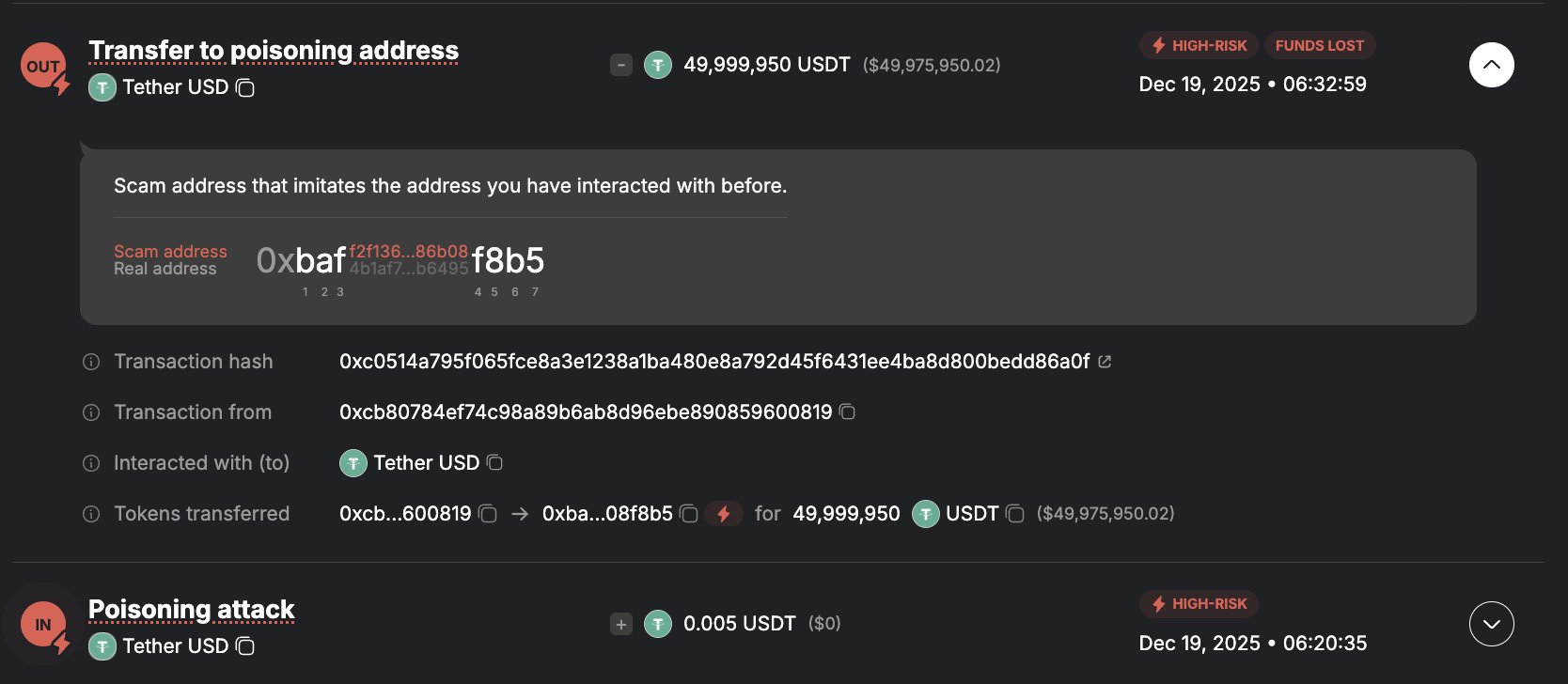
Blockchain security page, Web3 Antivirus reports that a crypto user recently fell victim to this scam, sending 49,999,950 USDT to a poisoned address copied from transaction history. Considering the large transaction, the user had tried taking caution by sending a small test transaction to the correct address. However, the nature of address poisoning requires close monitoring, where attackers are able to immediately send dust transactions from wallets resembling the intended address.
Address Poisoning

Cos, founder of fellow security platform Slowmist, provided valuable insights on this operation, noting the similarity between both addresses, which shared the same first 3 characters and last 4 characters. The victim unknowingly picked the poisoned address from the transaction history to complete the $50 million, thus marking one of the biggest on-chain individual losses of 2025. 

More data from Web3 Antivirus reveals that the victim wallet has been active on-chain for approximately two years and is primarily used for USDT transfers. The stolen $50 million was also initially withdrawn from Binance before the scam occurred. Notably, the stolen USDT has since been converted to ETH by the attackers and shared among multiple wallets, who have also funneled some of the loot through Tornado Cash.

Address Poisoning Victim Offers Bounty With 48-Hour Ultimatum

In other news, blockchain investigator Specter Analyst reports that the victim has attempted to establish communication with the attackers via an on-chain message. 

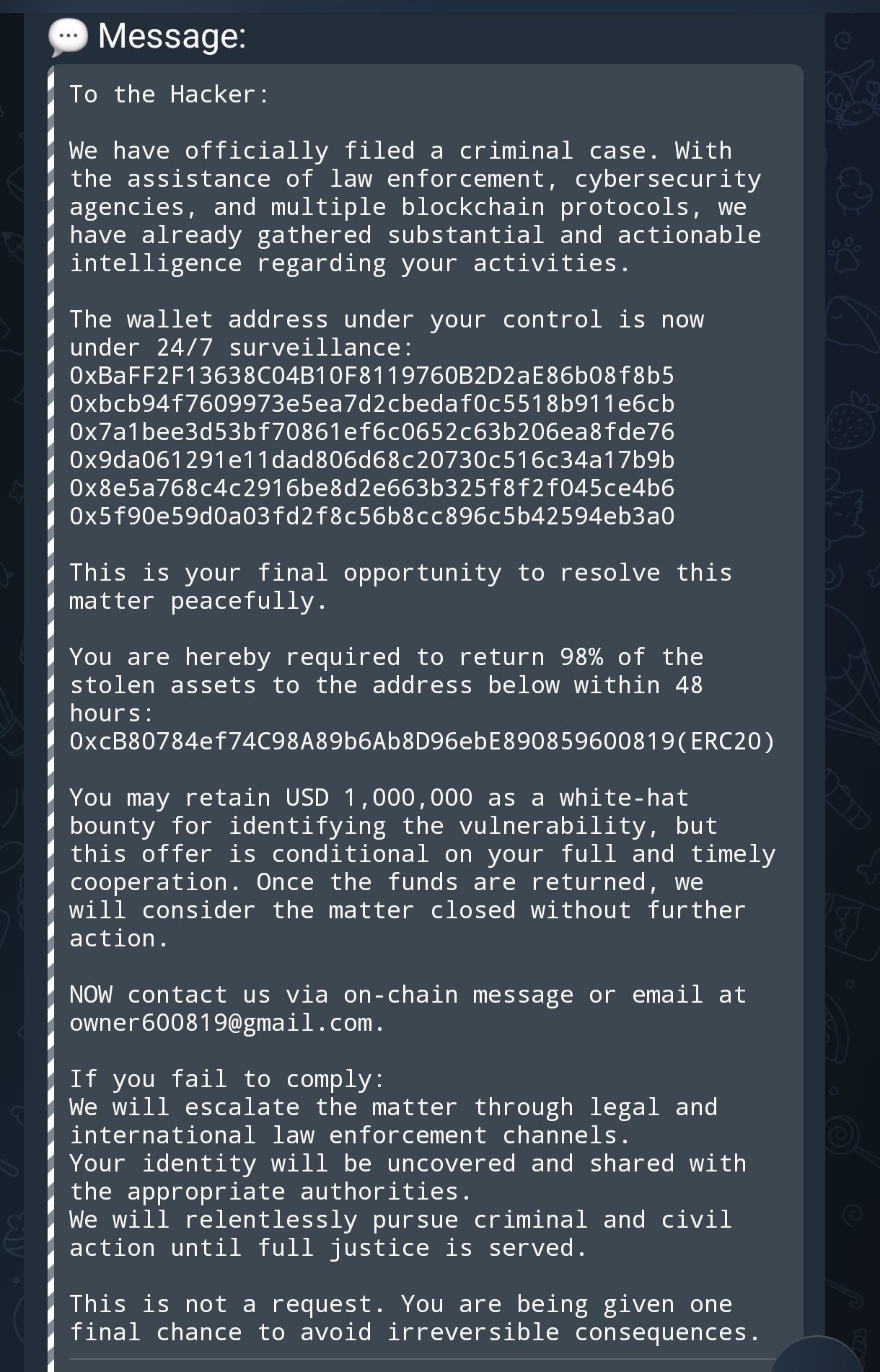
According to an X post on December 20, the victim claims to have filed a criminal complaint case while also enlisting the relevant law enforcement, cybersecurity, and blockchain protocols to provide needed intelligence on the scammer’s activities. Furthermore, all six addresses associated with the heist are now under constant surveillance. However, the aggrieved party is offering the perpetrators of the address poisoning a peaceful resolution, which involves the willing return of 98% of the loot to a specified address within 48 hours.
Address Poisoning

Notably, the victim will allow the bad actors to keep $1 million as a bug bounty for spotting such a vulnerability in their operations. However, they warn that failure to accept the amicable offer within the stipulated time will result in legal escalation of the matter to international law enforcement authorities. They further warn that the attackers’ identities will be revealed and shared with the relevant agencies to aid their arrest and persecution. At press time, total crypto losses in 2025 have surpassed $3.4 billion, underscoring the need for continually strengthened security measures within the thriving ecosystem. 

Address Poisoning
Market Opportunity
Scamcoin Logo
Scamcoin Price(SCAM)
$0.000829
$0.000829$0.000829
-0.71%
USD
Scamcoin (SCAM) Live Price Chart
Disclaimer: The articles reposted on this site are sourced from public platforms and are provided for informational purposes only. They do not necessarily reflect the views of MEXC. All rights remain with the original authors. If you believe any content infringes on third-party rights, please contact service@support.mexc.com for removal. MEXC makes no guarantees regarding the accuracy, completeness, or timeliness of the content and is not responsible for any actions taken based on the information provided. The content does not constitute financial, legal, or other professional advice, nor should it be considered a recommendation or endorsement by MEXC.

You May Also Like

Shocking OpenVPP Partnership Claim Draws Urgent Scrutiny

Shocking OpenVPP Partnership Claim Draws Urgent Scrutiny

The post Shocking OpenVPP Partnership Claim Draws Urgent Scrutiny appeared on BitcoinEthereumNews.com. The cryptocurrency world is buzzing with a recent controversy surrounding a bold OpenVPP partnership claim. This week, OpenVPP (OVPP) announced what it presented as a significant collaboration with the U.S. government in the innovative field of energy tokenization. However, this claim quickly drew the sharp eye of on-chain analyst ZachXBT, who highlighted a swift and official rebuttal that has sent ripples through the digital asset community. What Sparked the OpenVPP Partnership Claim Controversy? The core of the issue revolves around OpenVPP’s assertion of a U.S. government partnership. This kind of collaboration would typically be a monumental endorsement for any private cryptocurrency project, especially given the current regulatory climate. Such a partnership could signify a new era of mainstream adoption and legitimacy for energy tokenization initiatives. OpenVPP initially claimed cooperation with the U.S. government. This alleged partnership was said to be in the domain of energy tokenization. The announcement generated considerable interest and discussion online. ZachXBT, known for his diligent on-chain investigations, was quick to flag the development. He brought attention to the fact that U.S. Securities and Exchange Commission (SEC) Commissioner Hester Peirce had directly addressed the OpenVPP partnership claim. Her response, delivered within hours, was unequivocal and starkly contradicted OpenVPP’s narrative. How Did Regulatory Authorities Respond to the OpenVPP Partnership Claim? Commissioner Hester Peirce’s statement was a crucial turning point in this unfolding story. She clearly stated that the SEC, as an agency, does not engage in partnerships with private cryptocurrency projects. This response effectively dismantled the credibility of OpenVPP’s initial announcement regarding their supposed government collaboration. Peirce’s swift clarification underscores a fundamental principle of regulatory bodies: maintaining impartiality and avoiding endorsements of private entities. Her statement serves as a vital reminder to the crypto community about the official stance of government agencies concerning private ventures. Moreover, ZachXBT’s analysis…
Share
BitcoinEthereumNews2025/09/18 02:13
Forward Industries Bets Big on Solana With $4B Capital Plan

Forward Industries Bets Big on Solana With $4B Capital Plan

The firm has filed with the U.S. Securities and Exchange Commission to launch a $4 billion at-the-market (ATM) equity program, […] The post Forward Industries Bets Big on Solana With $4B Capital Plan appeared first on Coindoo.
Share
Coindoo2025/09/18 04:15
Coinbase Joins Ethereum Foundation to Back Open Intents Framework

Coinbase Joins Ethereum Foundation to Back Open Intents Framework

Coinbase Payments has joined the Open Intents Framework as a core contributor, working alongside Ethereum Foundation and other major players. The initiative aims to simplify complex multi-chain interactions through automated solver technology. The post Coinbase Joins Ethereum Foundation to Back Open Intents Framework appeared first on Coinspeaker.
Share
Coinspeaker2025/09/18 02:43
