Shiba Inu price stabilizes as selling pressure fades near historic support Compressed volatility places SHIB at levels linked to past explosive moves Liquidity Shiba Inu price stabilizes as selling pressure fades near historic support Compressed volatility places SHIB at levels linked to past explosive moves Liquidity

Shiba Inu Holds Near Historic Support as Market Structure Signals Shifting Risk Dynamics

  • Shiba Inu price stabilizes as selling pressure fades near historic support
  • Compressed volatility places SHIB at levels linked to past explosive moves
  • Liquidity thinning shifts risk balance as downside momentum weakens

Shiba Inu is trading near a price region that historically aligned with market exhaustion rather than trend continuation, drawing renewed attention to changing downside dynamics.
Recent price behavior shows SHIB stabilizing after months of persistent decline, reflecting a slowdown in selling intensity. Current structure suggests the asset is transitioning from active distribution into a phase of balance.


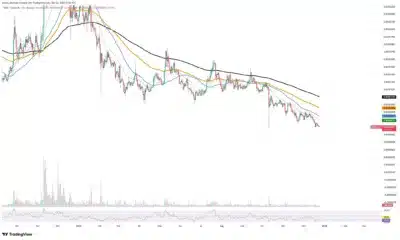
Over the past several months, SHIB has fallen by nearly 50% from local highs, gradually eroding bullish momentum while failing to attract sustained rebound demand. Despite that decline, downside follow through has weakened, indicating reduced seller urgency. Volatility has compressed significantly, and daily price ranges have narrowed into overlapping candles. This pattern contrasts with earlier breakdown phases, where each support loss triggered sharp extensions lower.


Importantly, SHIB now trades near a range that previously acted as a structural base. During an earlier cycle, price spent extended time fluctuating within a similar zone before volatility expanded aggressively. Once liquidity returned, SHIB advanced by roughly 400% within a short period. That move emerged from prolonged apathy and seller fatigue rather than early bullish confirmation.


Several of those characteristics are now visible again. Downside volume has declined sharply even as price drifted lower. Consequently, the lack of expanding sell volume suggests forced exits are largely exhausted. Recent candles reflect indecision instead of fear driven liquidation. Besides that, participation remains thin, a condition that often precedes volatility expansion.

shiba

Source: Tradingview

Also Read: Did Ripple Just Dump XRP? 65,000,000 to “Unknown” Wallet Sparks Attention


Liquidity Compression Highlights Sensitivity Around Current SHIB Levels

Market structure shows SHIB trading inside a compressed range with limited liquidity overhead. Extended compression typically increases sensitivity to directional breaks.
Moreover, when liquidity thins, relatively small inflows can drive outsized price movement. This dynamic explains why prior rallies from similar conditions unfolded rapidly rather than gradually.


However, the broader environment remains cautious. Liquidity across digital asset markets is selective, and speculative rotation remains restrained. Meme assets no longer attract indiscriminate inflows, which limits immediate upside follow through. Therefore, upside attempts may remain shallow without broader improvement in risk appetite.


Even so, the risk profile at current levels has shifted. Downside potential appears increasingly constrained relative to possible upside reactions. Additionally, a move above short term moving averages would mark the first meaningful structural improvement. Reclaiming prior consolidation zones could then accelerate price movement due to thin overhead liquidity.


SHIB has not confirmed a bullish reversal, and outcomes remain probabilistic. Still, price now trades at levels historically associated with sharp volatility expansion. While uncertainty persists, current structure favors surprise movement over continued gradual decline.


Also Read: Did Ripple CTO Subtly Advise XRP Holders Not to Sell? This Recent Comment Raises Eyebrows


The post Shiba Inu Holds Near Historic Support as Market Structure Signals Shifting Risk Dynamics appeared first on 36Crypto.

Market Opportunity
BitShiba Logo
BitShiba Price(SHIBA)
$0.000000000409
$0.000000000409$0.000000000409
+0.02%
USD
BitShiba (SHIBA) Live Price Chart
Disclaimer: The articles reposted on this site are sourced from public platforms and are provided for informational purposes only. They do not necessarily reflect the views of MEXC. All rights remain with the original authors. If you believe any content infringes on third-party rights, please contact service@support.mexc.com for removal. MEXC makes no guarantees regarding the accuracy, completeness, or timeliness of the content and is not responsible for any actions taken based on the information provided. The content does not constitute financial, legal, or other professional advice, nor should it be considered a recommendation or endorsement by MEXC.

You May Also Like

The Channel Factories We’ve Been Waiting For

The Channel Factories We’ve Been Waiting For

The post The Channel Factories We’ve Been Waiting For appeared on BitcoinEthereumNews.com. Visions of future technology are often prescient about the broad strokes while flubbing the details. The tablets in “2001: A Space Odyssey” do indeed look like iPads, but you never see the astronauts paying for subscriptions or wasting hours on Candy Crush.  Channel factories are one vision that arose early in the history of the Lightning Network to address some challenges that Lightning has faced from the beginning. Despite having grown to become Bitcoin’s most successful layer-2 scaling solution, with instant and low-fee payments, Lightning’s scale is limited by its reliance on payment channels. Although Lightning shifts most transactions off-chain, each payment channel still requires an on-chain transaction to open and (usually) another to close. As adoption grows, pressure on the blockchain grows with it. The need for a more scalable approach to managing channels is clear. Channel factories were supposed to meet this need, but where are they? In 2025, subnetworks are emerging that revive the impetus of channel factories with some new details that vastly increase their potential. They are natively interoperable with Lightning and achieve greater scale by allowing a group of participants to open a shared multisig UTXO and create multiple bilateral channels, which reduces the number of on-chain transactions and improves capital efficiency. Achieving greater scale by reducing complexity, Ark and Spark perform the same function as traditional channel factories with new designs and additional capabilities based on shared UTXOs.  Channel Factories 101 Channel factories have been around since the inception of Lightning. A factory is a multiparty contract where multiple users (not just two, as in a Dryja-Poon channel) cooperatively lock funds in a single multisig UTXO. They can open, close and update channels off-chain without updating the blockchain for each operation. Only when participants leave or the factory dissolves is an on-chain transaction…
Share
BitcoinEthereumNews2025/09/18 00:09
What is the Outlook for Digital Assets in 2026?

What is the Outlook for Digital Assets in 2026?

The post What is the Outlook for Digital Assets in 2026? appeared on BitcoinEthereumNews.com. The crypto market cap reached $4.3 trillion in 2025 as institutions
Share
BitcoinEthereumNews2025/12/25 03:23
Pudgy Penguins’ Non-Crypto Display Wraps Las Vegas Sphere, Potentially Elevating PENGU Brand Reach

Pudgy Penguins’ Non-Crypto Display Wraps Las Vegas Sphere, Potentially Elevating PENGU Brand Reach

The post Pudgy Penguins’ Non-Crypto Display Wraps Las Vegas Sphere, Potentially Elevating PENGU Brand Reach appeared on BitcoinEthereumNews.com. Pudgy Penguins,
Share
BitcoinEthereumNews2025/12/25 03:41