

Here’s What Will Drive XRP Price Appreciation – Crypto Researcher Shares Document
- XRP’s long-term value is framed as utility-driven, with institutional settlement usage creating sustained demand.
- Blockchain-based bank settlements offer a viable alternative to SWIFT, and Ripple’s integration-first model positions XRP within modernized cross-border payment flows.
- As institutional transaction volume grows, XRP demand scales with real payment activity.
Popular crypto researcher SMQKE has shared a document he says strengthens the case that XRP’s long-term price appreciation will be driven by real-world utility rather than speculation.
According to SMQKE, XRP’s design as a payment asset embedded within global financial infrastructure positions it to benefit directly from institutional settlement activity.
“XRP is designed to operate within global payment infrastructure,” SMQKE stated, emphasizing that adoption by financial institutions translates into direct usage within payment flows, creating sustained demand.
Document Highlights Blockchain-Based Bank Settlements
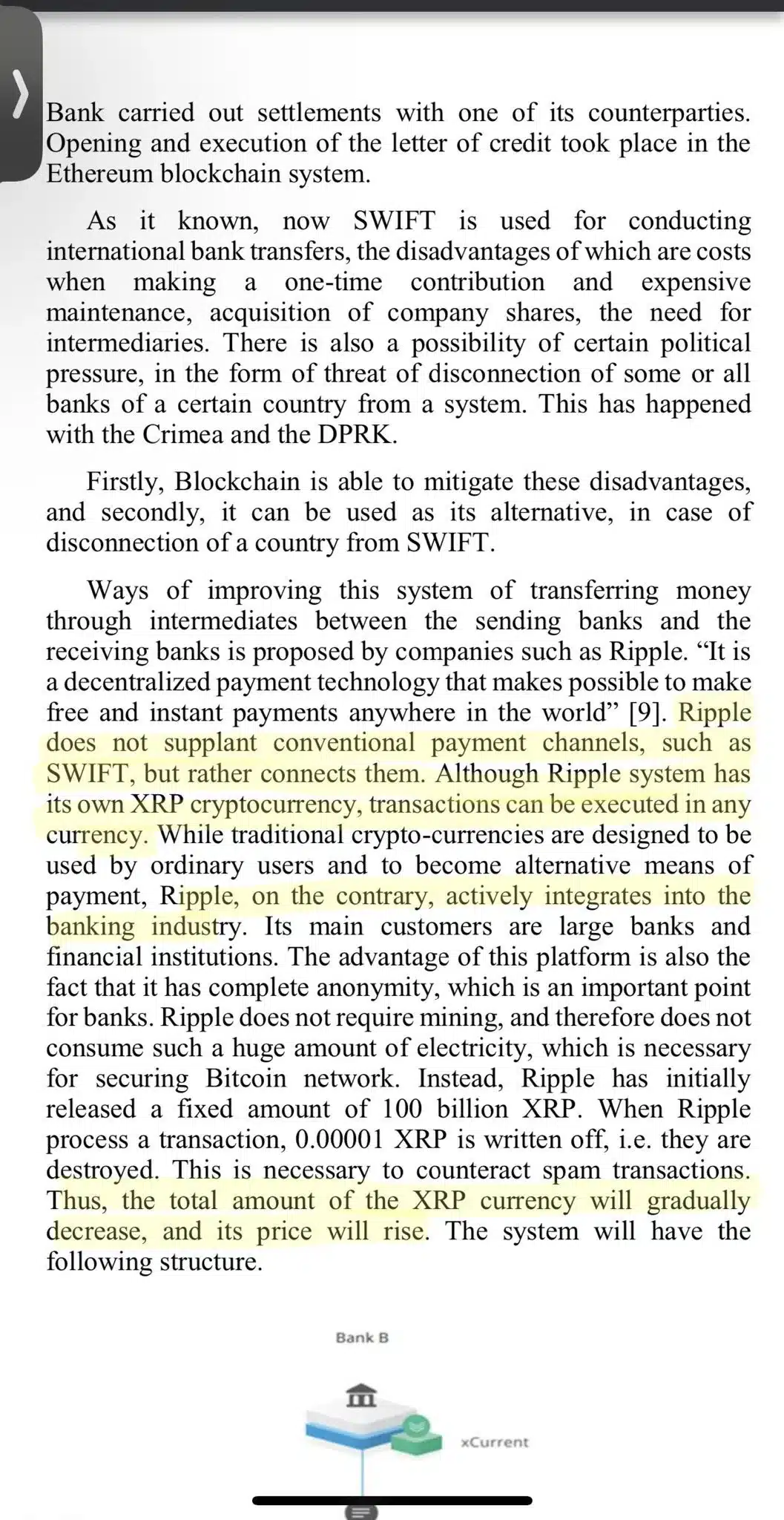
The document shared by SMQKE outlines how banks have already conducted settlements using blockchain systems, including the execution of letters of credit on-chain. It contrasts these blockchain-based processes with the traditional SWIFT system, which currently dominates international bank transfers.
According to the document, SWIFT-based transfers face several disadvantages, including high costs, reliance on intermediaries, expensive maintenance, and exposure to political pressure. The text cites historical examples where banks in certain regions faced disconnection risks, underscoring vulnerabilities in centralized messaging systems.
Also Read: Massive 7,800,000 XRP Coinbase Movement Sparks Attention – What’s Happening?
Blockchain Positioned as an Alternative to SWIFT
The document argues that blockchain technology can mitigate many of SWIFT’s shortcomings and, in some cases, act as a functional alternative if access to traditional systems is restricted. It highlights that blockchain-based settlement enables faster execution, reduced costs, and fewer intermediaries between sending and receiving banks.
Within this context, Ripple is cited as a company actively proposing improvements to cross-border payment systems. Rather than replacing existing rails, Ripple’s technology is described as connecting them, allowing institutions to modernize settlement without abandoning current infrastructure.
Ripple’s Integration Model Supports XRP Utility
A key point emphasized in the document is Ripple’s integration-first approach. It notes that Ripple does not seek to supplant conventional payment channels like SWIFT but instead links them through decentralized payment technology that enables near-instant global transfers.
Importantly, while Ripple has its own cryptocurrency, XRP, the document explains that transactions can be executed in any currency. However, XRP plays a critical role as a settlement asset within the system, particularly when institutions seek speed, liquidity efficiency, and cost reduction.
Source: SMQKE/X
Institutional Adoption Creates Real Demand for XRP
The document further distinguishes Ripple from traditional cryptocurrencies by highlighting its focus on institutional adoption. Unlike consumer-oriented crypto networks, Ripple actively integrates with the banking industry, with large banks and financial institutions listed as its primary customers.
It also notes XRP’s operational advantages, including the absence of mining, significantly lower energy consumption, and a fixed supply of 100 billion tokens. A small amount of XRP, 0.00001 per transaction, is permanently destroyed to prevent spam, gradually reducing supply over time.
According to SMQKE, this structure means that as institutional transaction volume increases, XRP demand rises alongside real payment activity rather than speculative trading.
Payment Utility Linked to Long-Term Price Appreciation
From a payments perspective, SMQKE argues the document demonstrates a clear mechanism for price appreciation. As financial institutions increasingly use XRP within settlement flows, demand becomes recurring and utility-driven.
“This is how price appreciation is supported, through real transaction flow,” SMQKE explained. Unlike hype-driven cycles, sustained institutional usage creates consistent demand that compounds as adoption grows.
XRP Positioned as Infrastructure, Not Narrative
The broader takeaway from the document is that XRP is positioned as financial infrastructure rather than an alternative consumer currency. By embedding itself into existing banking systems and cross-border settlement processes, XRP’s value proposition becomes tied to volume, efficiency, and institutional reliance.
As global payment networks modernize, SMQKE believes XRP’s role within these systems could become a key driver of long-term price appreciation, anchored not in speculation, but in utility-backed demand.
Also Read: Egrag Crypto: “We Are Still Accumulating XRP,” Shares Stance
The post Here’s What Will Drive XRP Price Appreciation – Crypto Researcher Shares Document appeared first on 36Crypto.
You May Also Like

The Channel Factories We’ve Been Waiting For

Elon Musk and Netanyahu Discuss AI and Tesla Plans In Joint Conference
