

iPhone 17 Series Breakdown: Full Specs, Price and Best Value Picks
The iPhone 17 Series is Apple’s latest flagship device in 2025, succeeding the iPhone 16 launched last year. With the series, Apple discontinued the Plus model and introduced the iPhone 17 Air, marketed as the thinnest iPhone.
Users get a 6.3-inch display on the base iPhone 17 and Pro, a 6.5-inch display on the Air, a 6.9-inch display on the Pro Max, and a 120Hz refresh rate across all devices. Each device in the series features a 48 MP rear camera that captures clear, well-detailed images.
The iPhone lineup was announced on September 9, 2025, and made available for purchase on September 19, 2025, ten days later.
iPhone 17 price in Nigeria
Buying iPhones in Nigeria is tricky because Apple doesn’t ship directly to Nigeria, so there’s no uniformprice in the country. There’s also a massive markup on the iPhone 17 in Nigeria, often due to outrageous customs duties and import levies.
The base iPhone 17, 256 GB, sells between ₦1,650,000.00 ($ 1,137.23) and ₦1,869,660.00 ($ 1,288.51). The 512 GB version price falls between ₦2,100,000.00 ($1447.26) and ₦2,337,660.00 ($1611.05). A price difference of over ₦500,000 ($344.59) reflects the additional cost of storage space.
The iPhone 17 Air model introduces a 1TB option. Current market rates are:
- 256 GB: ₦2,200,000.00 ($1516.17) – ₦2,337,600 ($1611)
- 512 GB: ₦2,500,000.00 ($1722.93) – ₦2,805,000.00 ($1933.12)
- 1TB: ₦2,900,000.00 ($1998.59) – ₦3,273,660.00 ($2256.11).
The iPhone 17 Pro shares the same storage tiers as the Air model. Users looking to buy the model would spend between:
- 256GB: ₦2,350,000.00 ($1619.55) – ₦2,700,000.00 ($1860.76)
- 512 GB: ₦2,800,000.00 ($1929.68) – ₦3,350,000.00 ($2308.72)
- 1TB: ₦3,300,000.00 ($2274.26) – ₦3,750,000.00 ($2584.39).
To get the 1TB option, users would be paying an additional fee of over ₦700,000.00 ($482.42).
Unlike other devices in the series, the iPhone 17 Pro Max added a 2 TB option. The iPhone 17 Pro Max in Nigeria costs between ₦2,600,000.00 ($1791.84) – ₦4,500,000.00 ($3101.27) and ₦3,150,000.00 ($2170.89) – ₦4,950,000.00 ($3411.39).
The prices stated above are not standard or static; changes in the Nigerian Naira/US Dollar exchange rate also affect prices. Be sure to confirm prices with your local vendor before making a purchase.
iPhone 17 full specifications
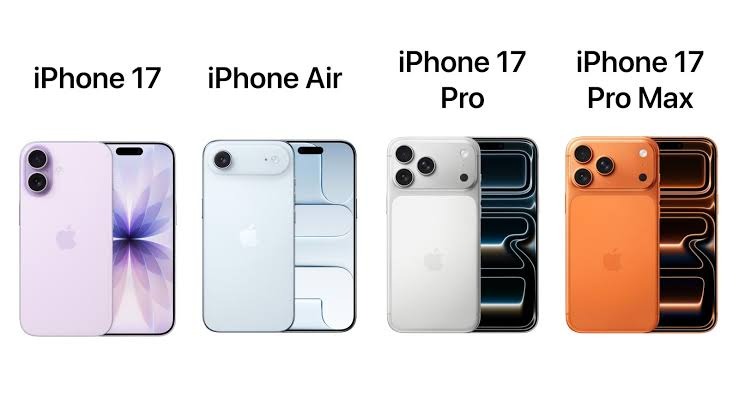
The iPhone 17 series is a high-end smartphone designed to rival other smartphones in camera performance, battery life, and everyday performance. This is how the iPhone 17 models compare.
- Design and build
The base iPhone 17 measures 149.6 mm in height and 8 mm in thickness. It weighs 177 grams, making it comfortable to hold. The screen uses Ceramic Shield 2 for protection, and the body mixes an aluminium frame with a glass back. It has an IP68 rating, meaning it is dustproof and waterproof, with a 6-meter water immersion rating. You can pick it up in Black, White, Mist Blue, Sage, or Lavender.
For the iPhone 17 Air, the focus is on achieving exceptional thinness and lightness. It is just 5.6 mm thick and weighs only 165 grams. It features a premium Grade 5 titanium frame and a glass back. Like the base model, it is IP68 water-resistant. This model is available in colours such as Space Black, Cloud White, Light Gold, and Sky Blue.
The iPhone 17 Pro is heavier and sturdier, weighing 206 grams and measuring 8.8 mm in thickness. It features an aluminium-alloy frame and offers an aluminium or glass back. It keeps the same Ceramic Shield 2 front and IP68 rating. Colour options for this model include Silver, Cosmic Orange, and Deep Blue.
The iPhone 17 Pro Max is the largest of the series, measuring 163.4 mm in height and weighing 233 grams. It shares the solid aluminium alloy build, Ceramic Shield 2 protection, and IP68 rating found on the Pro. It is available in Silver, Cosmic Orange, and Deep Blue.
- Display
On the iPhone 17, you get a 6.3-inch LTPO OLED screen with a resolution of 1206 x 2622. The 120 Hz refresh rate makes animations look very smooth. Brightness reaches 1000 nits for everyday use, peaking at 3000 nits.
The iPhone 17 Air features a 6.5-inch display with a 1260 x 2736 resolution. The screen-to-body ratio is about 89.9%, with the same high brightness capabilities as the standard model.
The iPhone 17 Pro matches the base model’s 6.3-inch display and 1206 x 2622 resolution. However, it maintains the Pro standard with LTPO Super Retina XDR OLED technology. It supports Dolby Vision and HDR10, ensuring movies and photos look vibrant and sharp.
The iPhone 17 Pro Max features a 6.9-inch screen, the biggest in the lineup. It has a resolution of 1320 x 2868, a pixel density of 460 ppi, and features a LTPO Super Retina OLED similar to the Pro.
- Performance and software
The iPhone 17 is powered by the Apple A19 chipset, built on a 3 nm process. It features a 6-core CPU and a 5-core GPU that handle games and daily tasks smoothly. It ships with iOS 26 and supports new features and updates.
The iPhone 17 Air features the Apple A19 Pro chipset. While it also uses a 5-core GPU, the Pro chip is designed for speed. It runs iOS 26.
The same Apple A19 Pro chipset powers the iPhone 17 Pro, but it gets a boost in graphics with a 6-core GPU. This extra power makes it better for heavy gaming or editing videos. It is designed to handle demanding tasks quickly while running the latest iOS 26 software.
The iPhone 17 Pro Max also uses the A19 Pro chip with the powerful 6-core GPU. This setup gives you the maximum performance available in the series.
- Memory and storage
For the iPhone 17, you get 8 GB of RAM. Storage options are 256 GB or 512 GB. It uses fast NVMe storage, so apps load quickly.
The iPhone 17 Air increases its RAM to 12 GB. You can choose from 256 GB, 512 GB, or 1 TB of storage. This extra RAM helps keep more apps open in the background, making the phone feel snappier.
The iPhone 17 Pro also comes with 12 GB of RAM standard. Storage options mimic the Air, offering 256 GB, 512 GB, and 1 TB.
The iPhone 17 Pro Max offers the most flexibility. It has 12 GB of RAM and offers a massive 2 TB of storage, in addition to the standard 256 GB, 512 GB, and 1 TB options. If you need maximum space for photos and videos, this is the one to get.
- Camera
The rear system on the iPhone 17 features two 48-megapixel cameras: a wide-angle lens and an ultrawide lens. The front camera is 18 megapixels with an f/1.9 aperture, great for sharp selfies. Both front and rear cameras can record in 4K at 60 fps, and they include features like Cinematic mode and Dolby Vision.
The iPhone 17 Air takes a simpler approach with a single 48-megapixel rear camera. Despite having just one lens, it supports advanced processing. The front camera uses the same 18-megapixel sensor as the other models.
The iPhone 17 Pro features a triple camera system. You get a 48-megapixel primary camera, a 48-megapixel ultrawide, and a 48-megapixel telephoto lens with 4x optical zoom. It also includes a LiDAR scanner for better depth sensing. This setup allows for 3D spatial video recording.
The iPhone 17 Pro Max shares the same m triple 48-megapixel system as the Pro, including the periscope telephoto lens. It supports advanced video formats like ProRes and Apple Log 2.
- Battery and charging
The iPhone 17 is powered by a 3692 mAh battery. It supports fast wired charging, getting you to 50% in 20 minutes. You also get 25W MagSafe wireless charging, which is convenient for cable-free power-ups.
The iPhone 17 Air has a smaller 3149 mAh battery. Wired charging takes about 30 minutes to reach 50%. MagSafe wireless charging is slightly slower at 20W.
The iPhone 17 Pro has a larger battery, ranging from 4000 mAh to 4252 mAh, depending on the SIM model. It supports the same fast 25W MagSafe charging and quick wired charging.
The iPhone 17 Pro Max has the largest battery, ranging from 4823 mAh to 5088 mAh, depending on the SIM model. Wired charging to 50% takes 20 mins, while 25W MagSafe charging reaches 50% in 30 mins.
- Connectivity
The iPhone 17 gives you the latest ways to connect. It supports Wi-Fi 7 and Bluetooth 6.0 for fast wireless speeds and stable audio connections. You get a USB Type-C 2.0 port for charging and data transfer. It also includes the second-generation Ultra Wideband (UWB) chip, which helps you find lost items with “Find My” more precisely. For emergencies, it can connect to satellites to send messages or request help when you have no signal.
The iPhone 17 Air meets these modern standards while being thinner. It supports the same Wi-Fi 7 and Bluetooth 6.0. Like the base model, it uses a USB Type-C 2.0 port. It handles 5G connections efficiently to keep you online, and it includes the same satellite safety features when you are off the grid.
The iPhone 17 Pro steps things up with faster wired connections. While it shares the Wi-Fi 7 and Bluetooth 6.0 capabilities, it upgrades the port to USB Type-C 3.2 Gen 2. This means you can transfer large files, such as 4K videos, much faster than on cheaper models. It also has the advanced UWB chip and reliable satellite support for messaging and emergencies.
The iPhone 17 Pro Max offers the same level of connectivity. It features Wi-Fi 7, Bluetooth 6.0, and the high-speed USB Type-C 3.2 Gen 2 port. Its larger body houses powerful antennas to deliver the best possible 5G signal.
- Apple Intelligence
The iPhone 17 uses the A19 chip to power new Apple Intelligence features. You can use “Writing Tools” to automatically rewrite emails or summarise long notes. It also supports “Visual Intelligence,” which lets you point your camera at a restaurant or event flyer to instantly get details.
The iPhone 17 Air runs these features on the more powerful A19 Pro chip. This allows for even faster responses when you ask Siri to find specific photos or files. You can generate custom “Genmoji” images or remove distractions from your photos using the “Clean Up” tool. The chip ensures these AI tasks do not drain your battery too quickly.
The iPhone 17 Pro takes full advantage of its 12 GB of RAM to handle the most demanding AI tasks. It supports advanced real-time translation during calls and complex AI-powered video editing tools. The “Visual Intelligence” feature works incredibly fast here, making it a powerful tool.
The iPhone 17 Pro Max gives you the best canvas for Apple Intelligence. Its huge screen is perfect for using split-screen views while the AI summarises documents or edits images for you. With the A19 Pro chip and plenty of memory, it handles heavy multitasking and AI-generated graphics without any lag.
Comparison within the 17 series and predecessors
No doubt, the iPhone 17 series is one of the best smartphones released in 2025. However, how does it compare with previous generations? Especially with the inclusion of the new “Air” model to replace the more familiar “Plus” model.
iPhone 17 Air vs iPhone 16 Plus
No one anticipated Apple discontinuing the Plus model. So when the company introduced the iPhone Air, highlighting its skinny design, it immediately sparked speculation and debate over whether the new iPhone 17 Air could actually surpass the iPhone 16 Plus. Let’s see how both devices compare:
Aside from having a larger battery, the iPhone 16 Plus doesn’t really hold an advantage over the iPhone 17 Air. The 17 Air matches -or outperforms- the 16 Plus in most areas, while maintaining a lighter and more comfortable design.
iPhone 16
The iPhone 16 is the direct predecessor to the 17. It introduced the Action Button, Camera Control, and Apple Intelligence, setting the foundation for the new series. However, the iPhone 17 widens the gap by finally fixing the iPhone 16’s biggest weakness: the display. While the 16 is stuck with a 60 Hz screen, the 17 upgrades to 120 Hz ProMotion.
iPhone 15
The iPhone 15 was a design turning point, introducing the Dynamic Island and USB-C port to the standard lineup. But compared to 17, it shows its age internally. The base 15 lacks the 8 GB (or higher) RAM needed to run the full Apple Intelligence suite. It also misses out on the dedicated Camera Control button and the Action Button, making the 17 a much more capable tool for photography and productivity.
iPhone 14
The iPhone 14 represents the old standard. It uses the discontinued Lightning port and the classic “notch” design, both of which Apple has abandoned in the 17. With a 12 MP main camera and an older A15 chip, it delivers far less detail and slower performance. The gap between the two highlights just how the iPhone has evolved in display quality and camera power.
Frequently asked questions
These questions come from what buyers usually search for about the iPhone 17 series. Many of them focus on price, iOS, and release of other models.
- Is Apple going to release an iPhone 17e?
Yes, reports strongly suggest Apple will release the iPhone 17e in early 2026 (likely between February and May) as a budget-friendly follow-up to the main series. It is expected to serve as the entry-level option, potentially replacing the iPhone 16e. Leaks indicate it will feature the A19 chip to support Apple Intelligence features, a 6.1-inch OLED display, and possibly a switch to the Dynamic Island design, moving away from the older notch found on previous budget models.
- Is iPhone 17 XR an original iPhone?
No, the iPhone 17 XR is not an original Apple product. It is a converted device common in the Nigerian market, where vendors package the internal components of an old iPhone XR (released in 2018) into a custom housing that mimics the design of the new 17 series.
- What iOS does iPhone 17 run on?
The iPhone 17 series ships with iOS 26, Apple’s most advanced operating system designed specifically for the new A19 and A19 Pro chips.
- Should I upgrade to iPhone 17?
You should upgrade if you own an iPhone 15 or older, as the iPhone 17 finally introduces the smooth 120 Hz display and the A19 chip required for Apple Intelligence. However, if you already have an iPhone 15 Pro or 16 Pro, the performance difference is minimal, meaning an upgrade isn’t necessary.
You May Also Like

Sources say SoftBank has fully committed to its $40 billion investment in OpenAI.
UAE’s Medcare Treats First International SMA Patient With Revolutionary Intrathecal Gene Therapy
